Vicenza in Provincia di Vicenza, Venetia, Italy — Southern and Western Europe (Mediterranean)
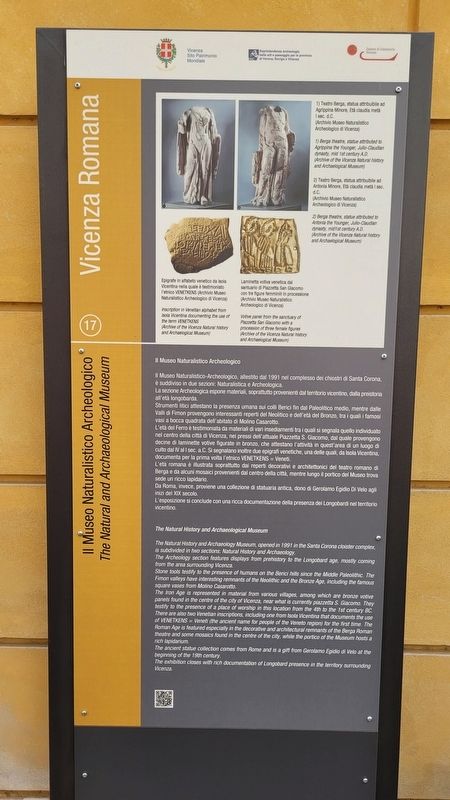
Il Museo Naturalistico Archeologico
⎯⎯⎯
The Natural and Archaeological Museum
Vicenza Romana
Photographed by James Hulse, June 22, 2023
1. Il Museo Naturalistico Archeologico / The Natural and Archaeological Museum Marker

Il Museo Naturalistico-Archeologico, allestito dal 1991 nel complesso dei chiostri di Santa Corona, è suddiviso in due sezioni: Naturalistica e Archeologica. La sezione Archeologica espone materiali, soprattutto provenienti dal territorio vicentino, dalla preistoria all'età longobarda. Strumenti litici attestano la presenza umana sui colli Berici fin dal Paleolitico medio, mentre dalle Valli di Fimon provengono interessanti reperti del Neolitico e dell'età del Bronzo, tra i quali i famosi vasi a bocca quadrata dell'abitato di Molino Casarotto. L'età del Ferro è testimoniata da materiali di vari insediamenti tra i quali si segnala quello individuato nel centro della città di Vicenza, nei pressi dell'attuale Piazzetta S. Giacomo, dal quale provengono decine di laminette votive figurate in bronzo, che attestano l'attività in quest'area di un luogo di culto dal IV al I sec. a.C. Si segnalano inoltre due epigrafi venetiche, una delle quali, da Isola Vicentina, documenta per la prima volta l'etnico VENETKENS = Veneti. L'età romana è illustrata soprattutto dai reperti decorativi e architettonici del teatro romano di Berga e da alcuni mosaici provenienti dal centro della città, mentre lungo il portico del Museo trova sede un ricco lapidario. Da Roma, invece, proviene una collezione statuaria antica, dono Gerolamo Egidio Di Velo agli inizi del XIX secolo. L'esposizione si conclude con una ricca documentazione della presenza dei Longobardi nel territorio vicentino.
Didascalie
1) Teatro Berga, statua attribuibile ad Agrippina Minore, Età claudia metà 1 sec. d.C. (Archivio Museo Naturalistico Archeologico di Vicenza)
2) Teatro Berga, statua attribuibile ad Antonia Minore, Età claudia metà I sec. d.C. (Archivio Museo Naturalistico Archeologico di Vicenza)
Epigrafe in alfabeto venetico da Isola Vicentina nella quale è testimoniato l'etnico VENETKENS (Archivio Museo Naturalistico Archeologico di Vicenza)
Laminetta votiva venetica dal santuario di Plazzetta San Giacomo con tre figure femminill in processione (Archivio Museo Naturalistico Archeologico di Vicenza)
The Natural History and Archaeological Museum
The
this page online

Photographed by James Hulse, June 22, 2023
2. The View of the Natural and Archaeological Museum and Marker
Captions
1) Berga theatre, statue attributed to Agrippina the Younger, Jullo-Claudian dynasty, mid 1st century A.D. (Archive of the Vicenza Natural history and Archaelogical Museum)
2) Berga theatre, statue attributed to Antonia the Younger, Jullo-Claudian dynasty, mid1st century A.D. (Archive of the Vicenza Natural history and Archaelogical Museum)
Inscription in Venetian alphabet from Isola Vicentina documenting the use of the term VENETKENS (Archive of the Vicenza Natural history and Archaelogical Museum)
Votive panel from the sanctuary of Plazzetta San Giacomo with a procession of three female figures (Archive of the Vicenza Natural history and Archaelogical Museum)
Erected by Vicenza Sito Patrimonio Mondiale, Soprintendenza archeologia belle arti e paesaggio per le province di Verona, Rovigo e Vicenza and Camera

Photographed by James Hulse, June 22, 2023
3. Roman artifacts in the Natural and Archaeological Museum
Topics. This historical marker is listed in this topic list: Anthropology & Archaeology. A significant historical year for this entry is 1991.
Location. 45° 32.98′ N, 11° 32.848′ E. Marker is in Vicenza, Veneto (Venetia), in Provincia di Vicenza. It is at the intersection of Contrà Santa Corona and Stradella Santa Corona, on the right when traveling north on Contrà Santa Corona. Touch for map. Marker is in this post office area: Vicenza, Veneto 36100, Italy. Touch for directions.

Regionally, it is in Europe, the European Union, the Schengen Area, a coastal Mediterranean country, and the Western World. Historically, it finds itself in what was once the Roman Empire and specifically also the Holy Roman Empire.
Other nearby markers. At least 8 other markers are within walking distance of this marker: Cappella Valmarana / The Valmarana chapel (within shouting distance of this marker); La via Postumia / The via Postumia (about 90 meters away, measured in a direct line); Palazzo Thiene / The Thiene Palace (about 120 meters away); L'area archeologica di Palazzo Chiericati / The Palazzo Chiericati archaeological site

Photographed by James Hulse, June 22, 2023
4. Roman column artifacts in the Natural and Archaeological Museum
Credits. This page was last revised on June 25, 2023. It was originally submitted on June 24, 2023, by James Hulse of Medina, Texas. This page has been viewed 147 times since then and 10 times this year. Photos: 1, 2, 3, 4. submitted on June 25, 2023, by James Hulse of Medina, Texas.
