Vicenza in Provincia di Vicenza, Venetia, Italy — Southern and Western Europe (Mediterranean)
L'area archeologica sottostante cattedrale
⎯⎯⎯
The archaeological site beneath the cathedral
Vicenza Romana
Photographed by James Hulse, June 23, 2023
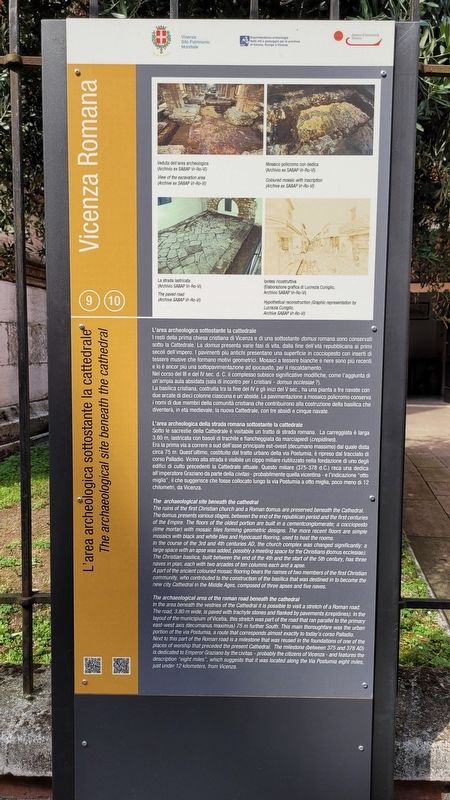
1. L'area archeologica sottostante cattedrale / The archaeological site beneath the cathedral Marker

I resti della prima chiesa cristiana di Vicenza e di una sottostante domus romana sono conservati sotto la Cattedrale. La domus presenta varie fasi di vita, dalla fine dell'età repubblicana ai primi secoli dell'impero. I pavimenti più antichi presentano una superficie in cocciopesto con inserti di tessere musive che formano motivi geometrici. Mosaici a tessere bianche e nere sono più recenti e lo è ancor più una sottopavimentazione ad ipocausto, per il riscaldamento. Nel corso del Ill e del IV sec. d. C. il complesso subisce significative modifiche, come l'aggiunta di un'ampia aula absidata (sala di incontro per i cristiani - domus ecclesiae ?). La basilica cristiana, costruita tra la fine del IV e gli inizi del V sec., ha una pianta a tre navate con due arcate di dieci colonne ciascuna e un'abside. La pavimentazione a mosaico policromo conserva i nomi di due membri della comunità cristiana che contribuirono alla costruzione della basilica che diventerà, in età medievale, à nuova Cattedrale, con tre absidi e cinque navate.
L'area archeologica della strada romana sottostante la cattedrale
Sotto le sacrestle della Cattedrale è visitabile un tratto di strada romana. La carreggiata è larga 3.80 m, lastricata con basoli di trachite e fiancheggiata da marciapiedi (crepidines). Era la prima via a correre a sud dell'asse principale est-ovest (decumano massimo) dal quale dista circa 75 m. Quest'ultimo, costituito dal tratto urbano della via Postumia, è ripreso dal tracciato di corso Palladio. Vicino alla strada è visibile un cippo miliare riutilizzato nella fondazione di uno degli edifici di culto precedenti la Cattedrale attuale. Questo miliare (375-378 d.C.) reca una dedica all'imperatore Graziano da parte della civitas - probabilmente quella vicentina
this page online
Didascalie
Veduta dell'area archeologica (Archivio ex SABAP Vr-Ro-Vi)
Mosaico policromo con dedica (Archivio ex SABAP Vr-Ro-Vi)
La strada lastricata (Archivio SABAP Vr-Ro-Vi)
Ipotesi ricostruttiva (Elaborazione grafica di Lucrezia Cunigilo, Archivio SABAP Vr-Ro-Vi)
The archaeological site beneath the cathedral
The ruins of the first Christian church and a Roman domus are preserved beneath the Cathedral. The domus presents various stages, between the end of the republican period and the first centuries of the Empire. The floors of the oldest portion are built in a cementconglomerate; a cocciopesto (lime mortar) with mosaic tiles forming geometric designs. The more recent floors are simple mosaics with black and white tiles and Hypocaust flooring, used to heat the rooms. In the course of the 3rd and 4th centuries AD, the church complex was changed significantly: a large space with an apse was added, possibly a meeting space for the Christians (domus ecclesiae).

Photographed by James Hulse, June 23, 2023
2. L'area archeologica sottostante cattedrale / The archaeological site beneath the cathedral Marker
The archaeological area of the roman road beneath the cathedral
In the area beneath the vestries of the Cathedral it is possible to visit a stretch of a Roman road. The road, 3.80 m wide, is paved with trachyte stones and flanked by pavements (crepidines). In the layout of the municipium of Vicetia, this stretch was part of the road that ran parallel to the primary east-west axis (decumanus maximus) 75 m further South. This main thoroughfare was the urban portion of the via Postumia, a route that corresponds almost exactly to today's corso Palladio. Next to this part of the Roman road is a milestone that was reused in the foundations of one of the places of worship that preceded the present
Photographed by James Hulse, June 23, 2023
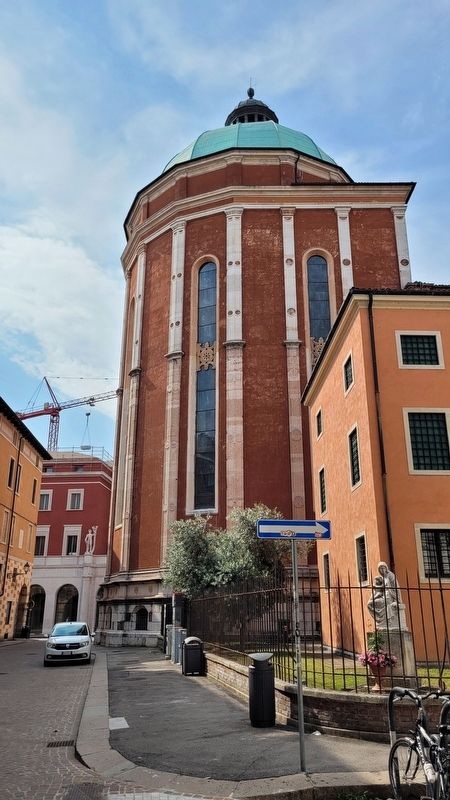
3. The duomo with the marker along the fence
Captions
View of the excavation area (Archive ex SABAP Vr-Ro-Vi)
Coloured mosaic with inscription (Archive ex SABAP Vr-Ro-Vi)
The paved road (Archive SABAP Vr-Ro-Vi)
Hypothetical reconstruction (Graphic representation by Lucrezia Cunillo, (Archive SABAP Vr-Ro-Vi)
Erected by Vicenza Sito Patrimonio Mondiale, Soprintendenza archeologia belle arti e paesaggio per le province di Verona, Rovigo e Vicenza and Camera di Commercio Vicenza. (Marker Number 9 & 10.)
Topics. This historical marker is listed in these topic lists: Architecture • Religion & Religious Structures • Roads & Vehicles.
Location. 45° 32.795′ N, 11° 32.66′ E. Marker is in Vicenza, Veneto (Venetia), in Provincia di Vicenza. It is at the intersection of Via Cesare Battisti, on the right when traveling south on Via Cesare Battisti. The marker is located along the fence of the cathedral. Touch for map. Marker is in this post office area: Vicenza, Veneto 36100, Italy. Touch for directions.

Regionally, it is in Europe, the European Union, the Schengen Area, a coastal Mediterranean country, and the Western World. Historically, it finds itself in what was once the Roman Empire and specifically also the Holy Roman Empire.
Other nearby markers. At least 8 other markers are within walking distance of this marker: Cattedrale: Portale settentrionale e cupola / Cathedral: northern portal and dome (within shouting distance of this marker); Il criptoportico romano di piazza duomo / The roman cryptoporticus in piazza Duomo
Photographed by James Hulse, June 23, 2023
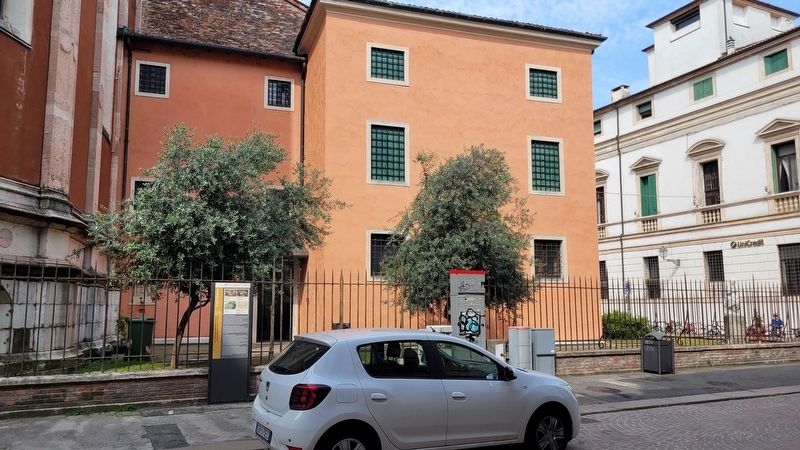
4. The view of the archaeological site beneath the cathedral Marker from the street
Also see . . .
1. L’area archeologica sottostante la Cattedrale. Museo Naturalistico Archeologico (Submitted on June 25, 2023, by James Hulse of Medina, Texas.)
2. L’area archeologica della strada romana sottostante la Cattedrale. Museo Naturalistico Archeologico (Submitted on June 25, 2023, by James Hulse of Medina, Texas.)
Credits. This page was last revised on June 25, 2023. It was originally submitted on June 25, 2023, by James Hulse of Medina, Texas. This page has been viewed 110 times since then and 16 times this year. Photos: 1, 2, 3, 4. submitted on June 25, 2023, by James Hulse of Medina, Texas.
