Tha Sao in Mueang Sai Yok, Kanchanaburi, Thailand — ประเทศไทย (Southeast Asia, Indochinese Peninsula)
Sir Edward “Weary” Dunlop
Photographed by Jj Karwacki
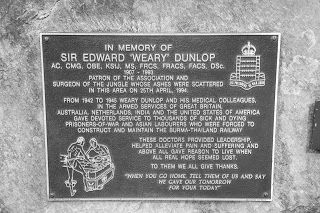
1. Sir Edward “Weary” Dunlop Marker
In memory of Sir Edward “Weary” Dunlop AC, CMG, OBE, KSI, MS, FRCS, FRACS, FACS, DSC., Patron of the Association and Surgeon of the Jungle, whose ashes were scattered in this area on 25th April 1994.
From 1942 to 1945 Weary Dunlop and his medical colleagues in the Armed Services of Great Britain, Australia, Netherlands, India and the United States of America gave devoted service to thousands of sick and dying prisoners-of-war and Asian labourers who were forced to construct and maintain the Burma-Thailand Railway.
These doctors provided leadership, helped alleviate pain and suffering and above all gave reason to live when all real hope seemed lost.
To them we all give thanks.
“When you go home, tell them of us and say, ‘We gave our tomorrow for your today’.”
Erected by St. Andrew’s Ambulance Association, Glasgow, Scotland (now St. Andrew’s First Aid).
Topics and series. This historical marker is listed in these topic lists: Railroads & Streetcars • Science & Medicine • War, World II. In addition, it is included in the The Thailand-Burma Railway series list. A significant historical date for this entry is April 25, 1994.
Location. 14° 21.361′ N,
this page online

Regionally, it is in Asia, specifically in Southeast Asia, in IndoChina, on the Bay of Bengal, and on the Pacific Rim.
Other nearby markers. At least one other marker is within walking distance of this marker: Hellfire Pass Memorial (here, next to this marker).
Regarding Sir Edward “Weary” Dunlop. He was the first Australian patron of St. Andrew’s Ambulance Association, now St. Andrew’s First Aid, the Scottish charitable association that erected this memorial plaque.
Also see . . . Wikipedia entry for Weary Dunlop. Excerpt:
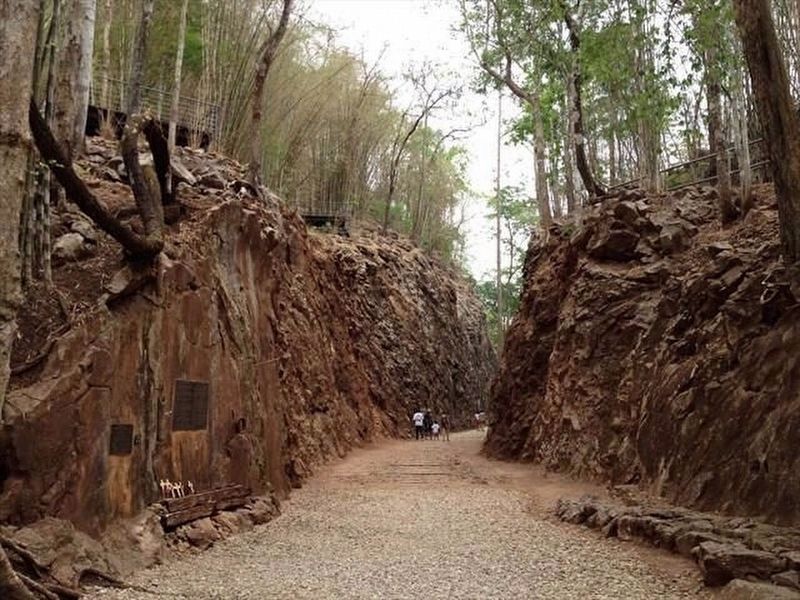
During the Second World War, Dunlop was appointed to medical headquarters in the Middle East, where he developed the mobile surgical unit. In Greece he liaised with forward medical units and Allied headquarters, and at Tobruk he was a surgeon until the Australian Divisions were withdrawn for(Submitted on June 27, 2023.)home defence. His troopship was diverted to Java in an ill-planned attempt to bolster the defences there. On 26 February 1942, he was promoted to temporary lieutenant-colonel. Dunlop became a Japanese prisoner of war in 1942 when he was captured in Bandung, Java, together with the hospital he was commanding.Photographed by Jj Karwacki2. Hellfire Pass and Memorial PlaquesThis historical marker is the smaller of the two that can be seen here affixed to the wall of the cut. Behind the photographer is as far as the roadbed has been rehabilitated for use by tourists and pilgrims. The Hellfire Pass Interpretive Centre is at the far end of the cut.
Because of his leadership skills, he was placed in charge of prisoner-of-war camps in Java, and was later transferred briefly to Changi, and in January 1943 commanded the first Australians sent to work on the Thai segment of the Burma-Thailand railway where prisoners of the Japanese were being used as forced labourers to construct a strategically important supply route between Bangkok and Rangoon. Conditions in the railway camps were primitive and horrific—food was totally inadequate, beatings were frequent and severe, there were no medical supplies, tropical diseases were rampant, and the Japanese required a level of productivity that would have been difficult for fully fit and properly equipped men to achieve.
Along with a number of other Commonwealth Medical Officers, Dunlop’s dedication and heroism became a legend amongprisoners. A courageous leader and compassionate doctor, he restored morale in those terrible prison camps and jungle hospitals. Dunlop defied his captors, gave hope to the sick and eased the anguish of the dying. His example was one of the reasons why Australian survival rates were the highest.Photo by Josh Parish at the English-language Wikipedia (CC BY-SA 3.0), May 2, 20053. Sir Edward Dunlop (1907-1993)Brass relief of Edward Dunlop from his memorial statue in the Royal Botanic Gardens, Melbourne, Victoria. Weary appears in uniform, so it is an image of him in his younger days.
He became, in the words of one of his men, the author Donald Stuart, “a lighthouse of sanity in a universe of madness and suffering.”

Credits. This page was last revised on June 27, 2023. It was originally submitted on June 27, 2023, by Jj Karwacki of Tha Maka, Kanchanaburi. This page has been viewed 362 times since then and 57 times this year. Photos: 1, 2. submitted on June 27, 2023, by Jj Karwacki of Tha Maka, Kanchanaburi. 3. submitted on June 27, 2023, by J. J. Prats of Powell, Ohio. • J. J. Prats was the editor who published this page.
