
Vicenza in Provincia di Vicenza, Venetia, Italy — Southern and Western Europe (Mediterranean)
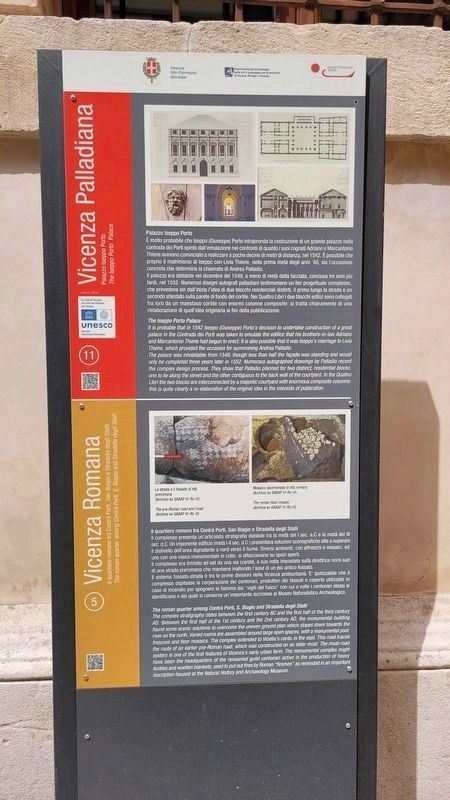
Palazzo Iseppo Porto
Vicenza Palladiana
⎯⎯⎯
Il quartiere romano tra Contrà Porti, San Biagio e Stradella degli Stalli
Vicenza Romana
Photographed by James Hulse, June 22, 2023
1. The Iseppo Porto Palace and Archaeology Marker

È molto probabile che Iseppo (Giuseppe) Porto intraprenda la costruzione di un grande palazzo nella contrada dei Porti spinto dall'emulazione nei confronti di quanto i suoi cognati Adriano e Marcantonio Thiene avevano cominciato a realizzare a poche decine di metri di distanza, nel 1542. È possibile che proprio il matrimonio di Iseppo con Livia Thiene, nella prima metà degli anni '40, sia l'occasione concreta che determina la chiamata di Andrea Palladio. Il palazzo era abitabile nel dicembre del 1549, a meno di metà della facciata, conclusa tre anni più tardi, nel 1552. Numerosi disegni autografi palladiani testimoniano un iter progettuale complesso, che prevedeva sin dall'inizio l'idea di due blocchi residenziali distinti, il primo lungo la strada e un secondo attestato sulla parete di fondo del cortile. Nei Quattro Libri i due blocchi edilizi sono collegati fra loro da un maestoso cortile con enormi colonne composite: si tratta chiaramente di una rielaborazione di quell'idea originaria ai fini della pubblicazione.
The Iseppo Porto Palace
It is
this page online
Il complesso presenta un'articolata stratigrafia databile tra la metà del I sec. a.C e la metà del III sec. d.C. Un imponente edificio (metà I-II sec. d.C.) presentava soluzioni scenografiche atte a superare il dislivello dell'area digradante a nord verso il fiume. Diversi ambienti, con affreschi e mosaici, ed uno con una vasca monumentale in cotto,
Photographed by James Hulse, June 22, 2023
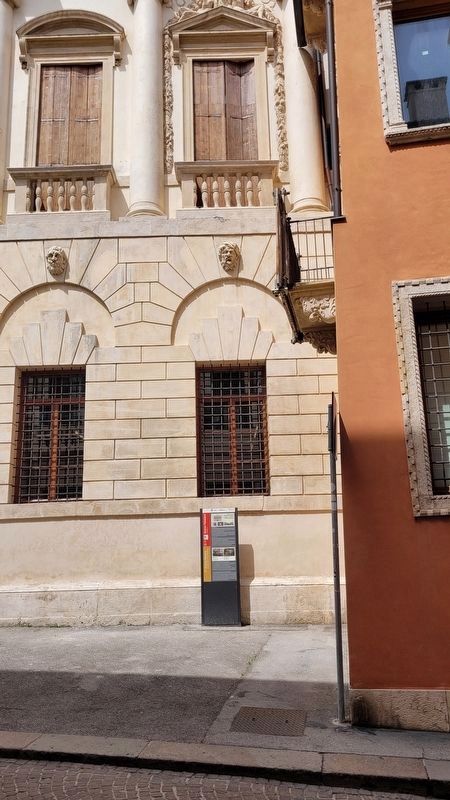
2. The Iseppo Porto Palace and Archaeology Marker in front of the Iseppo Palace
Didascalie
La strada e il fossato di età preromana (Archivio ex SABAP Vr-Ro-Vi)
Mosaico pavimentale di età romana (Archivio ex SABAP Vr-Ro-Vi)
The roman quarter among Contrà Porti, S. Biagio and Stradella degli Stalli
The complex stratigraphy dates between the first century BC and the first half of the third century AD. Between the first half of the 1st century and the 2nd century AD, the monumental building found some scenic solutions to overcome the uneven ground plan which slopes down towards the river on the north. Varied rooms are assembled around large open spaces, with a monumental pool, frescoes and floor mosaics. The complex extended to Vicetia's cardo in the east. This
Photographed by James Hulse, June 22, 2023
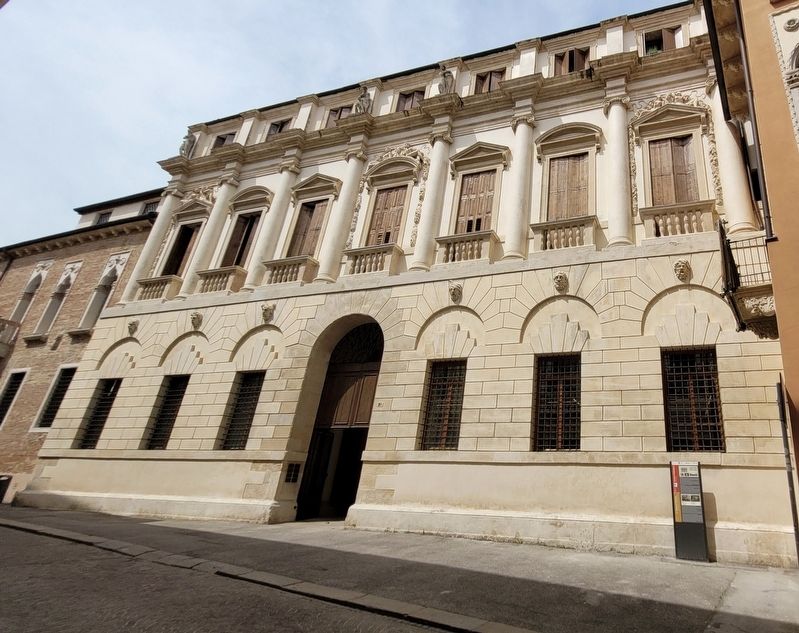
3. The view of the Iseppo Porto Palace and marker
Captions
The pre-Roman road and moat (Archive ex SABAP Vr-Ro-Vi)
The roman floor mosaic (Archive ex SABAP Vr-Ro-Vi)
Erected by Vicenza Sito Patrimonio Mondiale, Soprintendenza archeologia belle arti e paesaggio per le province di Verona, Rovigo e Vicenza and Camera di Commercio Vicenza. (Marker Number 11 & 5.)
Topics. This historical marker is listed in these topic lists: Anthropology & Archaeology • Architecture. A significant historical year for this entry is 1542.
Location. 45° 32.984′ N, 11° 32.721′ E. Marker is in Vicenza, Veneto (Venetia), in Provincia di Vicenza. It is on Contrà Porti 0.1 kilometers south of Contrà Pedemuro S. Biagio, on the right when traveling south. The marker is located along the wall and corner of the palace. Touch for map. Marker is in this post office area: Vicenza, Veneto 36100, Italy. Touch for directions.

Regionally, it is in Europe, the European Union, the Schengen Area, a coastal Mediterranean country, and the Western World. Historically, it finds itself in what was once the Byzantine Empire, the Roman Empire, and specifically the Holy Roman Empire.
Other nearby markers. At least 8 other markers are within walking distance of this marker: Palazzo Thiene / The Thiene Palace (about 120 meters away, measured in a direct line); Palazzo Barbarano / Barbarano Palace (about 150 meters away); Il Museo Naturalistico Archeologico / The Natural and Archaeological Museum (about 150 meters away); Cappella Valmarana / The Valmarana chapel (about 180 meters away); La via Postumia / The via Postumia (approx. 0.3 kilometers away); Basilica Palladiana / Palladian Basilica (approx. 0.3 kilometers away); Loggia del Capitaniato / The Loggia of the Capitaniato (approx. 0.3 kilometers away); L'area archeologica di Palazzo Chiericati / The Palazzo Chiericati archaeological site (approx. 0.3 kilometers away). Touch for a list and map of all markers in Vicenza.
More about this marker. The marker is shared for both the Iseppo Porto Palace and the Roman archaeology topic.
Also see . . .
1. Palazzo di Iseppo Porto. Camera di Commercio Vicenza (Submitted on July 2, 2023, by James Hulse of Medina, Texas.)
2. Il quartiere romano tra Contra’ Porti, San Biagio e Stradella degli Stalli. Museo Naturalistico Archeologico (Submitted on July 2, 2023, by James Hulse of Medina, Texas.)
Credits. This page was last revised on July 2, 2023. It was originally submitted on June 29, 2023, by James Hulse of Medina, Texas. This page has been viewed 121 times since then and 13 times this year. Photos: 1, 2, 3. submitted on July 2, 2023, by James Hulse of Medina, Texas.
