Fort Trumbull in New London in Southeastern Region, Connecticut — The American Northeast (New England)
Bottom Reflected Active Sonar System (BRASS)
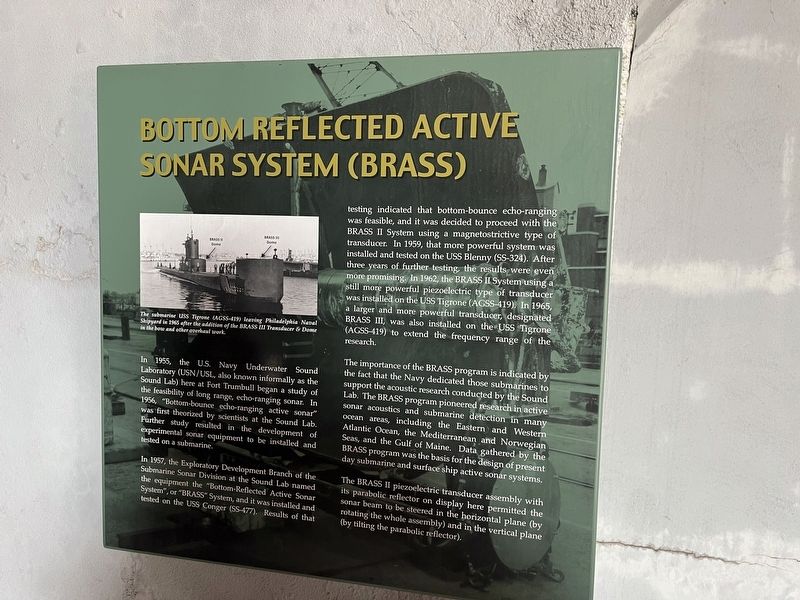
In 1955, the U.S. Navy Underwater Sound Laboratory (USN/USL, also known informally as the Sound Lab) here at Fort Trumbull began a study of the feasibility of long range, echo-ranging sonar. In 1956, "Bottom-bounce echo-ranging active sonar" was first theorized by scientists at the Sound Lab. Further study resulted in the development of experimental sonar equipment to be installed and tested on a submarine. In 1957, the Exploratory Development Branch of the Submarine Sonar Division at the Sound Lab named the equipment the "Bottom-Reflected Active Sonar System", or "BRASS" System, and it was installed and tested on the USS Conger (SS-477). Results of that testing indicated that bottom-bounce echo-ranging was feasible, and it was decided to proceed with the BRASS II System using a magnetostrictive type of transducer. In 1959, that more powerful system was installed and tested on the USS Blenny (SS-324). After three years of further testing, the results were even more promising. In 1962, the BRASS II System using a still more powerful piezoelectric type of transducer was installed on the USS Tigrone (AGSS-419). In 1965,
this page online
The importance of the BRASS program is indicated by the fact that the Navy dedicated those submarines to support the acoustic research conducted by the Sound Lab. The BRASS program pioneered research in active sonar acoustics and submarine detection in many ocean areas, including the Eastern and Western Atlantic Ocean, the Mediterranean and Norwegian Seas, and the Gulf of Maine. Data gathered by the BRASS program was the basis for the design of present day submarine and surface ship active sonar systems.
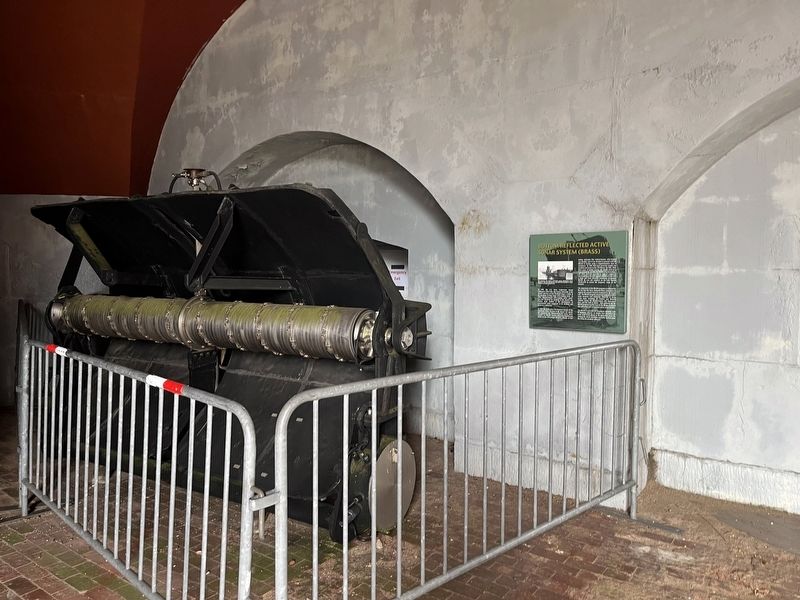
The BRASS II piezoelectric trasnducer assembly with its parabolic reflector on display here permitted the sonar beam to be steered in the horizontal plane (by rotating the whole assembly) and in the vertical plane (by tilting the parabolic reflector).
Topics. This historical marker is listed in these topic lists: Communications • War, Cold • Waterways & Vessels. A significant historical year for this entry is 1955.
Location. 41° 20.639′ N, 72° 5.593′ W. Marker is in

Regionally, this marker is on the Connecticut Shoreline and in the Thames River Valley. It is also in the American Northeast, in New England, and on the Eastern Seaboard. Globally, it is in the North Atlantic Region, North America, the Western Hemisphere, the Western World, and the Anglosphere. Historically, it finds itself in what was once New London County and also one of the original Thirteen Colonies.
Other nearby markers. At least 8 other markers are within walking distance of this marker: Cold War (a few steps from this marker); Fort Trumbull (a few steps from this marker); Scientific Research (within shouting distance of this marker); Merchant Marine (within shouting distance of this marker); North Battery (within shouting distance of this
By Devry Becker Jones (CC0), June 24, 2023
3. Bottom Reflected Active Sonar System (BRASS) Marker
The marker is on the grounds of Fort Trumbull State Park in an open-air exhibit.
Credits. This page was last revised on May 19, 2026. It was originally submitted on June 30, 2023, by Devry Becker Jones of Washington, District of Columbia. This page has been viewed 456 times since then and 42 times this year. Photos: 1, 2, 3. submitted on June 30, 2023, by Devry Becker Jones of Washington, District of Columbia.
