Downtown in New Haven in South Central Region, Connecticut — The American Northeast (New England)
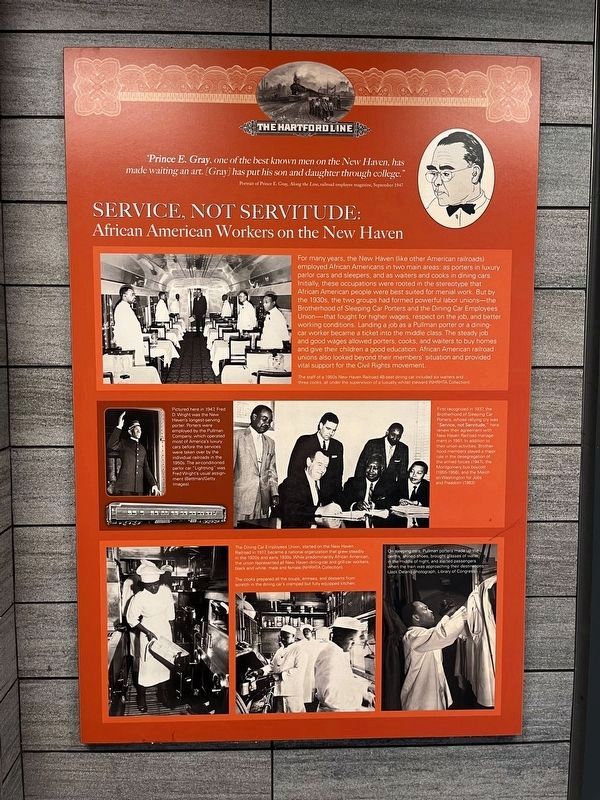
Service, Not Servitude: African American Workers on the New Haven
The Hartford Line
Photographed by Devry Becker Jones (CC0), June 24, 2023
1. Service, Not Servitude: African American Workers on the New Haven Marker
'Prince E. Gray, one of the best known men on the New Haven, has made waiting an art. [Gray] has put his son and daughter through college.
Portrait of Prince E. Gray, Along the Line, railroad employee magazine, September 1947
For many years, the New Haven (like other American railroads) employed African Americans in two main areas: as porters in luxury parlor cars and sleepers, and as waiters and cooks in dining cars. Initially, these occupations were rooted in the stereotype that African American people were best suited for menial work. But by the 1930s, the two groups had formed powerful labor unions—the Brotherhood of Sleeping Car Porters and the Dining Car Employees Union—that fought for higher wages, respect on the job, and better working conditions. Landing a job as a Pullman porter or a dining-car worker became a ticket into the middle class. The steady job and good wages allowed porters, cooks, and waiters to buy homes and give their children a good education. African American railroad unions also looked beyond their members' situation and provided vital support for the Civil Rights movement.
[Captions:]
The staff of a 1950s New Haven Railroad 48-seat dining car included six waiters and three cooks, all under the supervision of a (usually white) steward (NHRHTA Collection).
Pictured here in 1947, Fred D. Wright was the New Haven's longest serving porter. Porters were employed by the Pullman Company, which operated most of America's luxury cars before the services were taken over by the individual railroads in the 1950s. The air-conditioned parlor car "Lighting" was Fred Wright's usual assignment (Bettman/Getty Images).
First recognized in 1937, the Brotherhood of Sleeping Car Porters, whose rallying cry was "Service, not Servitude," here renew their agreement with New Haven Railroad management in 1961. In addition to their union activities, Brotherhood members played a major role in the desegregation of the armed forces (1947), the Montgomery bus boycott (1955-1956), and the March on Washington for Jobs and Freedom (1963).
The Dining Car Employees Union, started on the New Haven Railroad in 1917, became a national organization that grew steadily in the 1920s and early 1930s. While predominantly African American, the union represented all New Haven dining-car and grill-car workers, black and white, male and female (NHRHTA Collection).
The cooks prepared all the soups, entrees, and desserts from scratch in the dining car's cramped but fully equipped kitchen.
On sleeping cars, Pullman porters made up the berths, shined shoes, brought glasses of water in the middle of night, and alerted passengers when the train was approaching their destinations (Jack Delano photograph, Library of Congress).
Topics.
this page online
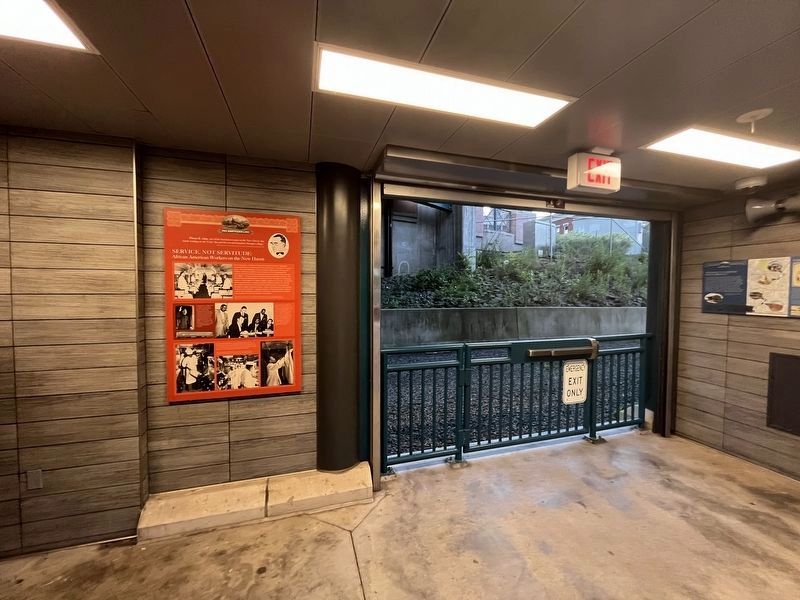
Location. 41° 18.307′ N, 72° 55.315′ W. Marker is in New Haven in South Central Region, Connecticut. It is in Downtown. It can be reached from State Street north of Chapel Street, on the right when traveling north. The marker hangs in the open-air Terminal 1 of the State Street station. Touch for map. Marker is at or near this postal address: 259 State Street, New Haven CT 06510, United States of America. Touch for directions.

Regionally, this marker is in the Connecticut River Valley and on the Connecticut Shoreline. It is also in the American Northeast, in New England, and on the Eastern Seaboard. Globally, it is in the North Atlantic Region, North America, the Western Hemisphere, the Western World, and the Anglosphere. Historically, it finds itself in what was once New Haven County and also one of the original Thirteen Colonies.
Other nearby markers. At least 8 other markers are within walking distance
Photographed by Devry Becker Jones (CC0), June 24, 2023
2. Service, Not Servitude: African American Workers on the New Haven Marker
Credits. This page was last revised on May 19, 2026. It was originally submitted on July 1, 2023, by Devry Becker Jones of Washington, District of Columbia. This page has been viewed 513 times since then and 90 times this year. Photos: 1, 2. submitted on July 1, 2023, by Devry Becker Jones of Washington, District of Columbia.
