De Pijp in Amsterdam, North Holland, Netherlands — Northwestern Europe
Willem Passtoors
Photographed by Andrew Ruppenstein, June 17, 2023
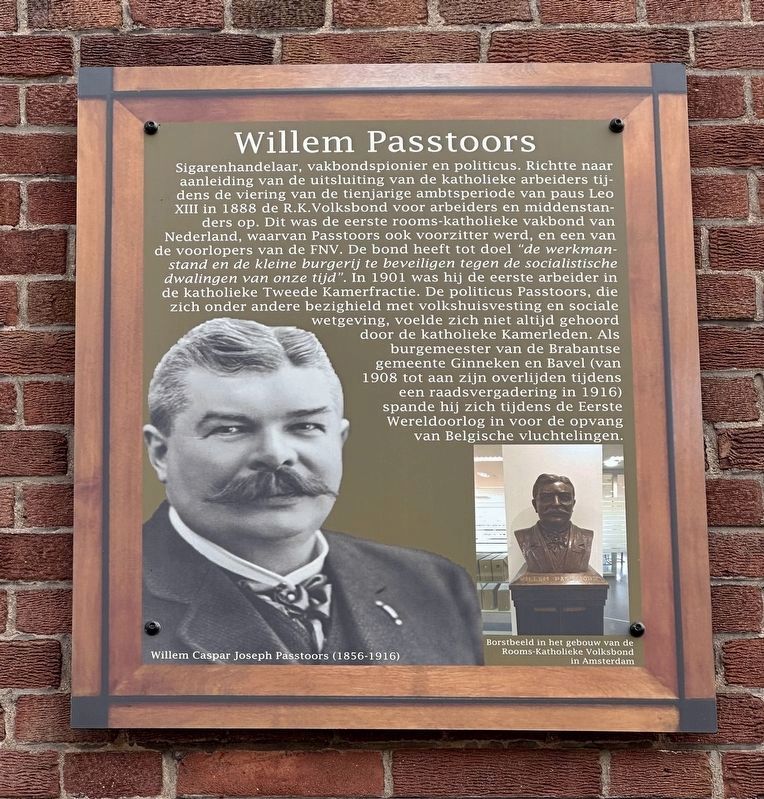
1. Willem Passtoors Marker

Willem Caspar Joseph Passtoors (1856-1916)
Sigarenhandelaar, vakbondspionier en politicus. Richtte naar aanleiding van de uitsluiting van de katholieke arbeiders tijdens de viering van de tienjarige ambtsperiode van paus Leo XIII in 1888 de R.K.Volksbond voor arbeiders en middenstanders op. Dit was de eerste rooms-katholieke vakbond van Nederland, waarvan Passtoors ook voorzitter werd, en een van de voorlopers van de FNV. De bond heeft tot doel "de werkmanstand en de kleine burgerij te beveiligen tegen de socialistische dwalingen van onze tijd". In 1901 was hij de eerste arbeider in de katholieke Tweede Kamerfractie. De politicus Passtoors, die zich onder andere bezighield met volkshuisvesting en sociale wetgeving, voelde zich niet altijd gehoord door de katholieke Kamerleden. Als burgemeester van de Brabantse gemeente Ginneken en Bavel (van 1908 tot aan zijn overlijden tijdens een raadsvergadering in 1916) spande hij zich tijdens de Eerste Wereldoorlog in voor de opvang van Belgische vluchtelingen.
Cigar merchant, trade union pioneer and politician. In 1888 he founded
this page online
Erected 2023 by Geef Straten Een Gezicht.
Topics and series. This historical marker is listed in these topic lists: Charity & Public Work • Government & Politics • Labor Unions. In addition, it is included in the Give Streets a Face / Geef Straten Een Gezicht
Photographed by Andrew Ruppenstein, June 17, 2023
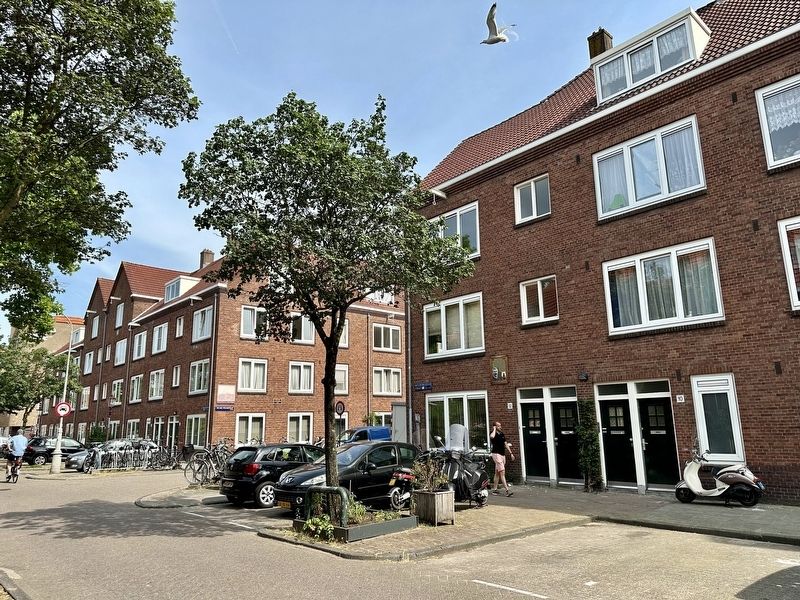
2. Willem Passtoors Marker - wide view
Location. 52° 21.002′ N, 4° 53.78′ E. Marker is in Amsterdam, Noord-Holland (North Holland). It is in De Pijp. It is on Willem Passtoorsstraat, on the right when traveling east. Touch for map. Marker is at or near this postal address: Willem Passtoorsstraat 12I, Amsterdam, Noord-Holland 1073 HH, Netherlands. Touch for directions.

Regionally, it is in Europe, the European Union, Atlantic Europe, the Benelux Low Countries, the Schengen Area, Western Europe, and the Western World. Historically, it finds itself in what was once the Holy Roman Empire.
Other nearby markers. At least 8 other markers are within walking distance of this marker: Burgemeester Tellegen / Mayor Tellegen (about 120 meters away, measured in a direct line); Thérèse Schwartze (about 150 meters away); Lutma (about 150 meters away); Coöperatiehof (Cooperation court) (approx. 0.2 kilometers away); Henriette Ronner (approx. 0.3 kilometers away); Talma (approx. 0.4 kilometers away); Samuel Sarphati (approx. 0.4 kilometers away); Vredeskerk (church of peace) (approx. half a kilometer away). Touch for a list and map of all markers in Amsterdam.
Also see . . . W.C.J. Passtoors (Parlement). Short biography provided by the Dutch Parliament.
Excerpt (in translation): First workers' representative of the Catholics in the House of Representatives. Was a worker in the cigar industry and later a traveling salesman. Founded a Roman Catholic trade union in Amsterdam. Schaepman found him unreliable and treated him as an outcast, after which he left the Catholic Chamber Club for some time (in 1906). Became mayor of Ginneken near Breda during his parliamentary membership. Sturdy and broad-shouldered man, who was easy-going, simple and jovial.(Submitted on July 2, 2023.)
Credits. This page was last revised on December 31, 2023. It was originally submitted on July 2, 2023, by Andrew Ruppenstein of Lamorinda, California. This page has been viewed 173 times since then and 15 times this year. Photos: 1, 2. submitted on July 2, 2023, by Andrew Ruppenstein of Lamorinda, California.
