Conley Hills in East Point in Fulton County, Georgia — The American South (South Atlantic)
Lynching in America
⎯⎯⎯
The Lynching of Zeb Long
Community Remembrance Project
Photographed by Duane and Tracy Marsteller, June 11, 2023
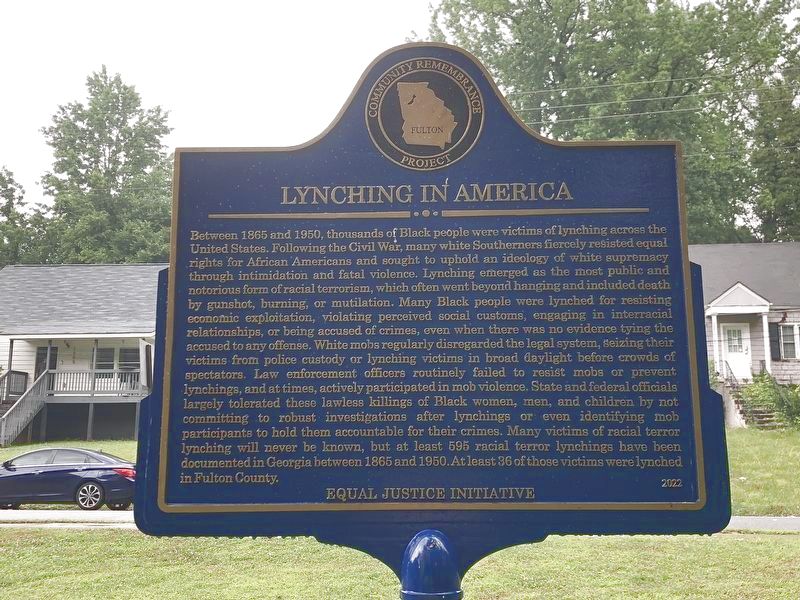
1. Lynching in America side of marker
Lynching in America. Between 1865 and 1950, thousands of Black people were victims of lynching across the United States. Following the Civil War, many white Southerners fiercely resisted equal rights for African Americans and sought to uphold an ideology of white supremacy through intimidation and fatal violence. Lynching emerged as the most public and notorious form of racial terrorism, which often went beyond hanging and included death by gunshot, burning, or mutilation. Many Black people were lynched for resisting economic exploitation, violating perceived social customs, engaging in interracial relationships, or being accused of crimes, even when there was no evidence tying the accused to any offense. White mobs regularly disregarded the legal system, seizing their victims from police custody or lynching victims in broad daylight before crowds of spectators. Law enforcement officers routinely failed to resist mobs or prevent lynchings, and at times, actively participated in mob violence. State and federal officials largely tolerated these lawless killings of Black women, men, and children by not committing to robust
this page online
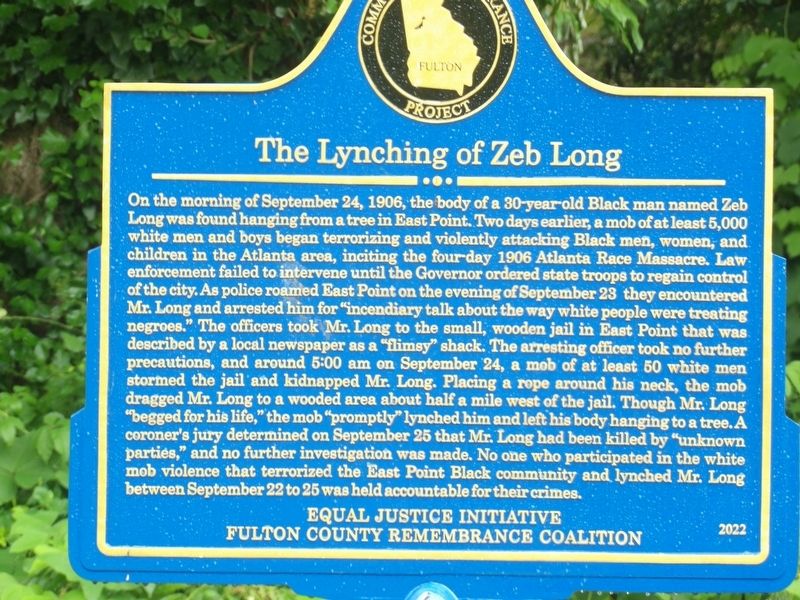
The Lynching of Zeb Long. On the morning of September 24, 1906, the body of a 30-year-old Black man named Zeb Long was found hanging from a tree in East Point. Two days earlier, a mob of at least 5,000 white men and boys began terrorizing and violently attacking Black men, women, and children in the Atlanta area, inciting the four-day 1906 Atlanta Race Massacre. Law enforcement failed to intervene until the Governor ordered state troops to regain control of the city. As police reamed East Point on the evening of September 23 they encountered Mr. Long and arrested him for “incendiary talk about the way white people were treating negroes.” The officers took Mr. Long to the small wooden jail in East Point that was described by a local newspaper as a “flimsy” shack. The arresting officer took no further precautions,
Photographed by Duane and Tracy Marsteller, June 11, 2023
2. The Lynching of Zeb Long side of marker
Erected 2022 by Fulton County Remembrance Coalition • Equal Justice Initiative.
Topics and series. This historical marker is listed in these topic lists: African Americans • Civil Rights • Law Enforcement. In addition, it is included in the Lynching in America series list. A significant historical date for this entry is September 24, 1906.
Location. 33° 41.043′ N, 84° 26.977′ W. Marker is in East Point, Georgia, in Fulton County. It is in Conley Hills. It is on Warren Way south of Headland Drive, on the
Photographed by Duane and Tracy Marsteller, June 10, 2023
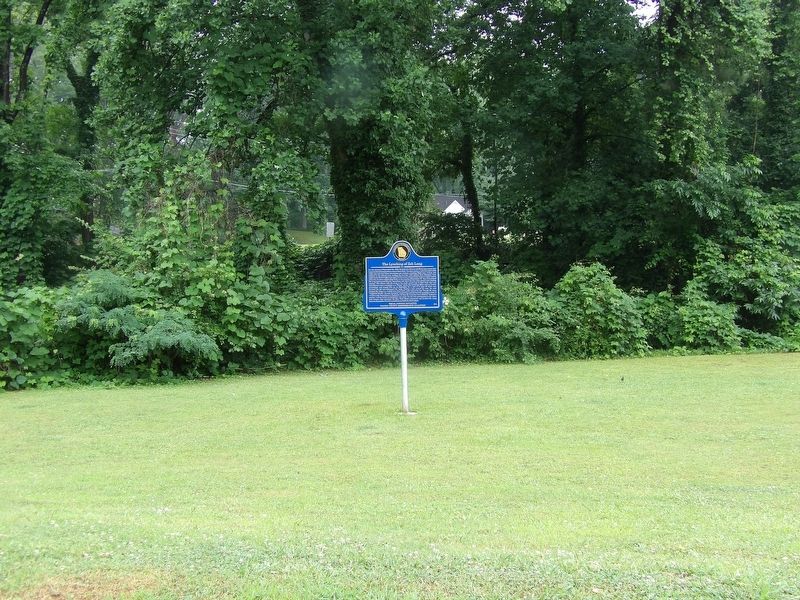
3. The Lynching of Zeb Long / Lynching in America Marker

Regionally, this marker is in the Piedmont and in Metro Atlanta. It is also in the American South and specifically in the Deep South. Globally, it is in North America, the Western Hemisphere, the Western World, and the Anglosphere. Historically, it finds itself in what was once the territory of the Mississippian Culture, one of the original Thirteen Colonies, one of the Confederate States of America, and the Antebellum South.
Other nearby markers. At least 8 other markers are within 2 miles of this marker, measured as the crow flies: Lynching in America / The Lynching of Warren Powell (approx. 0.6 miles away); East Point (approx. 0.6 miles away); William A. Russell High School (approx. 0.8 miles away); St. John's Episcopal Church (approx. 1.6 miles away); In Memoriam (approx. 1.9 miles away); College Park World War II Monument (approx. 1.9 miles away); In Memory of Maj. Joseph A. Bishop (approx. 2 miles away); The Freedom Tree (approx. 2 miles away).
Photographed by Brandon D Cross
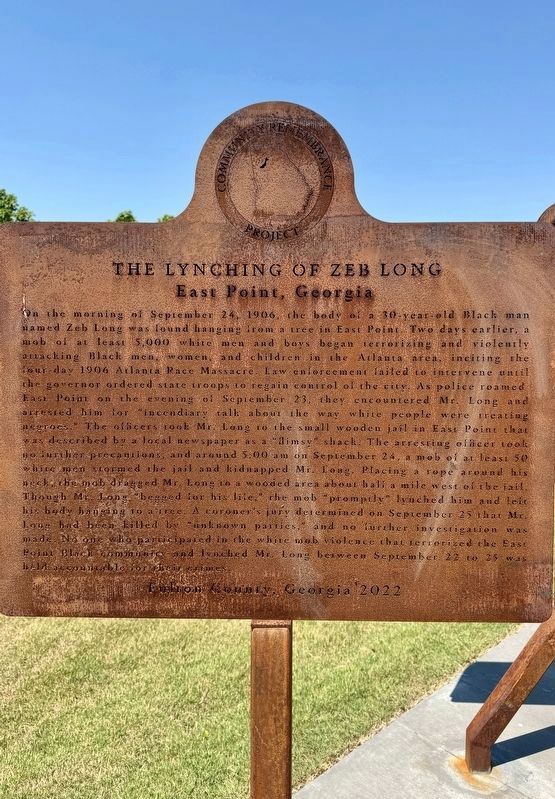
4. The Lynching of Zeb Long Marker
“A Replica marker of one side is located at the Equal Justice Initiatives' National Memorial for Peace and Justice in Montgomery, Alabama. The Equal Justice Initiative supports efforts to locally memorialize documented victims of racial violence and to educate communities about the history of racial injustice.” Mark Hilton
Also see . . . Atlanta Race Massacre of 1906. Between September 24 and September 26, 1906, white mobs killed dozens of Black Atlantans, wounded scores of others, and inflicted considerable property damage. Known thereafter as the Atlanta Race Riot, or the Atlanta Race Massacre, the event was one of a series of violent conflagrations that erupted in southern cities during the dawn of the Jim Crow era. (Clifford Kuhn and Gregory Mixon, New Georgia Encyclopedia) (Submitted on July 3, 2023, by Duane and Tracy Marsteller of Murfreesboro, Tennessee.)
Credits. This page was last revised on August 5, 2025. It was originally submitted on July 3, 2023, by Duane and Tracy Marsteller of Murfreesboro, Tennessee. This page has been viewed 781 times since then and 58 times this year. Photos: 1, 2, 3. submitted on July 3, 2023, by Duane and Tracy Marsteller of Murfreesboro, Tennessee. 4. submitted on October 16, 2024, by Brandon D Cross of Flagler Beach, Florida.
