East MLK in Austin in Travis County, Texas — The American South (West South Central)
Site of Fort Colorado
(Also called Coleman’s Fort)
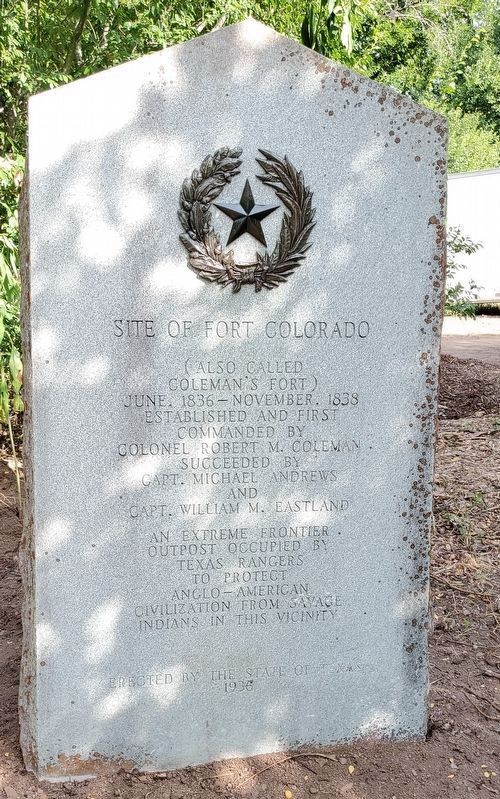
Photographed by Richard Denney, July 3, 2023
1. Site of Fort Colorado Marker
The marker has been moved to the Travis Audubon's Blair Woods Preserve overlooking Coleman Springs.
Established and first commanded by
Colonel Robert M. Coleman.
Succeeded by Capt. Michael Andrews
And
Capt. William M. Eastland.
An extreme frontier outpost occupied by Texas Rangers to protect Anglo-American civilization from savage Indians in this vicinity.
Erected 1936 by State of Texas. (Marker Number 14229.)
Topics and series. This historical marker is listed in these topic lists: Exploration • Forts and Castles • Indigenous Peoples and Communities. In addition, it is included in the Texas 1936 Centennial Markers and Monuments series list. A significant historical year for this entry is 1836.
Location. 30° 17.166′ N, 97° 40.475′ W. Marker is in Austin, Texas, in Travis County. It is in East MLK. It can be reached from East Martin Luther King Jr Boulevard, on the right when traveling east. Touch for map. Marker is at or near this postal address: 5401 E Martin Luther King Jr Blvd, Austin TX 78723, United States of America. Touch for directions.

Regionally, this marker is in Central Texas. It is also in the American South. Globally, it is in North America, a Gulf of Mexico state, the Western Hemisphere, the Western World, and the Anglosphere. Historically, it finds itself in what was once New Spain, the Republic of Texas, one of the Confederate States of America, and the Antebellum South.
Other nearby markers. At least 8 other markers are within 3 miles of this marker, measured as the crow flies: The Texas Centennial Historic Marker & Fort Colorado (here, next to this marker); First Colored Baptist Church (approx. 0.4 miles away); Bethany Cemetery (approx. 0.8 miles away); Mueller Airport (approx. 1½ miles away); Evergreen Cemetery (approx. 1.6 miles away); Annie Webb Blanton (approx. 1.7 miles away); The Original Townsite of Montopolis (approx.
this page online
Another marker is no longer nearby. Site of Pecan Springs School (was approx. 1.1 miles away but has been confirmed missing).
More about this marker. In 1936 this marker was located north of today's Martin Luther Kind Blvd (MLK), before MLK was constructed. In 1966 the Texas Highway Department relocated the marker to the south side of MLK to make way for a housing subdivision. With no pull-off, in time the increased traffic on MLK made access to the marker unsafe, and it was being vandalized. In the summer of 2023, working with Travis Audubon and the Texas Historical Commission, the Travis County Historical Commission, with additional grant funding from Preservation Austin, had the marker moved onto Travis Audubon's Blair Woods Preserve/Sanctuary as part of a larger project to interpret the history of Fort Colorado in conjunction with the National Park Service and El Camino Real de los Tejas Trail Association. The marker is no longer visible from MLK. It is accessible via a well-maintained trail above Coleman Springs.
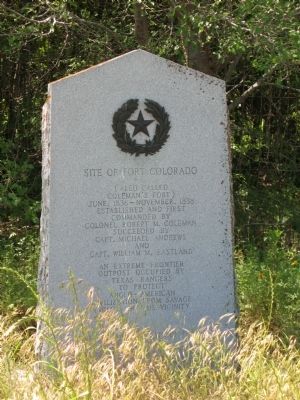
Photographed by Richard Denney, April 25, 2010
2. Site of Fort Colorado Marker
Also see . . .
1. Blair Woods Nature Preserve. Travis Audubon's web page for Blair Woods. (Submitted on July 6, 2023, by Richard Denney of Austin, Texas.)
2. Update on the Texas Centennial Historical Marker at Blair Woods. at the request of and in collaboration with the Texas Historical Commission and the Travis County Historical Commission, a 1936 Texas Centennial historical marker was moved from the Martin Luther King Jr Blvd right-of-way, adjacent to Blair Woods, into the preserve itself. Due to the markers historically inaccurate and offensive text, plans are being made to add an interpretive educational display exploring fully the role of the fort in the lives of all the local people. (Submitted on July 21, 2023.)
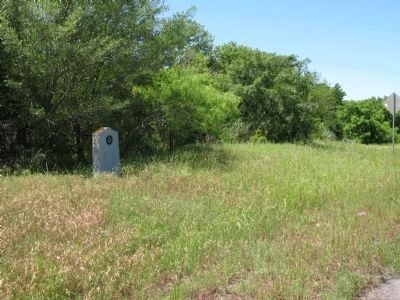
Photographed by Richard Denney, April 25, 2010
3. Former Marker Location Looking West
The marker was previously located on MLK Blvd with nowhere to pull off safely for viewing.

Photographed by Richard Denney
4. Blair Woods Pond
Pond created for wildlife by UT's Dr. Frank Blair by impounding water from nearby Coleman Springs. Blair, an internationally recognized zoologist, donated the property to Travis Audubon upon his death in 1985. Coleman Springs was utilized by Fort Colorado. Gunnar Brune (Springs of Texas, Volume 1) states that soldiers from the fort used the water between 1836 and 1838, and was also a favorite Indian campground in earlier days.
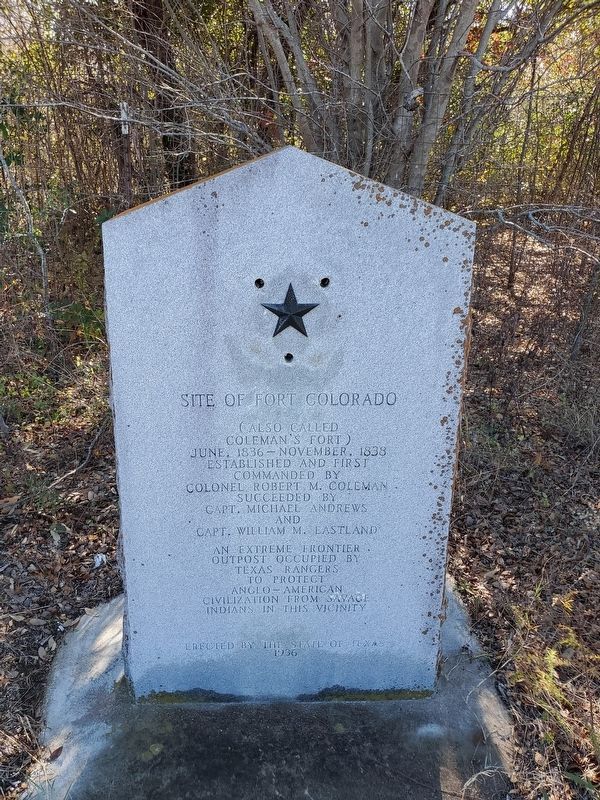
Photographed by Richard Denney, December 27, 2020
5. Site of Fort Colorado Marker
The marker was vandalized in 2020, the wreath removed.

Photographed by Richard Denney
6. Map showing the marker's location inside Travis Audubon's Blair Woods Sanctuary
Map showing the marker's location inside Travis Audubon's Blair Woods Sanctuary. New handicap parking and trail access to the marker and other features have been created.

Photographed by Richard Denney, December 14, 2025
7. El Camino Real de los Tejas National Historic Trail Association
Fort Colorado on Blair Woods Preserve is recognized by El Camino Real de los Tejas National Historic Trail Association as being historically significant to Spain's “Royal Road of the Tejas (Indians).” National Park Service signage has been installed at the location.

Photographed by Jeff Leichsenring, December 7, 2025
8. Site of Fort Colorado Marker
Credits. This page was last revised on May 25, 2026. It was originally submitted on April 25, 2010, by Richard Denney of Austin, Texas. This page has been viewed 3,797 times since then and 268 times this year. Last updated on July 6, 2023, by Richard Denney of Austin, Texas. Photos: 1. submitted on July 3, 2023, by Richard Denney of Austin, Texas. 2, 3. submitted on April 25, 2010, by Richard Denney of Austin, Texas. 4. submitted on November 28, 2012, by Richard Denney of Austin, Texas. 5. submitted on December 27, 2020, by Richard Denney of Austin, Texas. 6. submitted on July 4, 2023, by Richard Denney of Austin, Texas. 7. submitted on September 14, 2024, by Richard Denney of Austin, Texas. 8. submitted on December 11, 2025, by Jeff Leichsenring of Garland, Texas. • James Hulse was the editor who published this page.
