Near Fort Snelling in Hennepin County, Minnesota — The American Midwest (Upper Plains)
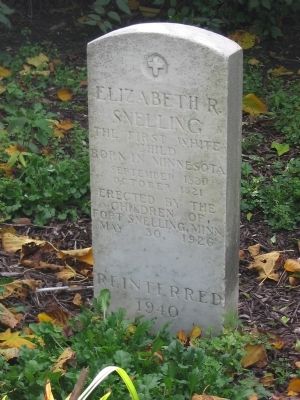
Elizabeth R. Snelling
Photographed by Keith L, October 16, 2008
1. Elizabeth R. Snelling Marker
Snelling
The first white
child
born in Minnesota
September 1820
October 1821
Erected by the
children of
Fort Snelling, Minn.
May 30, 1926
Reinterred
1940
Erected 1926 by the children of Fort Snelling, Minnesota.
Topics. This historical marker is listed in these topic lists: Cemeteries & Burial Sites • Settlements & Settlers • Women. A significant historical month for this entry is May 1986.
Location. 44° 53.524′ N, 93° 11.08′ W. Marker is near Fort Snelling, Minnesota, in Hennepin County. It can be reached from State Highway 55 north of State Highway 5, on the right when traveling north. The marker is next to the Fort Snelling Chapel parking area at Historic Fort Snelling (one mile east of the Twin Cities International Airport). Touch for map. Marker is in this post office area: Saint Paul MN 55111, United States of America. Touch for directions.

Regionally, this marker is in the Twin Cities Metropolitan Area. It is also in the American Midwest, in the Corn Belt, and in the Great River Road Region. Globally, it is in North America, the Western Hemisphere, the Western World,
this page online
Other nearby markers. At least 8 other markers are within walking distance of this marker: Giacomo Constantino Beltrami (a few steps from this marker); An Appreciation: Colonel Josiah Snelling (a few steps from this marker); Service (about 400 feet away, measured in a direct line); Identity (about 400 feet away); Hope (about 500 feet away); The Treaty of 1805 (about 500 feet away); Perseverance (about 500 feet away); Pride (about 500 feet away). Touch for a list and map of all markers in Fort Snelling.
Other markers no longer nearby. U.S. Army, Buildings 17 and 18 (was about 500 feet away but has been permanently removed); The Prairie (was about 500 feet away but has been permanently removed).
Photographed by Keith L, October 16, 2008
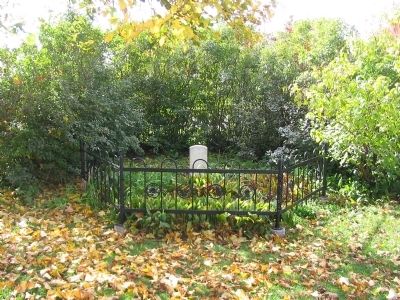
2. Elizabeth R. Snelling Marker
Photographed by Keith L, October 16, 2008
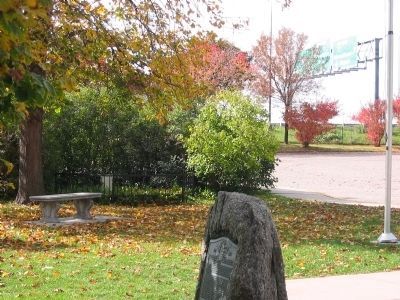
3. Elizabeth R. Snelling Marker (background)
Photographed by Keith L, October 16, 2008
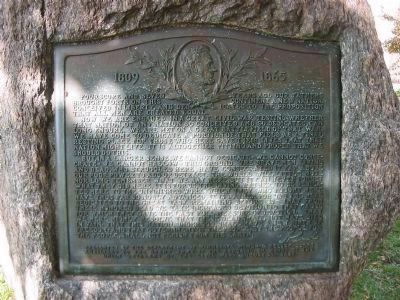
4. The Gettysburg Address (foreground of Photo 3)
Four score and seven years ago our fathers brought forth on this continent, a new nation, conceived in Liberty, and dedicated to the proposition that all men are created equal.
Now we are engaged in a great civil war, testing whether that nation, or any nation so conceived and so dedicated, can long endure. We are met on a great battlefield of that war. We have come to dedicate a portion of that field, as a final resting place for those who here gave their lives that that nation might live. It is altogether fitting and proper that we should do this.
But, in a larger sense, we cannot dedicate—we cannot consecrate—we cannot hallow—this ground. The brave men, living and dead, who struggled here, have consecrated it, far above our poor power to add or detract. The world will little note, nor long remember what we say here, but it can never forget what they did here. It is for us the living, rather, to be dedicated here to the unfinished work which they who fought here have thus far so nobly advanced. It is rather for us to be here dedicated to the great task remaining before us—that from these honored dead we take increased devotion to that cause for which they gave the last full measure of devotion—that we here highly resolve that these dead shall not have died in vain—that this nation, under God, shall have a new birth of freedom—and that government of the people, by the people, for the people, shall not perish from the earth.
Presented by the Department of Minnesota Woman's Relief Corps Auxiliary to the Grand Army of the Republic, in honor of the Union Veterans of the Civil War, August 26, 1928.
Credits. This page was last revised on July 11, 2023. It was originally submitted on October 18, 2008, by Keith L of Wisconsin Rapids, Wisconsin. This page has been viewed 2,544 times since then and 82 times this year. Last updated on July 10, 2023, by McGhiever of Minneapolis, Minnesota. Photos: 1, 2, 3. submitted on October 18, 2008, by Keith L of Wisconsin Rapids, Wisconsin. 4. submitted on March 21, 2009, by Keith L of Wisconsin Rapids, Wisconsin. • J. Makali Bruton was the editor who published this page.
