Near Shiloh in Hardin County, Tennessee — The American South (East South Central)
7th Iowa Infantry Regiment
Tuttle's Brigade - W.H.L. Wallace's Division
| — | Army of the Tennessee | — |
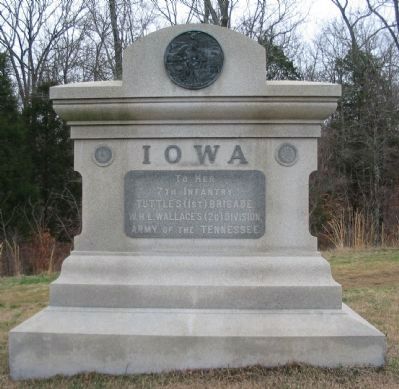
Photographed by Craig Swain, March 16, 2009
1. 7th Iowa Infantry Regiment Monument
to her
7th Infantry,
Tuttle's (1st) Brigade,
W.H.L. Wallace's (2d) Division,
Army of the Tennessee.
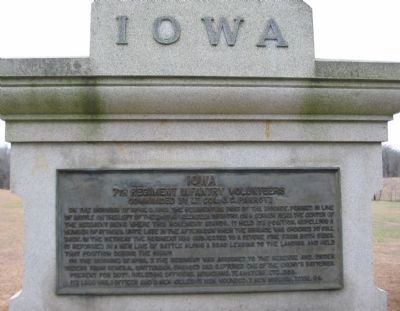
(Back):
7th Regiment Infantry Volunteers
commanded by by Lt. Col. J.C. Parrott
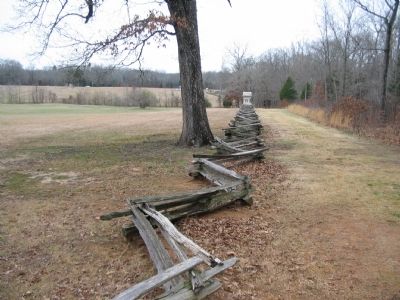
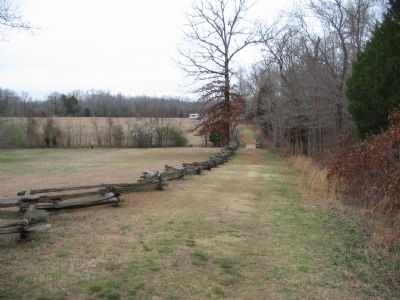
On the morning of April 6, 1862, the regiment, as part of the brigade, formed in line of battle on the left of the 2d Iowa Volunteer Infantry, on a sunken road, the center of the regiment being where this monument stands. It held its position, repelling a number of attacks, until late in the afternoon, when the brigade was ordered to fall back. In the retreat the regiment was subjected to a severe fire from both sides. It reformed in a new line of battle along a road leading to the Landing, and held that position during the night.
On the morning of April 7th the regiment was assigned to the reserve and, under orders from General Crittenden, charged and captured one of the enemy's batteries.
Present for duty, including officers, musicians, teamsters, etc., 383. Its loss was, 1 officer and 9 men killed; 17 men wounded; 7 men missing; total, 34.
Erected by State of Iowa.
Topics. This historical marker is listed in this topic list:
this page online
Location. 35° 8.211′ N, 88° 20.319′ W. Marker is near Shiloh, Tennessee, in Hardin County. It is on Eastern Corinth Road, on the right when traveling north. Located along the Sunken Road Trail between the Eastern Corinth Road and the Corinth Road in Shiloh National Military Park. Touch for map. Marker is in this post office area: Shiloh TN 38376, United States of America. Touch for directions.

Regionally, this marker is in West Tennessee. It is also in the American South and specifically in the Upper South. Globally, it is in North America, the Western Hemisphere, the Western World, and the Anglosphere. Historically, it finds itself in what was once the territory of the Mississippian Culture, one of the Confederate States of America, and the Antebellum South.
Other nearby markers. At least 8 other markers are within walking distance of this marker: 12th Iowa Infantry Regiment (within shouting distance of this marker); Surrender of the Hornets' Nest (about 400 feet away, measured in a direct line); First Minnesota Light Artillery (about 400 feet away); "Hornets Nest"
Photographed by Craig Swain, March 16, 2009
2. Back of Monument
Also see . . . 7th Iowa Infantry Regiment. A history of the Regiment. (Submitted on September 28, 2009, by Craig Swain of Leesburg, Virginia.)
Additional commentary.
1. Dudley L. Campbell, B Company, 7th Iowa Vollunteer Infantry
My Great, Great Grandfather, Dudly L. Campbell must have been in this fight. I have his promotion certificate to First Sargent, dated April 12, 1862 at Pittsburg, Tenn. I manage to visit this battlefield and walked the area this monument is located. I could almost smell the black powder smoke. May all the men that struggled here, north and south, rest in peace.
— Submitted September 2, 2012, by Curtis Campbell of Huntington Beach, California.
Photographed by Craig Swain, March 16, 2009
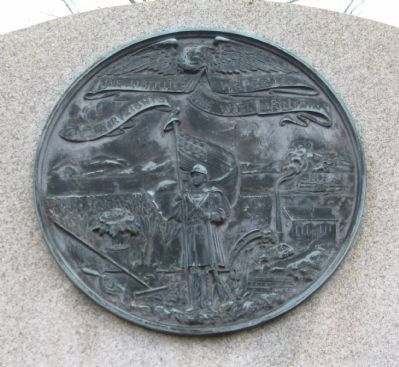
3. State Seal on Front of Monument
Photographed by Craig Swain, March 16, 2009
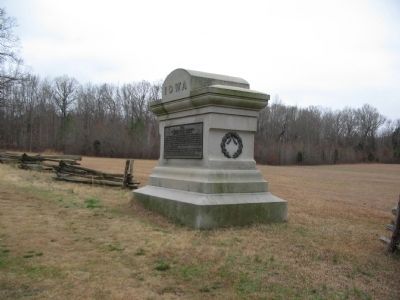
4. 7th Iowa Infantry Regiment Monument
A restored wood fence borders the trace of the "sunken road."
Photographed by Craig Swain, March 16, 2009
5. 7th Iowa Infantry Line
Looking down the "sunken road" along the line held by the regiment during the mid-day and afternoon fighting.
Photographed by Craig Swain, March 16, 2009
6. Right Flank of the 7th Iowa
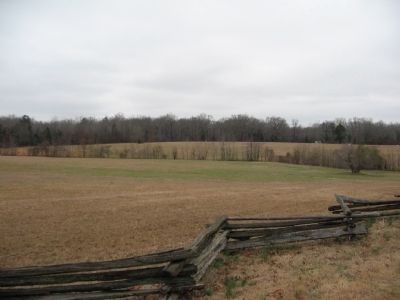
Looking northwest from the monument along the "sunken road". The Regiment's right flank stood near a creek passing through the field.
Photographed by Craig Swain, March 16, 2009
7. Confederate Assaults
Looking southwest from the monument across Duncan Field. The Confederates formed and advanced across the open field repeatedly during the fighting from mid-day into the afternoon. On the far right, the Corinth Road passed through the field. In the distant center, in the tree line, Confederate General Ruggles massed artillery to bombard the Federal lines in the afternoon.
Credits. This page was last revised on June 16, 2016. It was originally submitted on September 28, 2009, by Craig Swain of Leesburg, Virginia. This page has been viewed 1,493 times since then and 35 times this year. Photos: 1, 2, 3, 4, 5, 6, 7. submitted on September 28, 2009, by Craig Swain of Leesburg, Virginia.
