University in Blacksburg in Montgomery County, Virginia — The American South (Mid-Atlantic)
Student Diversity
Photographed by Duane and Tracy Marsteller, June 17, 2023
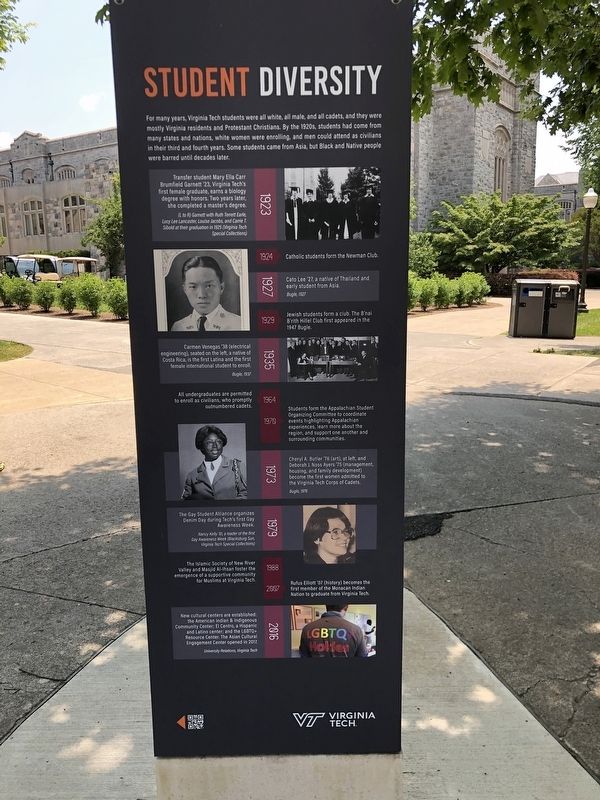
1. Student Diversity Marker, Side One
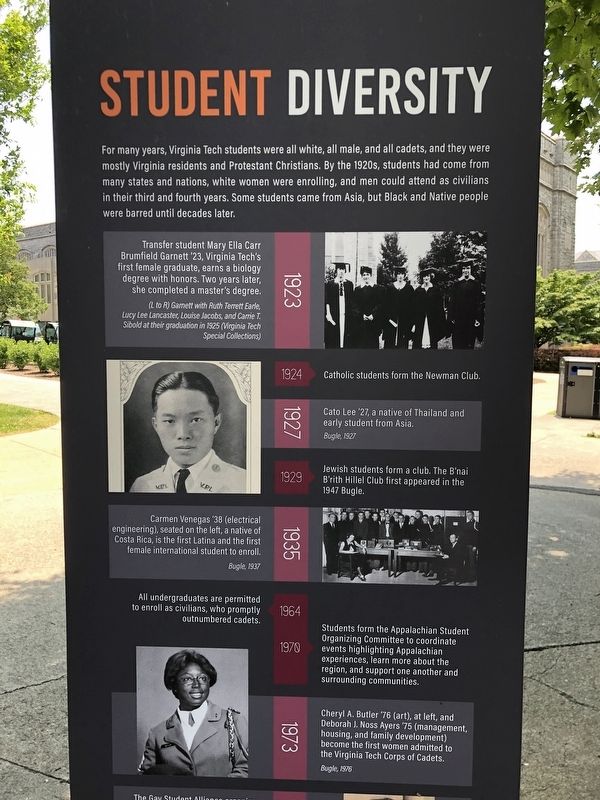
• 1923: Transfer student Mary Ella Carr Brumfield Garnett '23, Virginia Tech's first female graduate, earns a biology degree with honors. Two years later, she completed a master's degree. (L to R) Garnett with Ruth Terrett Earle, Lucy Lee Lancaster, Louise Jacobs, and Carrie T. Sibold at their graduation in 1925 (Virginia Tech Special Collections)
• 1924: Catholic students form the Newman Club.
• 1927: Cato Lee '27, a native of Thailand and early student from Asia. Bugle, 1927
• 1929: Jewish students form a club. The B'nai B'rith Hillel Club first appeared in the 1947 Bugle.
• 1935: Carmen Venegas '38 (electrical engineering), seated on the left, a native of Costa Rica, is the first Latina and the first female international
this page online
• 1964: All undergraduates are permitted to enroll as civilians, who promptly outnumbered cadets.
• 1970: Students form the Appalachian Student Organizing Committee to coordinate events highlighting Appalachian experiences, learn more about the region, and support one another and surrounding communities.
• 1973: Cheryl A. Butler '76 (art), at left, and Deborah J. Noss Ayers '75 (management, housing and family development) become the first women admitted to the Virginia Tech Corps of Cadets). Bugle, 1976
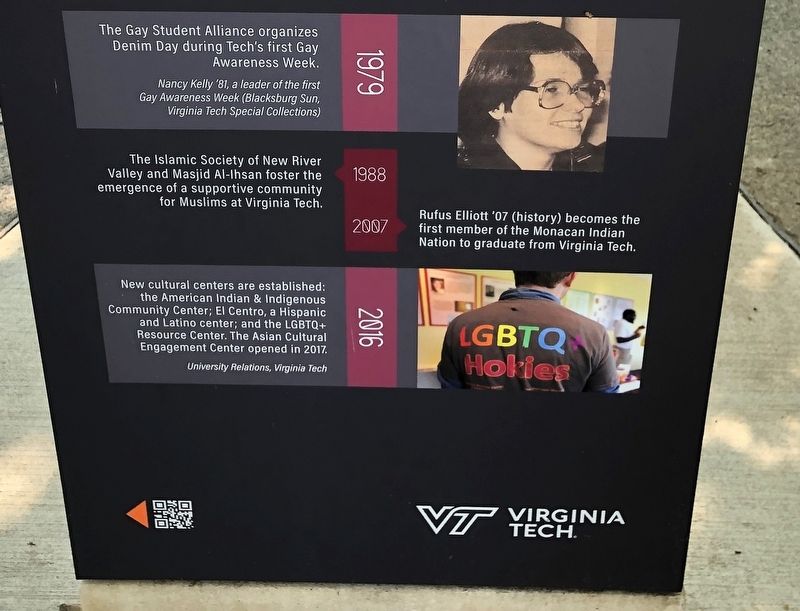
• 1979: The Gay Student Alliance organizes Denim Day during Tech's first Gay Awareness Week. Nancy Kelly '81, a leader of the first Gay Awareness Week (Blacksburg Sun, Virginia Tech Special Collections)
• 1988: The Islamic Society of New River Valley and Masjid Al-Ihsan foster the emergence of a supportive community for Muslims at Virginia Tech.
• 2007: Rufus Elliott '07 (history) becomes the first member of the Monacan Indian Nation to graduate from Virginia Tech.
• 2016: New cultural centers are established: the American Indian & Indigenous Community Center; El Centro, a Hispanic and Latino center;
Photographed by Duane and Tracy Marsteller, June 17, 2023
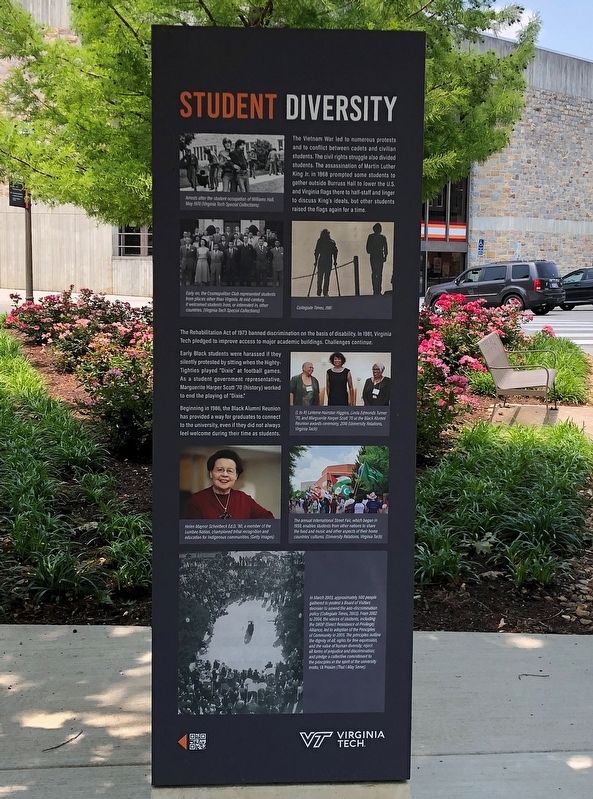
2. Student Diversity Marker, Side Two
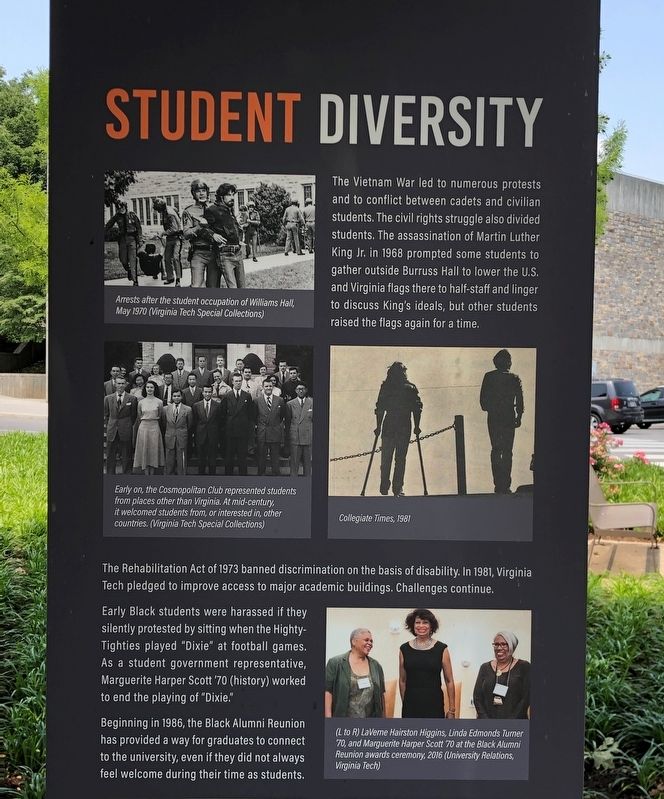
The Vietnam War led to numerous protests and to conflict between cadets and civilian students. The civil rights struggle also divided students. The assassination of Martin Luther King Jr. in 1968 prompted some students to gather outside Burress Hall to lower the U.S. and Virginia flags there to half-staff and linger to discuss King's ideals, but other students raised the flags again for a time.
The Rehabilitation Act of 1973 banned discrimination on the basis of disability. In 1981, Virginia Tech pledged to improve access to major academic buildings. Challenges continue.
Early Black students were harassed if they silently protested by sitting when the Highty- Tighties played “Dixie” at football games. As a student government representative, Marguerite Harper Scott '70 (history) worked to end the playing of “Dixie.”
Beginning in 1986, the Black Alumni Reunion has provided a way for graduates to connect to the university, even if they did not always feel welcome during their time as students.
[Captions
Photographed by Duane and Tracy Marsteller, June 17, 2023
3. Student Diversity Marker Side One closeup
• Arrests after the student occupation of Williams Hall, May 1970 (Virginia Tech Special Collections)
• Left: Early on, the Cosmopolitan Club represented students from places other than Virginia. At mid-century, it welcomed from, or interested in, other countries. (Virginia Tech Special Collections) Right Collegiate Times, 1981
• (L to R) LaVerne Hairston Higgins, Linda Edmonds Turner '70, and Marguerite Harper Scott '70 at the Black Alumni Reunion awards ceremony, 2016. (University Relations, Virginia Tech)
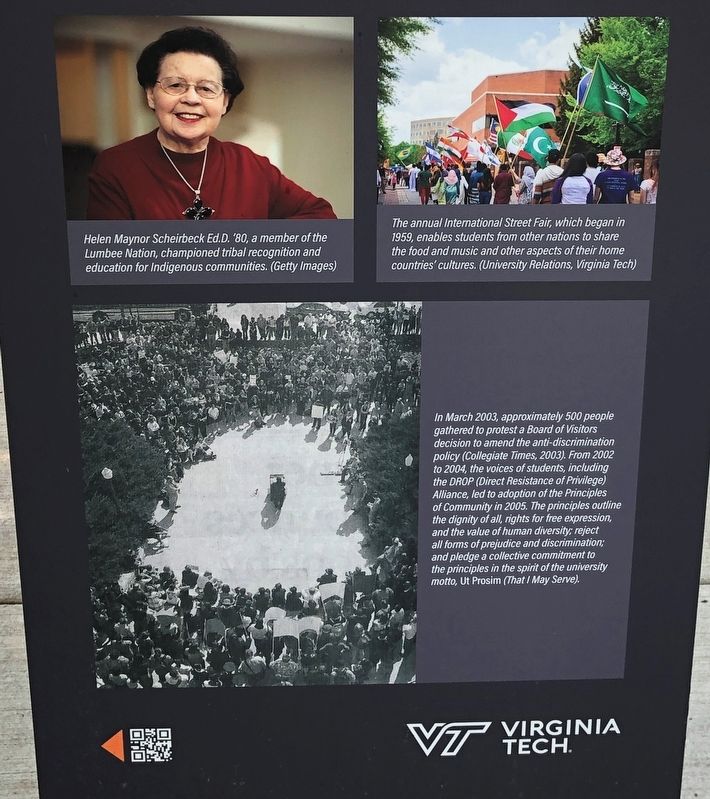
• Left Helen Maynor Scheirbeck Ed.D '80, a member of the Lumbee Nation, championed tribal recognition and education for Indigenous communities. (Getty Images); Right The annual International Street Fair, which began in 1959, enables students from other nations to share the food and music and other aspects of their home countries' cultures. (University Relations, Virginia Tech)
• In March 2003, approximately 500 people gathered to protest a Board of Visitors decision to amend the anti-discrimination policy (Collegiate Times, 2003). From 2002 to 2004, the voices of students, including the DROP (Direct Resistance
Photographed by Duane and Tracy Marsteller, June 17, 2023
4. Student Diversity Marker Side One closeup
Erected by Virginia Tech.
Topics. This historical marker is listed in these topic lists: African Americans • Education • Women. A significant historical year for this entry is 1925.
Location. 37° 13.651′ N, 80° 25.127′ W. Marker is in Blacksburg, Virginia, in Montgomery County. It is in University. It can be reached from Kent Street south of Drillfield Drive, on the right when traveling south. Marker is in the triangle formed by sidewalks across the street from Hokieshop University Bookstore. Touch for map. Marker is at or near this postal address: 115 Kent St, Blacksburg VA 24061, United States of America. Touch for directions.

Regionally, this marker is in Southwest Virginia, in the Blue Ridge Highlands, and in the New River Gorge. It is also in the American South,
Photographed by Duane and Tracy Marsteller, June 17, 2023
5. Student Diversity Marker Side Two closeup
Other nearby markers. At least 8 other markers are within walking distance of this marker: Women's History / Women on Campus (about 300 feet away, measured in a direct line); Carol Montgomery Newman (about 400 feet away); Virginia Tech War Memorial Chapel (about 700 feet away); Paul Ernest Torgersen (about 800 feet away); John Houston Squires (approx. 0.2 miles away); Theodorick Pryor Campbell (approx. 0.2 miles away); William MacFarland Patton (approx. 0.2 miles away); William Frank Henderson (approx. 0.2 miles away). Touch for a list and map of all markers in Blacksburg.
Photographed by Duane and Tracy Marsteller, June 17, 2023
6. Student Diversity Marker Side Two closeup
Photographed by Duane and Tracy Marsteller, June 17, 2023
7. Student Diversity Marker
Credits. This page was last revised on July 16, 2023. It was originally submitted on July 13, 2023, by Duane and Tracy Marsteller of Murfreesboro, Tennessee. This page has been viewed 307 times since then and 23 times this year. Photos: 1, 2, 3, 4, 5, 6, 7. submitted on July 13, 2023, by Duane and Tracy Marsteller of Murfreesboro, Tennessee.
