Museum District in Richmond, Virginia — The American South (Mid-Atlantic)
Arthur Ashe Monument
Monument Avenue Historic District
Photographed by Richard E. Miller, September 27, 2009
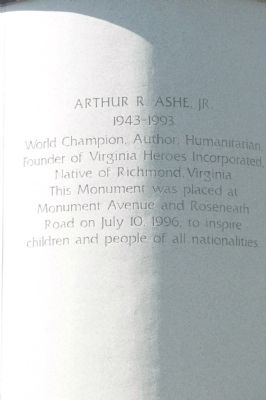
1. Arthur Ashe Monument, east side inscription
[Inscription on east face of monument:]
1943 - 1993
World Champion, Author, Humanitarian,
Founder of Virginia Heroes, Incorporated,
Native of Richmond, Virginia.
This Monument was placed at
Monument Avenue and Roseneath
Road on July 10, 1996,
to inspire children and people of all nationalities.
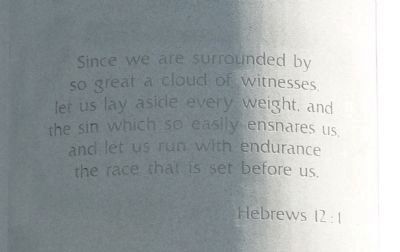
[Inscription on west face of monument:]
so great a crowd of witnesses,
let us lay aside every weight, and
the sin which so easily ensnares us.
and let us run with endurance
the race that is set before us.
Hebrews 12:1
Erected 1996.
Topics and series. This historical marker and monument is listed in these topic lists: African Americans • Sports. In addition, it is included in the National Historic Landmarks series list. A significant historical month for this entry is July 1783.
Location. 37° 33.91′ N, 77° 28.744′ W. Marker is in Richmond, Virginia. It is in the Museum District. It is at the intersection of Monument Avenue and Roseneath Road, in the median on Monument Avenue. Marker is in the city's "Museum District" and the Monument Avenue Historic District, two blocks southwest of Broad Street (U.S. Rte 33/250) and southeast of I-195. Touch for map. Marker is at or near this postal address: 3321 Monument Avenue, Richmond VA 23221, United States of America. Touch for directions.

Regionally, this marker and monument is in Central Virginia. It is also in the American South and specifically in the Upper South. Globally, it is in North America, the Western Hemisphere, the Western World, and the Anglosphere. Historically, it finds itself in what was once the territory of the Mississippian Culture, one of the original Thirteen Colonies, one of the Confederate States of America, and the Antebellum South.
Other nearby markers. At least 8 other
this page online
Other markers no longer nearby. Second Line of the Confederate Defenses (was within shouting distance of this marker but has been permanently removed); Maury (was approx. 0.3 miles away but has been permanently removed); Stonewall Jackson (was approx. half a mile away but has been permanently removed).
More about this marker. At the base of this marker is a Register of National Historic Places marker for the Monument Avenue Historic District. The Monument Avenue Historic District is also registered as a National Historic Landmark.
Also see . . .
1. Arthur Ashe.
Photographed by Richard E. Miller, September 27, 2009
2. Arthur Ashe Monument, west side inscription
2. Arthur Ashe Monument. Wikipedia entry (Submitted on July 25, 2024, by Larry Gertner of New York, New York.)
3. Monument Avenue. Wikipedia entry (Submitted on September 28, 2009, by Richard E. Miller of Oxon Hill, Maryland.)
4. Take a HMDb tour of the monuments on “America’s Most Beautiful Boulevard.”. (Submitted on October 2, 2009.)
Additional keywords. Tennis; U.S. Open; AIDS; Paul De Pasquale, sculptor.
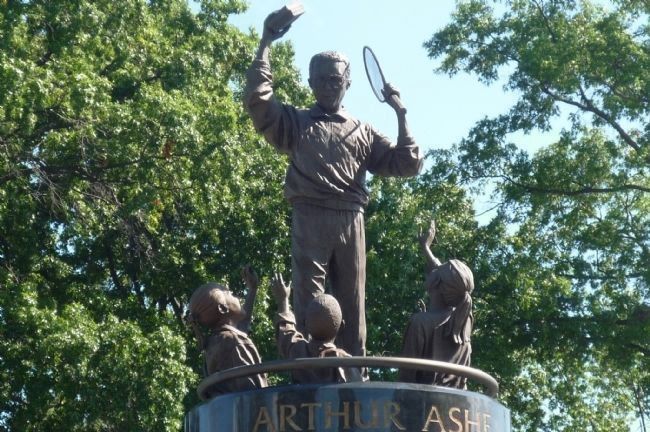
Photographed by Richard E. Miller, September 27, 2009
3. Arthur Ashe, sculpture by Paul De Pasquale,
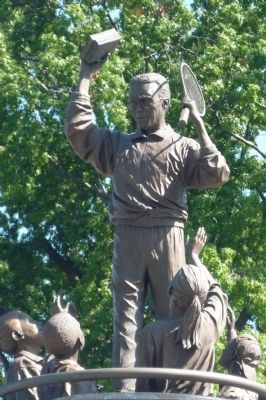
Photographed by Richard E. Miller, September 27, 2009
4. Arthur Ashe Monument.
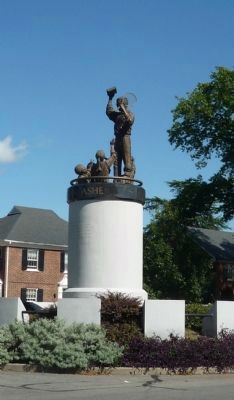
Photographed by Richard E. Miller, September 27, 2009
5. Arthur Ashe Monument
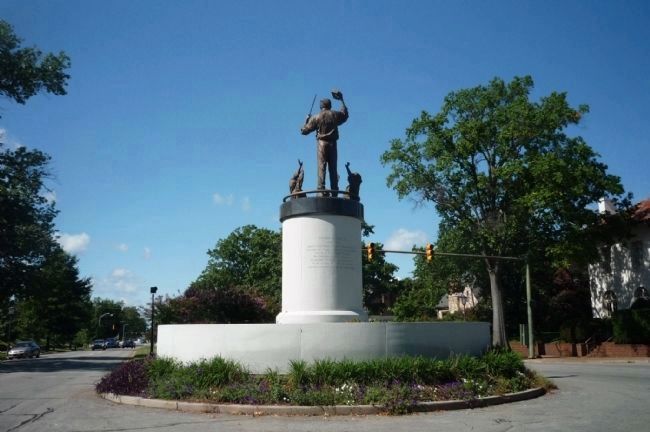
Photographed by Richard E. Miller, September 27, 2009
6. Arthur Ashe Monument
view from the east near Historic District marker.
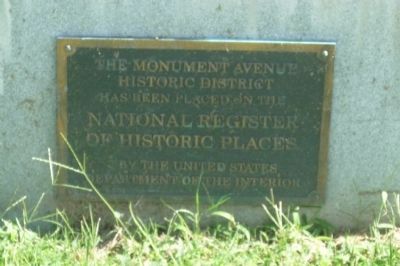
Photographed by Richard E. Miller, September 27, 2009
7. Monument Avenue Historic District /National Register of Historic Places marker,
in the grass at the curb east of the Arthur Ashe monument
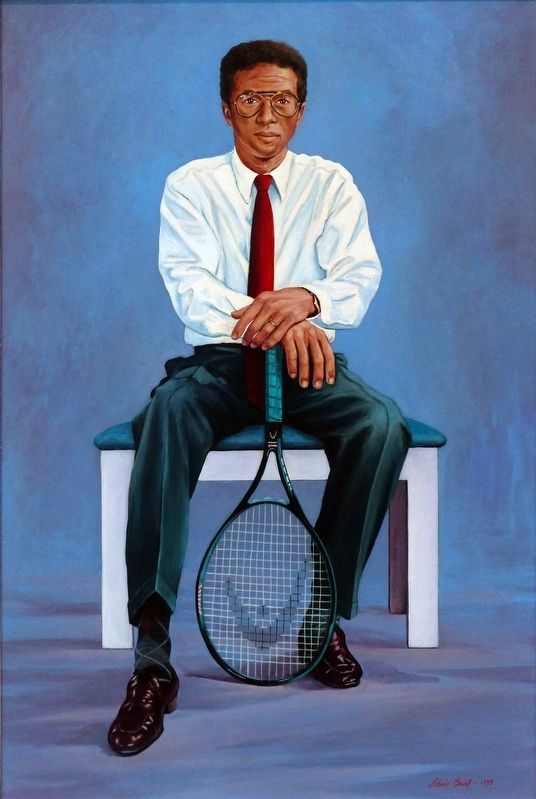
Photographed by Allen C. Browne, July 25, 2017
8. Arthur Ashe
This 1993 portrait of Arthur Ashe (1943-1993) by Louis Briel hangs in the National Portrait Gallery in Washington, DC.
“Armed with superb natural talent, a keen competitive spirit, and poise that set him apart from his rivals, Arthur Ashe made his way from the segregated playground courts of his youth to the pinnacle of the tennis world. Rated among the world's top ten players while still in college, Ashe reached the number-one ranking in spectacular fashion in 1968. After capturing the U.S. amateur title, he served an astonishing twenty-six aces in the final to become the first African American man to claim the U.S. Open championship. Ashe went on to record multiple tournament victories, including his memorable triumph over Jimmy Connors at Wimbledon in 1975. Following a heart attack that forced his retirement in 1980, Ashe dedicated his energies to humanitarian causes. He became a leader in the fight against AIDS in 1992, after revealing that he had contracted the virus through a transfusion” — National Portrait Gallery
“Armed with superb natural talent, a keen competitive spirit, and poise that set him apart from his rivals, Arthur Ashe made his way from the segregated playground courts of his youth to the pinnacle of the tennis world. Rated among the world's top ten players while still in college, Ashe reached the number-one ranking in spectacular fashion in 1968. After capturing the U.S. amateur title, he served an astonishing twenty-six aces in the final to become the first African American man to claim the U.S. Open championship. Ashe went on to record multiple tournament victories, including his memorable triumph over Jimmy Connors at Wimbledon in 1975. Following a heart attack that forced his retirement in 1980, Ashe dedicated his energies to humanitarian causes. He became a leader in the fight against AIDS in 1992, after revealing that he had contracted the virus through a transfusion” — National Portrait Gallery
Photographed by J. Makali Bruton, July 2, 2015
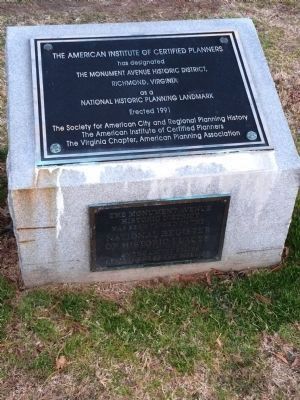
9. Monument Avenue Historic District marker near Arthur Ashe Monument Marker
This small concrete block with two markers is directly southeast of the Arthur Ashe monument along Monument Avenue. The first marker says "The American Institute of Certified Planners has designated The Monument Avenue Historic District, Richmond, Virginia as a National Historic Planning Landmark. Erected 1991. The Society for American City and Regional Planning History, The American Institute of Certified Planners, and The Virginia Chapter, American Planning Association." The second, lower marker states that "The Monument Avenue Historic District has been placed on the National Register of Historic Places by the United States Department of the Interior."
Credits. This page was last revised on July 25, 2024. It was originally submitted on September 28, 2009, by Richard E. Miller of Oxon Hill, Maryland. This page has been viewed 3,655 times since then and 127 times this year. Photos: 1, 2, 3, 4, 5, 6. submitted on September 28, 2009, by Richard E. Miller of Oxon Hill, Maryland. 7. submitted on September 29, 2009, by Richard E. Miller of Oxon Hill, Maryland. 8. submitted on September 16, 2017, by Allen C. Browne of Silver Spring, Maryland. 9. submitted on February 15, 2015, by J. Makali Bruton of Washington, District of Columbia. • Kevin W. was the editor who published this page.
