North Waterfront in San Francisco City and County, California — The American West (Pacific Coastal)
Gardeners
Alcatraz Landing
| — | Keepers & the Kept | — |
Photographed by Joseph Alvarado
1. Gardeners Marker
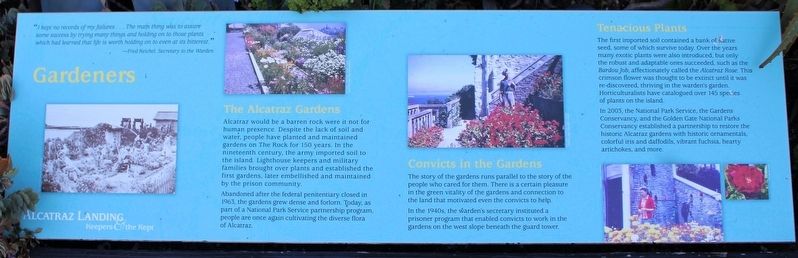
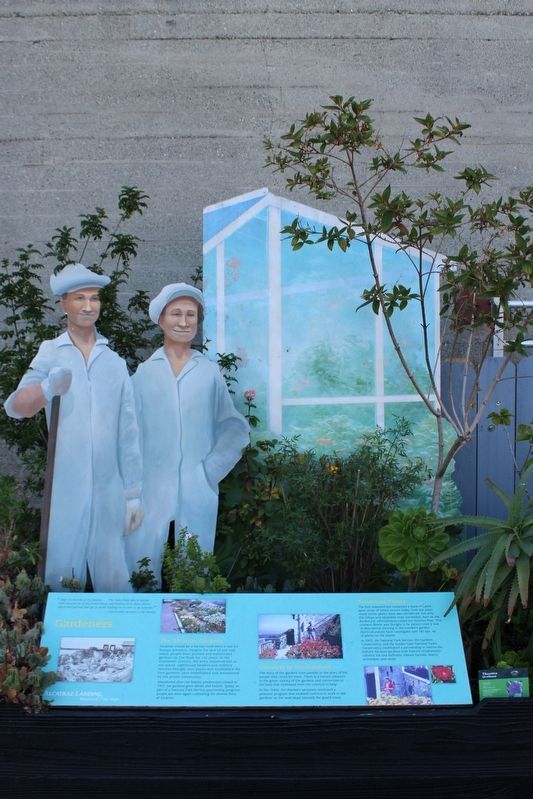
Alcatraz would be a barren rock were it not for human presence. Despite the lack of soil and water, people have planted and maintained gardens on The Rock for 150 years. In the nineteenth century, the army imported soil to the island. Lighthouse keepers and military families brought over plants and established the first gardens, later embellished and maintained by the prison community.
Abandoned after the federal penitentiary closed in 1963, the gardens grew dense and forlorn. Today, as part of the National Park Service partnership program, people are once again cultivating the diverse flora of Alcatraz.
Convicts in the Gardens
The story of the gardens runs parallel to the story of the people who cared for them. There is a certain pleasure in the green vitality of the gardens and connection to the land that motivates even the convicts to help.
Tenacious Plants
The first imported soil contained a bank of native seed, some of which survive today. Over the years many exotic plants were also introduced, but only the robust and adaptable ones succeeded, such as the Bardou Job, affectionately called
this page online
In 2003, the National Park Service, the Gardens Conservancy, and the Golden Gate National Parks Conservancy established a partnership to restore the historic Alcatraz gardens with historic ornamentals, colorful iris and daffodils, vibrant fuchsia, hearty artichokes, and more.
”I kept no records of my failures… The main thing was to assure some success by trying many things and holding on to those plants which had learned that life was worth holding on to even at its bitterest.”
- Fred Reichel, Secretary to the Warden
Topics. This historical marker is listed in these topic lists: Horticulture & Forestry • Parks & Recreational Areas. A significant historical year for this entry is 1963.
Location. 37° 48.408′ N, 122° 24.292′ W. Marker is in San Francisco, California, in San Francisco City and County. It is in North Waterfront. It can be reached from The Embarcadero south of Bay Street, on the right when traveling north. The resin marker
Photographed by Joseph Alvarado, June 15, 2023
2. Gardeners Marker

Regionally, this marker is on the Coast Ranges. It is also on the American Pacific Coast. Globally, it is in North America, on the Ring of Fire, on the Pacific Rim, in the Western Hemisphere, in the Western World, and in the Anglosphere. Historically, it finds itself in what was once New Spain and also Mexico’s Alta California.
Other nearby markers. At least 8 other markers are within walking distance of this marker: Families (here, next to this marker); Lighthouse Keepers (within shouting distance of this marker); National Park Service (within shouting distance of this marker); Army Soldiers (within shouting distance of this marker); Correctional Officers (within shouting distance of this marker); The Dock (within shouting distance of this marker); Industrial Buildings (within shouting distance of this marker); Main Prison Building (within shouting distance of this marker). Touch for a list and map of all markers in San Francisco.
Also see . . .
1. Gardens of Alcatraz. National Park Service
"Alcatraz Island has no native flora. Upon the arrival of the U.S. Army and Lighthouse Service, the island was a barren, bird guano encrusted rock. All the soil and plants you'll find on Alcatraz today were brought to the island by people."(Submitted on July 17, 2023, by Joseph Alvarado of Livermore, California.)
2. History of Gardening on the Island. Golden Gate National Parks Conservancy
"In the 1920s, the military and the California Spring Blossom and Wildflower Association initiated an islandwide beautification project, and prisoners planted hundreds of trees and shrubs and many pounds of seeds."(Submitted on July 17, 2023, by Joseph Alvarado of Livermore, California.)
Credits. This page was last revised on March 5, 2025. It was originally submitted on July 17, 2023, by Joseph Alvarado of Livermore, California. This page has been viewed 151 times since then and 14 times this year. Photos: 1, 2. submitted on July 17, 2023, by Joseph Alvarado of Livermore, California.
Editor’s want-list for this marker. Photos of the gardens. • Can you help?
