
Flushing in Queens in Queens County, New York — The American Northeast (Mid-Atlantic)
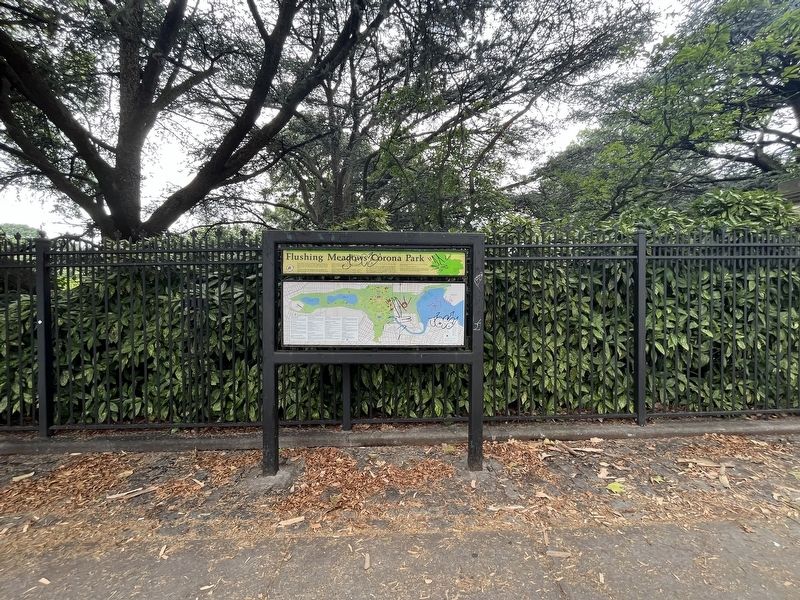
Flushing Meadows Corona Park

Flushing Meadows-Corona Park, today New York City's second largest park, has risen like a phoenix from the ashes. The 1,255-acre open space was indeed an ash disposal heap in the early 20th Century, noted by F. Scott Fitzgerald in The Great Gatsby as "a fantastic form where ashes grow like wheat into ridges and hills and grotesque gardens, where ashes take the form of houses and chimneys and rising smoke…"
In the 1930s, with dreams of transforming the ash heap into living green space, Parks Commissioner Robert Moses converted the site into the grounds for the 1939-40 New York World's Fair. He planned to use the profits from the exposition to build a glorious park.
Though the fairgrounds were landscaped and became Flushing Meadows Park, the Fair lost money and the area was left unfinished. With the exception of the United Nations' use of the New York City building (a product of the 1939 exposition) as the General Assembly chamber between 1946 and 1950, the site stood idle and neglected.
In 1960, Moses proposed that the City sponsor a second exposition in the park. The plans for the 1964-65 World's Fair provided
this page online
by 1968, athletic fields, playgrounds, a boat rental concession in Meadow Lake, a model airplane field, a bicycle path and the Queens Zoo had been added to the park. In 1978, Louis Armstrong Stadium, formerly the Singer Bowl, became the USTA National Tennis Center. The 1980s saw an expanded Hall of Science and Queens Museum of Art. In the 1990s, the rebuilt Queens Zoo was opened by the New York Zoological Society (1992), the Queens Theatre in the Park was rebuilt (1993) and the Unisphere was refurbished (1994-1995). the Arthur Ashe tennis stadium was ready for the US Open in 1997.
Flushing Meadows-Corona Park is owned by the City of New York and managed by Parks & Recreation.
City of New York Parks & Recreation
The design and development of this map were
Cultural Institutions
The Queens Museum of Art
A visual arts center occupying half the New York City Building, the museum presents a series of fine arts exhibitions, films and an extensive educational program. The Museum is home to the Panorama of New York City—the world's largest architectural scale model of an urban area.
New York Hall of Science
Built for the 1964 World's Fair, today the facility is New York City's only hands-on science and technology museum.
Queens Wildlife Center
Operated by the Wildlife Conservation Society, this zoo has a diverse collection of North American animals exhibited on naturalistic grounds, allowing an unusual intimacy between visitors and animals.
Queens Botanical Garden
begun as a five-acre floral exhibition "Gardens on Parade" for the 1939 World's Fair, the Queens Botanical Garden was founded in 1946. In the early 1960s, the Garden was moved to its present 39-acre site which features teaching collections, a Victorian style garden, and a 21-acre arboretum.
Queens Theatre in the Park
Located in the Theaterama of the 1964 World's Fair New York State Complex, the theater presents a variety of professional performing artists and serves as a showcase for local arts groups. The facility accommodates a 500-seat main auditorium and a 100-seat lower level theater.
Professional Sports Facilities
Shea Stadium
Shea Stadium, built in 1962, is home to the New York Mets professional baseball club. Shea Stadium also hosts entertainment events: The Beatles, The Who, The Rolling Stones, Eric Clapton and Elton John are just a few of those who have performed here.
USTA National Tennis Center
The Louis Armstrong Stadium, newly constructed Arthur Ashe Stadium and associated tennis courts and concessions are the home of the United States Open, one of the world's four most prestigious Grand Slam tennis tournaments. During the rest of the year, courts are available for public play, instructional programs and tournaments.
Playgrounds
Dinosaur Playground (center of park, near Fountain of Planets)
Lawrence Street Playground (center of park, near Fountain of Planets)
Mauro Playground (southeast corner, near NYC Transit Yard)
Meadow Lake East Playground (north of Meadow Lake, near Grand Central Parkway)
Playground for all Children (Corona Avenue, near Queens Wildlife Center)
Saturn Playground (center of park, near Fountain of Planets)
On the Waterfront
Willow Lake
Willow Lake flows into Meadow Lake and encompasses 43 acres in the southeastern-most portion of the park. Its unique setting is ideally suited to bird watchers and nature lovers.
Meadow Lake
This 84-acre man-made body of sparkling, fresh water is New York City's largest lake. A popular spot for boating, fishing, crew and sailing, the water keeps splashing while scores of other recreation activities fill the surrounding athletic fields, bike paths, a model plane facility and picnic areas.
Flushing Bay Promenade
Located along Flushing Bay in the northern most portion of Flushing Meadows Corona Park. This 1.7 mile promenade is ideal for biking, jogging, observing airport and boat traffic, experiencing the marina and observing the presence of wildlife. It is truly a unique place.
Monuments and Sculptures
1. Candela Structures
Dedicated to Felix Candela, the architect who designed the Mexican Pavilion. Built as a bush shelter for the 1964 World's Fair.
2. Passarelle Plaza Mosaics
Colorful images of both New York World's Fairs. Installed in 1998 as part of the reconstruction of the Passarelle area.
3. World's Fair Flagpoles
Topped by two stylized art deco American eagles, these poles stand as a tribute to the 1939 World's Fair.
4. George Washington
This cast of an original Donald Delue sculpture was displayed at the 1964 World's Fair.
5. Rocket Thrower
This work of art was created by Donald Delue for the 1964 World's Fair. It serves as the center of the fountain allée.
6. The Whispering Column of Jerash
This marble column from the ancient Roman Temple was a gift from the King Prussein of Jordan.
7. Untitled, by Matt Mullican
Images from past World's Fairs and images of the present day park were sandblasted in black granite as part of the 1993 reconstruction of the Unisphere's landscape.
8. Freedom of the Human Spirit
This bronze figurative sculpture, which stands 28 feet tall, was fashioned by Marshall M. Fredericks for the 1964 World's Fair.
9. The Unisphere
This monumental stainless steel globe, standing 140 feet high, was presented to the 1964 World's Fair by United States Steel. Today, it is Queens' most recognizable symbol, serving as the centerpiece for the park and its surrounding area and the park's most popular meeting place.
10. Form
Contrived by José de Rivera for the 1964 World's Fair, this sculpture consists of a rotating stainless steel curve which sits atop a polished granite base.
11. Forms in Transit
Fabricated by Theodore Roszak for the 1964 World's Fair, this 43 foot long piece created from steel and aluminum was designed to convey movement in space.
12. The Excedra
A semicircular stone bench commemorates the location of the Vatican Pavilion at the 1964 World's Fair.
13. Time Capsules
A granite column marks the spot where two time capsules lie buried underground. These historic capsules deposited September 23, 1938 and October 16, 1965, are a record of 20th-century civilization meant to endure for 5,000 years.
Concessions
Bike Rental (near Pasarelle Plaza and Boathouse)
Pitch & Putt Golf (near Pasarelle Plaza)
Carousel (near Queens Wildlife Center)
World's Fair Marina (Flushing Bay)
Grand Bay Marina Restaurant (Flushing Bay)
Terrace on the Park Catering Hall and Restaurant (111th Street, near Queens Wildlife Center)
Trolley Service Available 🚎
Erected by City of New York Parks & Recreation (NYC Parks).
Topics and series. This historical marker is listed in these topic lists: Architecture • Arts, Letters, Music • Parks & Recreational Areas • Sports. In addition, it is included in the NYC Parks, and the Time Capsules series lists. A significant historical year for this entry is 1939.
Location. 40° 45.074′ N, 73° 49.562′ W. Marker is in Queens, New York, in Queens County. It is in Flushing. It is on Main Street just south of Elder Avenue, on the left when traveling north. The marker stands just south of the walking entrance to the Queens Botanical Garden. Touch for map. Marker is at or near this postal address: 43-49 Main Street, Flushing NY 11355, United States of America. Touch for directions.

Regionally, this marker is in New York City. It is also in the American Northeast and on the Eastern Seaboard. Globally, it is in North America and the Western World. Historically, it finds itself in what was once one of the original Thirteen Colonies.
Other nearby markers. At least 8 other markers are within walking distance of this marker: 9/11 Memorial (here, next to this marker); Symphytum officinale (about 600 feet away, measured in a direct line); Parthenium integrifolium (about 600 feet away); Artemisia abrotanum (about 600 feet away); Teucrium chamaedrys (about 600 feet away); Medicinal Plants (about 700 feet away); Eschscholzia californica (about 700 feet away); Opuntia compressa (about 700 feet away). Touch for a list and map of all markers in Queens.
Also see . . . Time Capsule: Songs for a Future Generation Wikipedia article. The B-52s' "best of" compilation album cover features the band posing in front of the Unisphere. (Submitted on July 18, 2023, by Devry Becker Jones of Washington, District of Columbia.)
Credits. This page was last revised on July 18, 2023. It was originally submitted on July 18, 2023, by Devry Becker Jones of Washington, District of Columbia. This page has been viewed 205 times since then and 13 times this year. Photos: 1, 2. submitted on July 18, 2023, by Devry Becker Jones of Washington, District of Columbia.
