The Loop District in Chicago in Cook County, Illinois — The American Midwest (Great Lakes)
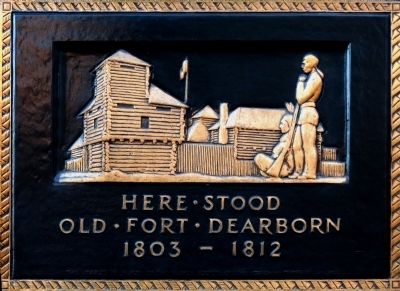
Old Fort Dearborn
Photographed by Allen C. Browne, November 4, 2012
1. Old Fort Dearborn Marker, Inset
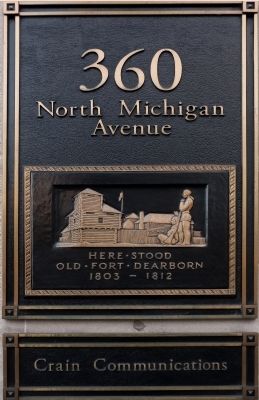
On the street number plate for the Crain Communications building.
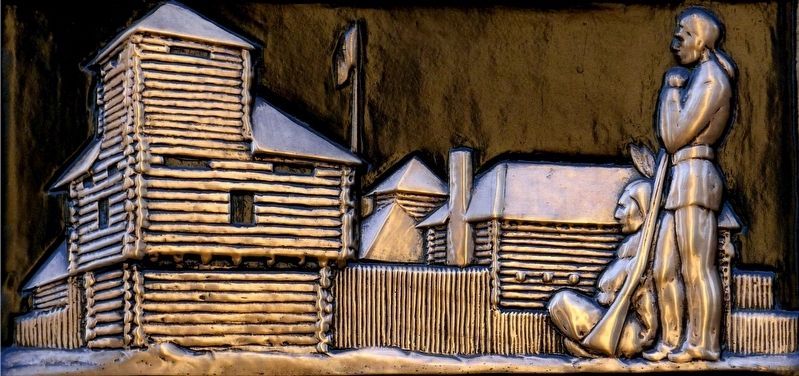
Old • Fort • Dearborn
1803 – 1812
Erected 1932 by The National Society of The Colonial Dames of America in the State of Illinois.
Topics and series. This historical marker is listed in this topic list: War of 1812. In addition, it is included in the The Colonial Dames of America, National Society of series list. A significant historical year for this entry is 1803.
Location. 41° 53.283′ N, 87° 37.486′ W. Marker is in Chicago, Illinois, in Cook County. It is in The Loop District. It is at the intersection of North Michigan Avenue and East Wacker Drive, on the right when traveling south on North Michigan Avenue. Touch for map. Marker is at or near this postal address: 360 N Michigan Ave, Chicago IL 60601, United States of America. Touch for directions.

Regionally, this marker is in Chicago’s Loop. It is also in the American Midwest. Globally, it is in North America, on the Great Lakes, in the Western Hemisphere, in the Western World, and in the Anglosphere. Historically, it finds itself in what was once the Viceroyalty of New France, the territory of the Mississippian Culture, and the Northwest
this page online
Other nearby markers. At least 8 other markers are within walking distance of this marker: 333 North Michigan Building (within shouting distance of this marker); Site of Fort Dearborn (within shouting distance of this marker); Fort Dearborn (within shouting distance of this marker); a different marker also named 333 North Michigan Building (within shouting distance of this marker); Chicago River (within shouting distance of this marker); Rene Robert Cavalier Sieur de La Salle (within shouting distance of this marker); Michigan Avenue Bridge and Wacker Drive Esplanade (within shouting distance of this marker); Regeneration (within shouting distance of this marker). Touch for a list and map of all markers in Chicago.
Also see . . . Wikipedia entry for the Battle of Fort Dearborn. It begins,
The Battle of Fort Dearborn was an engagement between United States troops and Potawatomi Native Americans that occurred on August 15, 1812, near Fort Dearborn in what is now Chicago, Illinois (at that time, wilderness in the Illinois Territory). The battle, which occurred during the War of 1812, followed the evacuation of(Submitted on July 21, 2023.)the fort as ordered by the commander of the United States Army of the Northwest, William Hull. The battle lasted about 15 minutes and resulted in a complete victory for the Native Americans. After the battle, Fort Dearborn was burned down. Some of the soldiers and settlers who had been taken captive were later ransomed.Photographed by Allen C. Browne, November 4, 20122. Old Fort Dearborn MarkerNow the street-number plate on the Crane Communications building.
Additional commentary.
1. Major Amos Stoddard, Commanding Officer, Fort Dearborn, June 30 - September 22, 1808
According to entries in the Orderly Book of the Company of Captain Amos Stoddard, November 1807 - June 1808, Major Amos Stoddard (he was promoted to Major on June 30, 1807) was in command at Fort Adams (40 miles south of Natchez, Wilkerson County, Mississippi) from November 1807 until about June 18, 1808. Prior to that he had been in command at Newport Barracks, Kentucky from approximately January until November 1807. And prior to that, he served as the First Civil Commandant of Upper Louisiana at St. Louis from January 1804 until October 1, 1804. While serving as governor at St. Louis (after transferring the Louisiana territory from Spain to France and from France to the United States over March 9-10, 1804), he assisted the Lewis & Clark expedition and saw the Corp of Discovery off at St. Charles on May 21, 1804. In the fall of 1805, he led a deputation of Indian chiefs to Washington to meet with President Jefferson. Being ill at the time, he took leave for nine months of 1806 before recruiting a new artillery company and heading west to the Mississippi territory.
The following garrison order was recorded in the Orderly Book at Fort Adams on on June 17, 1808:
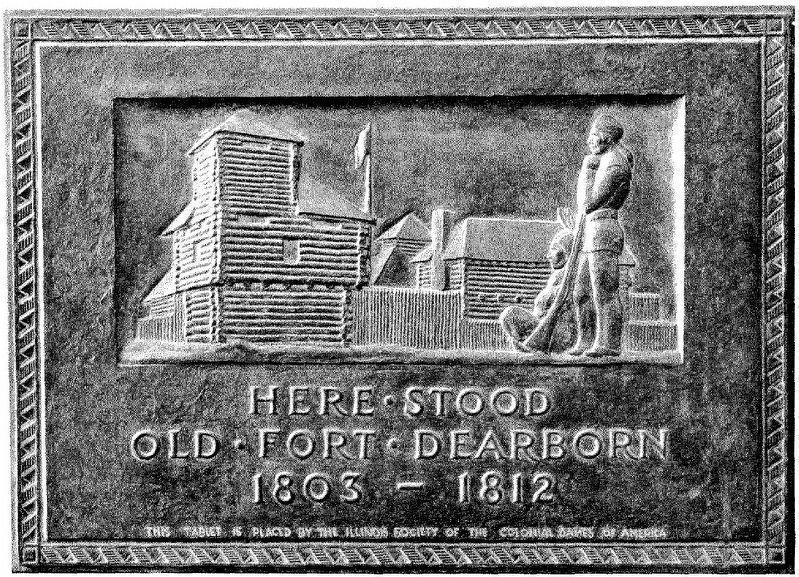
The Troops of this Garrison will be in readiness to move for Fort Dearborn at a moments warning; Lieut Preble is to assume command of the company of Artillerists, to whom Lieut Reed will transferall the necessary books and papers, The soldiers are to take no useless baggage with them, - The Commanding officers of the Companies will make out returns for tents. Tents will be distributed as follows, viz, To Artillerists, 8 tents, To Captain Pikes Company 8 Tents, to Captain Swans Company 9 tents, and to late Captain Lockwoods Company 9 tentsPhotograph from the 1935 sketch “History of the Illinois Society” by Mrs. Paul Blatchford, Page 19, 19353. Old Fort Dearborn Marker in 1935The marker was placed at the corner of Wacker Drive and Michigan Avenue in 1932. This photograph of the original marker was published in a “Historical Sketch of the National Society of the Colonial Dames of America in the State of Illinois” by Mrs. Paul Blatchford in 1935. Compare with photo No. 1 and see Commentary No. 2 for a history of the marker itself. (Fair Use copy)
On July 3rd, the Garrison order entry of the day at Fort Dearborn was:
As tomorrow is imphatically the birthday of our Country, each soldier will Receive one gill of extra whiskey at 12 Oclock, After that day the troops will parade for roll call in their clean Summer uniforms with their arms in good order.
On or about September 28, 1808, Major Amos Stoddard took an extended leave and descended the Mississippi River to the Red River region and the Mississippi territory for the purpose of conducting research for his book, Sketches, Historical and Descriptive, of Louisiana, published in 1812.
Major Amos Stoddard died on May 11, 1813 from tetanus that developed from a shrapnel wound during the siege of Fort Meigs, Ohio during the War of 1812.
Sources:
The Autobiography Manuscript of Major Amos Stoddard,
Photographed by Allen C. Browne, November 4, 2012
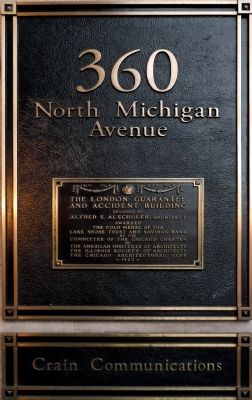
4. 360 North Michigan Avenue
The London Guarantee and Accident Building designed by Alfred S. Alschuler. architect. Awarded the Gold Medal of the Lake Shore Trust and Savings Bank by the Committee of the Chicago Chapter of the American Institute of Architects, The Illinois Society of Architects, The Chicago Architectural Club, 1923.Crain Communications
National Archives, Records of the U.S. Army, War Department, 1st Artillery Regiment 1802-1814, GR-98, E.94,
Orderly Book of the Company of Captain Amos Stoddard, November 1807-June 1808
— Submitted March 18, 2021, by Robert Stoddard of Idyllwild, California.
2. The marker itself has its own history
The bronze tablet shown in photograph No. 2 appears to be quite modern and it is hard to believe that it is the same tablet that was placed on this building in 1932. Well, it is and it isn’t. What you see on photograph No. 2 above is the original 1932 tablet that has been embedded in the newer larger tablet, which likely dates to a more recent refurbishment of the building’s façade.
The original tablet was photographed in 1935 for a publication of the Illinois Chapter of the National Society of Colonial Dames of America, the organization that in 1932 placed the marker on the 1922 building at 360 North Michigan Avenue. That 1935 halftone photograph is reproduced as photograph No. 3 earlier on this page.
If you compare photo No. 3 with photo No. 1 you will notice that everything matches, including its unique border design, except that the legend in small type at the bottom of the original tablet is missing on the present day tablet. That legend read, “This tablet is placed by the Illinois Society of the Colonial Dames of America.”
But a careful examination of the current tablet (click on photo No. 1 to enlarge) shows remnants of the text under the dark brown color. The new tablet has been “oil rubbed,” which means a dark oily product is painted on to protect the bronze, and then rubbed off the high points of the engraving, leaving them the shiny gold color. It appears that the small text was not or could not be rubbed to a shine.
That legend proving the provenance of the tablet is still there. It
Photographed by Allen C. Browne, November 12, 2016
5. Old Fort Dearborn
— Submitted July 19, 2023, by Sean P. Flynn of Oak Park, Illinois.

Photographed by Allen C. Browne, November 4, 2012
6. 360 North Michigan Avenue

Photographed by Allen C. Browne, November 12, 2016
7. London Guarantee & Accident Bldg
Photographed by Allen C. Browne, November 12, 2016
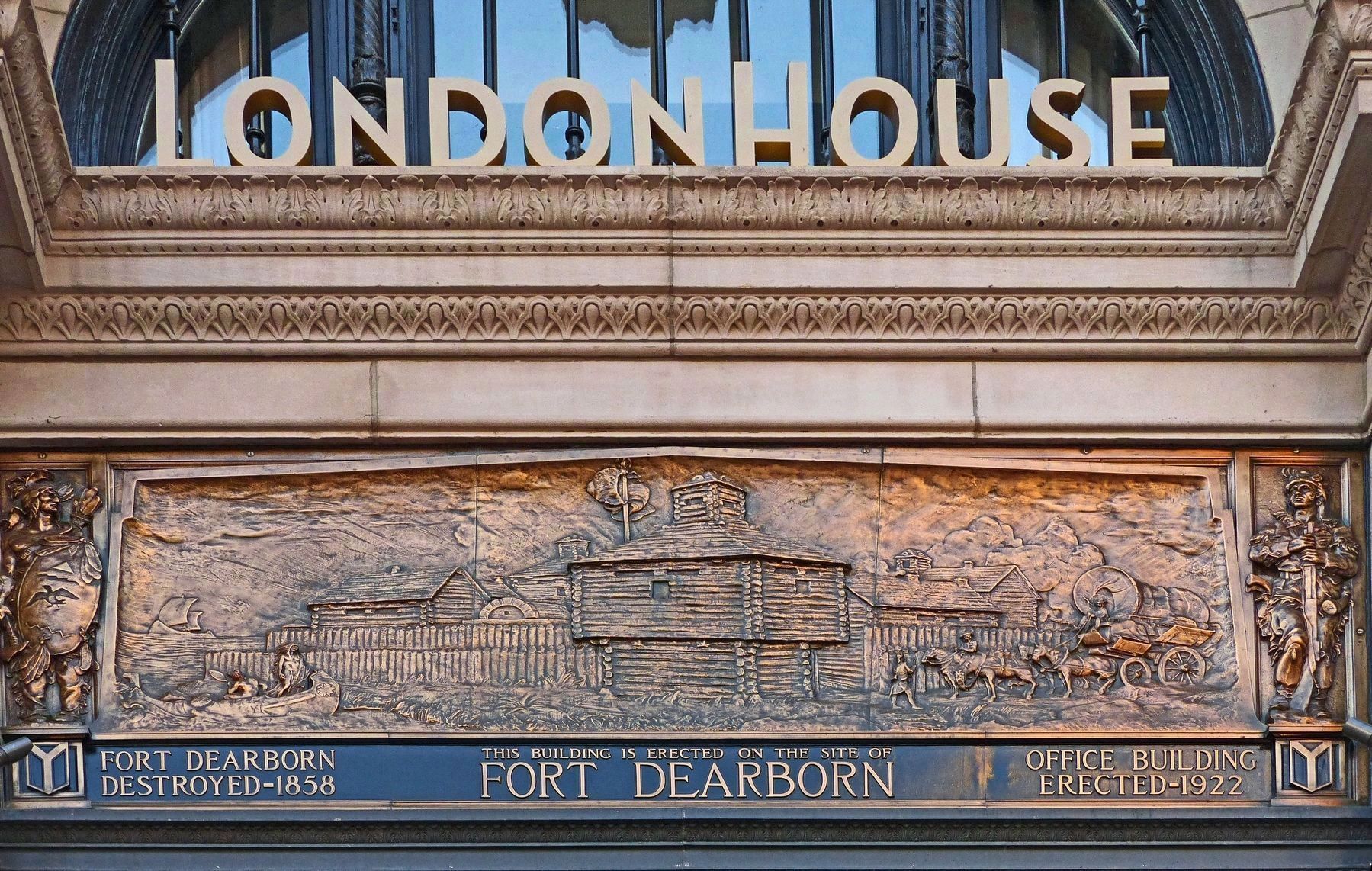
8. London House
Fort Dearborn
Fort Dearborn Destroyed — 1858
Office Building Erected — 1922
circa 1930
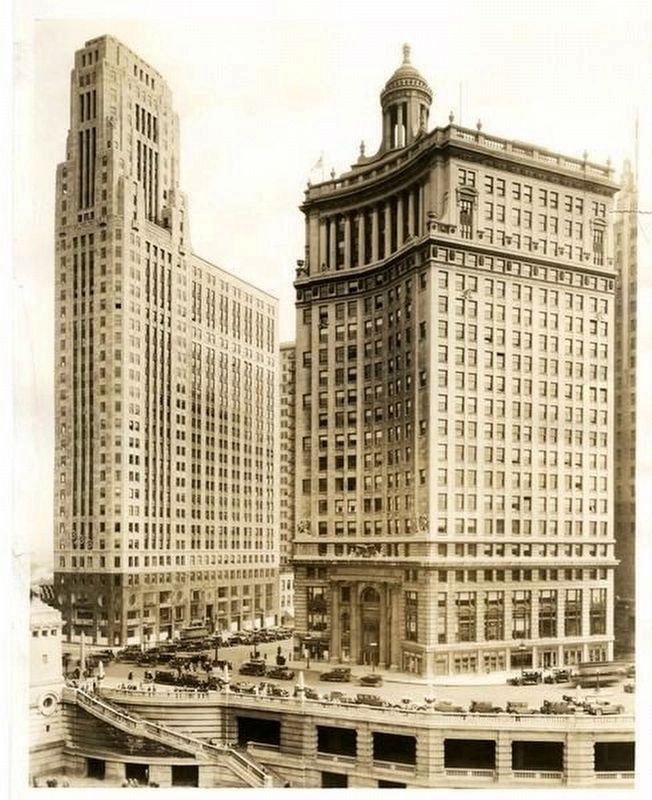
9. 333 North Michigan and the London Guarantee & Accident Building
The Indiana Limestone Photograph Collection was a previously unknown collection of more than 25,000 photographs found in a house owned by the Indiana Limestone Company in Bedford, Indiana. The photos document the use of Indiana limestone in prominent buildings across the United States. This photo, likely from the 1930s, features two famed Chicago buildings constructed of Indiana limestone: the London Guarantee & Accident Building, where Fort Dearborn had sat less than 80 years earlier, and the art-deco 333 North Michigan Avenue across the street.
Credits. This page was last revised on October 31, 2024. It was originally submitted on December 12, 2014, by Allen C. Browne of Silver Spring, Maryland. This page has been viewed 1,530 times since then and 84 times this year. Last updated on July 18, 2023, by Sean P. Flynn of Oak Park, Illinois. Photos: 1, 2. submitted on December 12, 2014, by Allen C. Browne of Silver Spring, Maryland. 3. submitted on July 19, 2023, by J. J. Prats of Powell, Ohio. 4. submitted on December 12, 2014, by Allen C. Browne of Silver Spring, Maryland. 5. submitted on November 19, 2016, by Allen C. Browne of Silver Spring, Maryland. 6. submitted on December 12, 2014, by Allen C. Browne of Silver Spring, Maryland. 7, 8. submitted on November 18, 2016, by Allen C. Browne of Silver Spring, Maryland. 9. submitted on November 9, 2023, by Sean P. Flynn of Oak Park, Illinois. • Devry Becker Jones was the editor who published this page.
