Rione IX Pigna in Roma in Città metropolitana di Roma Capitale, Latium, Rome, Italy — Central Italy (Tyrrhenian Coast)
Pantheon
Roma
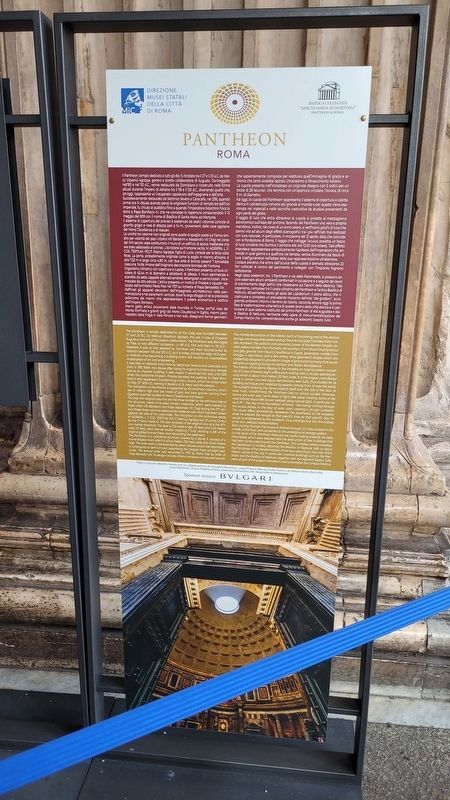
Photographed by James Hulse, June 13, 2023
1. Pantheon Marker

Il Pantheon, tempio dedicato a tutti gli dèi, fu fondato tra il 27 e il 25 a.C. da Marco Vipsanio Agrippa, genero e stretto collaboratore di Augusto. Danneggiato nell'80 e nel 110 d.C., venne restaurato da Domiziano e ricostruito nelle forme attuali durante l'impero di Adriano tra il 118 e il 125 d.C., divenendo quello che, ad oggi, rappresenta un insuperato capolavoro dell'ingegneria e dell'arte. Successivamente restaurato da Settimio Severo e Caracalla, nel 399, quando ormai era in disuso avendo perso le originarie funzioni di tempio ed edificio imperiale, fu chiuso al pubblico fino a quando l'Imperatore bizantino Foca lo donò a Papa Bonifacio IV, che ne concesse la riapertura consacrandolo il 13 maggio del 609 con il nome di Basilica di Santa Maria ad Martyres. I sistema di copertura del pronao è sostenuto da sedici colonne corinzie di granito grigio e rosa di altezza pari a 14 m., provenienti dalle cave egiziane del Mons Claudianus e di Assuan.
Le uniche tre colonne non originali sono quelle di spoglio poste sul fianco sinistro per volontà dei papi Urbano VIII Barberini e Alessandro VII Chigi nel corso del XVII secolo: esse sostituirono il muro di un edificio di epoca medievale che era stato addossato al pronao. L'iscrizione sul frontone recita: M. AGRIPPA.LF. COS. TERTIUM. FECIT (Marco Agrippa, figlio di Lucio, console per la terza volta fece). La porta, probabilmente originale come la soglia in marmo africano, è alta 7,53 m e larga circa 4,90 m, con due ante di bronzo pesanti 7 tonnellate ciascuna. Nulla rimane dell'originaria decorazione bronzea del frontone. Organismo cilindrico con copertura a cupola, il Pantheon presenta un'aula circolare di 43,44 m di diametro e altrettanti di altezza. Il muro perimetrale è scandito da sette cappelle alternativamente rettangolari e semicircolari,
this page online
Marmi giallo antico provenienti dalla Numidia in Tunisia, porfidi rossi dal Monte Porfirete e graniti grigi dal Mons Claudianus in Egitto, marmi pavonazzetto dalla Frigia in Asia Minore e non solo, disegnano forme geometriche sapientemente composte per restituire quell'immagine di grazia e armonia che tanto avrebbe ispirato Umanesimo e Rinascimento italiano. La cupola presenta nell'intradosso un originale disegno con 5 ordini per un totale di 28 lacunari, che termina con un'apertura circolare, l'oculus, di circa 9 m. di diametro.
Ad oggi, la cupola del Pantheon rappresenta il sistema di copertura a calotta sferica in calcestruzzo romano più grande al mondo e per questo viene esaminata nei materiali e nelle tecniche costruttive
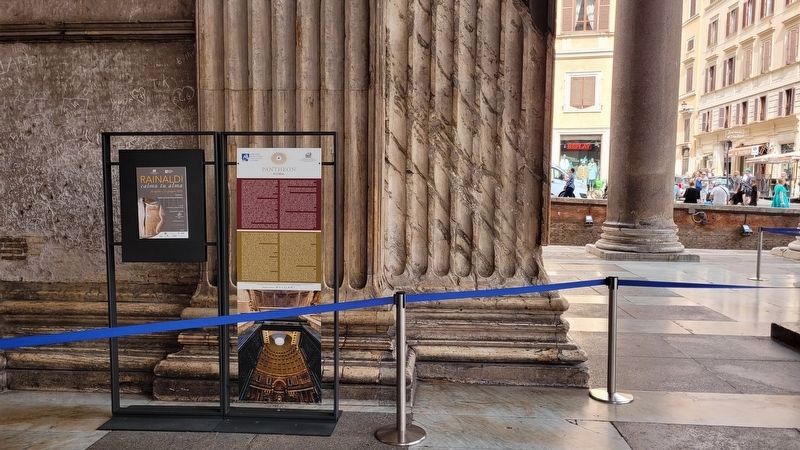
Photographed by James Hulse, June 13, 2023
2. The view of the Pantheon Marker under the portico of the Pantheon at the entrance
Il raggio di luce che entra attraverso la cupola si proietta al mezzogiorno astronomico sull'asse del portone, facendo del Pantheon una vera e propria meridiana. Inoltre, nel corso di un anno solare, si verificano giochi di luce che danno vita ad alcuni degli effetti scenografici tra i più raffinati mai realizzati con luce naturale. In particolare, in occasione del 21 aprile, data che coincide con la fondazione di Roma, il raggio che trafigge l'oculus, proietta un fascio di luce circolare che illumina il portone alle ore 12:00 (ora solare). Tale effetto intendeva rappresentare simbolicamente l'apoteosi dell'imperatore che, entrando in quel giorno e a quell'ora nel tempio, veniva illuminato dal fascio di luce, trasfigurandosi nell'estasi della sua rappresentazione ultraterrena. L'acqua piovana che entra dall'oculus della cupola è drenata attraverso 22 fori collocati al centro del pavimento e collegati con l'impianto fognario sottostante.
Negli spazi posteriori, tra il Pantheon e via della Palombella, si possono ancora osservare alcuni ambienti conformati in occasione e a seguito

Photographed by James Hulse, June 13, 2023
3. Outside view of the Pantheon
The Pantheon, a temple dedicated to all the Gods, was founded between 27 and 25 B.C. by Marcus Vipsanius Agrippa, the son in law of Emperor Augustus and one of his closest collaborators. The Pantheon was damaged by fires

Photographed by James Hulse, June 13, 2023
4. Inside view of the Pantheon
It was later on restored once more by Septimius Severus and Caracalla and then, in 399, fallen into disuse after losing its original functions as a temple and as an imperial building, it was closed. It remained this way until 609, when the byzantine Emperor Phocas donated the building to Pope Boniface IV, who reopened it transforming it into a church, which he consecrated on May 13th 609 A.D, naming it Basilica of St. Mary and the Martyrs. The roof system of the Pronao is supported by 16 Corinthian columns, which are 14 meters high and are made of grey and pink granite coming from Egyptian quarries located at Mons Claudianus and Aswan.
The only non-original columns are the three located on the left-hand side of the structure, made of re-used ancient materials, which were erected by Pope Urban VIII Barberini

Photographed by James Hulse, June 13, 2023
5. The alter of the church in the Pantheon
The Pantheon is a cylindrical structure covered by a dome: it consists of a round shaped room which is 43.44 meters (150 feet) wide and 43.44 meters high. The inner wall is characterized by seven alcoves which are alternatively rectangular or semi-circular, separating the chapels there are eight aedicules. The second order was renovated in 1757 by Paolo Posi by order of Pope Benedict XIV: its design consists of blind windows and squared panels. The marble decorations in the interior, both of the paving and of the vertical facings, are of exquisite workmanship: the precious

Photographed by James Hulse, June 13, 2023
6. The Eye of the Pantheon - Oculus
The hole in the top of the Pantheon is 8 meters in diameter and it is the only source of light for the Pantheon.
The interior of the dome displays in the intrados an original pattern consisting of 5 rows of twenty-eight coffers each, ending with a circular opening (oc- ulus) which is about nine meters (30 feet) wide. It is the largest unreinforced dome in roman concrete (opus caemeticium) ever built, thus studied for its building technique and materials by experts coming from all over the world. The sunlight entering the dome projects itself onto the axis of the door at solar noon, transforming the Pantheon into an actual sundial. Moreover, during one solar year, some plays of light take place creating some of the most refined visual effects ever realized using natural light. In particular, on April 21st - the day of the foundation of Rome - the sunray coming through the oculus shines on the door at solar noon creating a circular sunbeam. This visual effect symbolically represents the apotheosis of the emperor, while he entered the temple at that specific time on that specific day. he would be enlightened by the sunbeam, thus transfiguring into the ecstasy of his own celestial representation.
Rain coming through the oculus is drained through 22 holes located in the middle of the floor and connected to the underground sewage system. On the back of the Pantheon there are the rooms looking towards via della Palombella, which were restored after the destruction of later buildings that had been constructed around the Pantheon. This complex, where nowadays the Lapidarium is located, adjoining the Basilica of Neptune, tells us about the first phase of the transformations of the town planning in this area of the historic centre of the city: in particular, imperial buildings such as the Pantheon and the Basilica of Neptune, together with the adjacent Saepta Julia, were all part of the project intended to monumentalize the Campus Martius.
Erected by Direzione Musei Statali della Città di Roma, Basilica Collegiata "Sancta Maria Ad Martyres" Pantheon di Roma and Bulgari.
Topics. This historical marker is listed in these topic lists: Anthropology & Archaeology • Architecture • Arts, Letters, Music • Religion & Religious Structures. A significant historical date for this entry is April 21, 1757.
Location. 41° 53.941′ N, 12° 28.612′ E. Marker is in Roma, Lazio (Latium, Rome), in Città metropolitana di Roma Capitale. It is in Rione IX Pigna. It is at the intersection of Piazza della Rotonda and Via della Minerva on Piazza della Rotonda. The marker is located under the portico of the Pantheon. Touch for map. Marker is at or near this postal address: Piazza della Rotonda 11, Roma, Lazio 00186, Italy. Touch for directions.

Regionally, it is in Europe, the European Union, the Schengen Area, a coastal Mediterranean country, and the Western World. Historically, it finds itself in what was once the Roman Empire.
Other nearby markers. At least 8 other markers are within walking distance of this marker: Rione III Colonna / Colonna District III (within shouting distance of this marker); Il Municipio di Buenos Aires (within shouting distance of this marker); The Trevi-Pantheon Route (within shouting distance of this marker); Hotel del Sole (within shouting distance of this marker); Pietro Mascagni (within shouting distance of this marker); Lodovico Ariosto (within shouting distance of this marker); Hotel Pantheon (within shouting distance of this marker); Piazza della Rotonda (within shouting distance of this marker). Touch for a list and map of all markers in Roma.
Credits. This page was last revised on November 4, 2025. It was originally submitted on July 26, 2023, by James Hulse of Medina, Texas. This page has been viewed 805 times since then and 64 times this year. Photos: 1, 2, 3, 4, 5, 6. submitted on July 27, 2023, by James Hulse of Medina, Texas.
