South Los Angeles in Los Angeles County, California — The American West (Pacific Coastal)
Second Baptist Church

courtesy City of Los Angeles, circa 2020
1. Second Baptist Church Marker
A Tradition of Faith and Activism
A block west of Central Avenue, radiating from the corner of 24th Street and Griffith Avenue, stands Second Baptist Church, among the most influential of the city's African American faith institutions. The church has had a remarkable history steeped in both spirituality and activism, particularly with regard to civil rights and community development. Established in 1885 in a room over a stable in downtown Los Angeles, the congregation grew as migration in the early 20th century packed the pews with African Americans from Louisiana, Texas, and Arkansas.
Paul Revere Williams, an African American architect, and Norman Foote Marsh designed the building, Second Baptist's third home. The gold-toned brick, Romanesque Revival structure, which opened in January 1926, featured seating for more than 2,000 congregants. It was Williams' first major public commission and one of the few from the black community. According to church history, the congregation's leaders, including Reverend Thomas Lee Griffich, hired an African American real estate agent with a very
this page online
Sanctuary of Service
Through the decades, the church has always combined the sacred and the secular. When the National Association for the Advancement of Colored People (NAACP) held its first West Coast convention in Los Angeles in 1928, delegates attended all-day sessions at Second Baptist. In 1954, the congregation contributed $1,500 to the NAACP Legal Defense Fund to print the briefs used in the U.S. Supreme Court case Brown v. Board of Education.
Church members raised money so that Ralph J. Bunche, the valedictorian of his class at local Thomas Jefferson High School, could attend UCLA. Bunche became a civil rights advocate and United Nations diplomat. He was the first African American to win the Nobel Peace Prize, awarded in 1950 for his negotiation of a ceasefire in the 1948-49 Arab-Israeli conflict. In 1961, Second Baptist parishioners paid for round-trip bus tickets for a dozen Los Angeles-area "Freedom Riders" - eight whites and four African Americans - who traveled to Jackson, Mississippi, to protest Southern states' disregard for
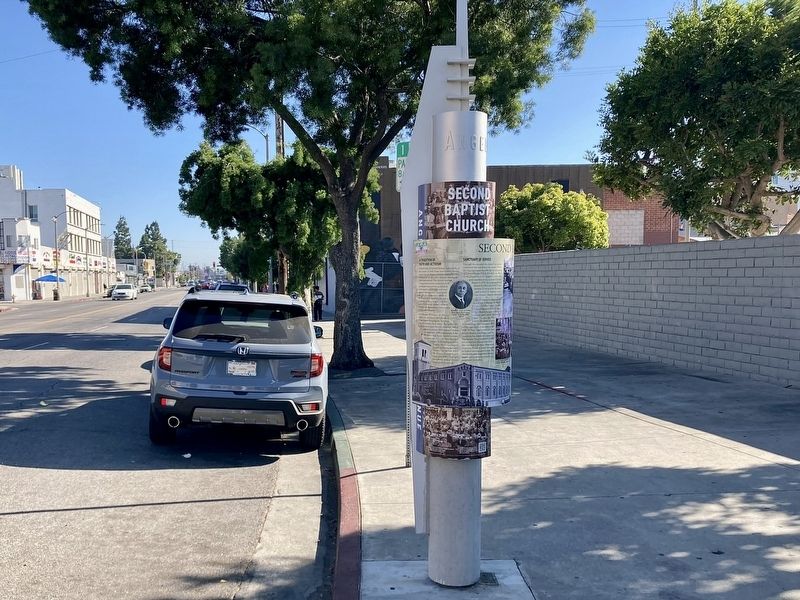
Photographed by Craig Baker, July 4, 2023
2. Second Baptist Church Marker
Second Baptist's congregants included such influential individuals as Lt. Col. Allen Allensworth, U.S. Surgeon General David Satcher, Congresswoman Juanita Millender McDonald, and renowned attorney Johnnie Cochran Jr.
Shouting "Amen!" to Dr. King
In March 1968, parishoners shouted "Amen!" from the church pews after Reverend Dr. Martin Luther King Jr. proclaimed that racism was still a glaring reality and that it was "time for somebody in Washington to say we made a mistake in Vietnam." Just weeks later, he was assassinated in Memphis, Tennessee. King received the Nobel Peace Prize in 1964 for his efforts to end segregation and racial discrimination through civil disobedience and other nonviolent means.
Community Building
East of the church, Second Baptist built two complexes of federally subsidized housing for seniors, Griffith Gardens and Kilgore Manor. The latter is named for longtime pastor Thomas Kilgore Jr., who helped organize the historic

Photographed by Craig Baker, July 7, 2021
3. Second Baptist Church
Located one block west of the marker.
Erected 2020 by City of Los Angeles.
Topics. This historical marker is listed in these topic lists: African Americans • Civil Rights • Religion & Religious Structures. A significant historical month for this entry is January 1926.
Location. 34° 1.228′ N, 118° 15.262′ W. Marker is in Los Angeles, California, in Los Angeles County. It is in South Los Angeles. It is on Central Avenue just south of 24th Street, on the right when traveling south. Touch for map. Marker is at or near this postal address: 2405 S Central Ave, Los Angeles CA 90011, United States of America. Touch for directions.

Regionally, this marker is in the Transverse Ranges. It is also on the American Pacific Coast. Globally, it is in North America, on the Ring of Fire, on the Pacific Rim, in the Western Hemisphere, in the Western World, and in the Anglosphere. Historically, it finds itself in what was once New Spain and also Mexico’s Alta California.
Other nearby markers. At least 8 other markers are within walking distance of this marker: Lincoln Theatre (within shouting distance of this marker); Lincoln Theater (within shouting distance of this marker); Liberty Savings and Loan (about 300 feet away, measured in a direct line); Second Baptist Church of Los Angeles (about 600 feet away); 28th Street YMCA (approx. ¼ mile away); Jack’s Basket Room (approx. 0.4 miles away); Jack’s Chicken Basket (approx. half a mile away); African American Firefighters (approx. 0.6 miles away). Touch for a list and map of all markers in Los Angeles.
Also see . . . Angeles Walk L.A. Self-guided walking tours of historic neighborhoods in Los Angeles. The Second Baptist Church marker is part of the Central Avenue walk. (Submitted on July 28, 2023.)
Credits. This page was last revised on July 20, 2026. It was originally submitted on July 28, 2023, by Craig Baker of Sylmar, California. This page has been viewed 417 times since then and 87 times this year. Photos: 1, 2, 3. submitted on July 28, 2023, by Craig Baker of Sylmar, California.
