Rione X Campitelli in Roma in Città metropolitana di Roma Capitale, Latium, Rome, Italy — Central Italy (Tyrrhenian Coast)
Complesso Santuariale e Domestico Augusteo
⎯⎯⎯
Augustan Sanctuary and Residential Complex

Photographed by James Hulse, June 14, 2023
1. Complesso Santuariale e Domestico Augusteo / Augustan Sanctuary and Residential Complex Marker

this page online
English:
On the summit of the Palatine facing the valley of the Circus Maximus and near the mementos of the founder Romulus kept in the sanctuary of Victoria and Magna Mater, excavations have brought to light the remains of the house of Augustus and the large sanctuary he dedicated to Apollo in 28 BC. The area previously hosted a late Republican residential district (2nd-1st century BC). This was an area of aristocratic houses, with luxurious wall and floor decorations, of which significant remains survive to give us an idea of how the Palatine looked when it was home to Rome's most powerful men. According to ancient authors, Octavian initially lived in one of these houses, chosen for its vicinity to the original

Photographed by James Hulse, June 14, 2023
2. The wide view of the Augustan Sanctuary and Residential Complex Markers
Topics. This historical marker is listed in this topic list: Anthropology & Archaeology.
Location. 41° 53.359′ N, 12° 29.122′ E. Marker is in Roma, Lazio (Latium, Rome), in Città metropolitana di Roma Capitale. It is in Rione X Campitelli. It is at the intersection of Via Sacra and Via Nova on Via Sacra. The marker is located south of the Arch of Titus in the park at Palatine
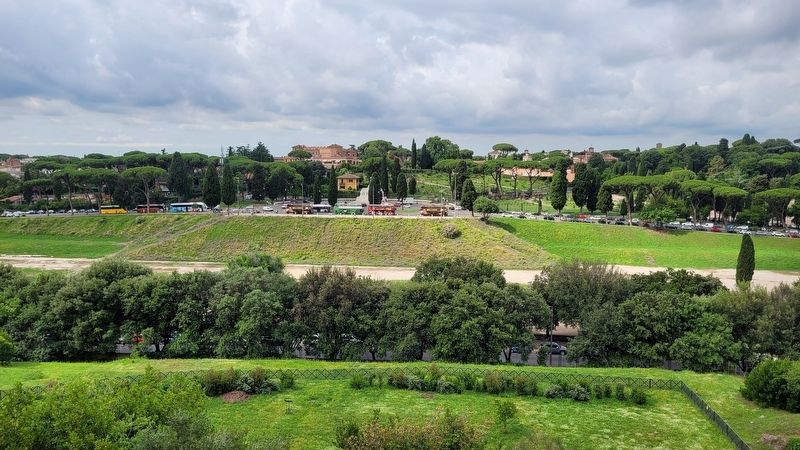
Photographed by James Hulse, June 14, 2023
3. The view of the valley of the Circus Maximus

Regionally, it is in Europe, the European Union, the Schengen Area, a coastal Mediterranean country, and the Western World. Historically, it finds itself in what was once the Roman Empire.
Other nearby markers. At least 8 other markers are within walking distance of this marker: Cisterne Arcaiche / Archaic Cisterns (a few steps from this marker); Casa di Livia / House of Livia (a few steps from this marker); Tempio di Victoria / Temple of Victoria (a few steps from this marker); Tempietto / Small Temple (a few steps from this marker); Ambienti Di Servizio / Service Rooms (within shouting distance of this marker); Palatino: Alle Origini del Sacro / The Palatin Hills: the Origins of the Sacred (within shouting distance of this marker); Tempio della Magna Mater / Temple of Magna Mater (within shouting distance of this marker); Villaggio di Capanne / Hut Village (within shouting distance of this marker). Touch for a list and map of all markers in Roma.
More about this marker. The marker is located in the Parco Archeologico del Colosseo (Roman Forum Archaeological Park) and it does require an entry fee to visit.
Also see . . . Parco Archeologico del Colosseo. Roma Turismo (Submitted on August 2, 2023, by James Hulse of Medina, Texas.)
Credits. This page was last revised on August 2, 2023. It was originally submitted on August 2, 2023, by James Hulse of Medina, Texas. This page has been viewed 255 times since then and 29 times this year. Photos: 1, 2, 3. submitted on August 2, 2023, by James Hulse of Medina, Texas.
