Keokuk in Lee County, Iowa — The American Midwest (Upper Plains)
Chief Keokuk

Photographed by Cajun Scrambler, July 25, 2023
1. Chief Keokuk Marker
Chief Keokuk was born in 1780 near the present location of Rock Island, Illinois. His tribe, the Sauk Indians, joined with the remnants of the Mesquakie tribe (or Fox Indians) to form a community they called Saukenuk not far from where the Rock River joins the Mississippi.
In Keokuk's first battle, when he was still very young, he killed a Sioux Indian, the mortal enemy of the Sauk and Fox tribes, with a spear from horseback. This gave Keokuk great fame in his tribe who were known for their skill fighting on foot but not on horseback. Because he was a skilled horseman and presented a striking figure, Keokuk preferred to be seen on horseback.
By 1832 most of the Sauk and Fox lands east of the Mississippi had been taken over by white settlers. Black Hawk, a member of Keokuk's tribe, wanted the land back, and so he crossed the Mississippi with a number of braves, along with their wives and children. Other members of the Sauk and Fox tribes stayed with Keokuk in Iowa. They stayed because of Keokuk's most famous and memorable speech. In it, he offered to lead his warriors into battle against the Americans,
this page online
The ensuing conflict, known today as the Black Hawk War, resulted in Keokuk becoming the undisputed chief of the Sauk tribe and was recognized as such by the United States government.
Though Chief Keokuk never lived in Keokuk, he is buried here. Keokuk died in Kansas in 1848. In 1883 a monument was erected in his honor, and his bones were brought back from Kansas to be buried under it. In 1913 a statue of Keokuk was installed on top of the monument's base. Interestingly, the statue's sculptor, Nellie Walker, placed on Keokuk's head a feathered Sioux war bonnet, even though the Sauk and the Sioux were bitter enemies.
The town of Keokuk got its name in 1834, just after the Black Hawk War.
Erected by Main Street Keokuk, Inc., Great River Gala.
Topics. This historical marker is listed in this topic list: Indigenous Peoples and Communities. A significant historical year for this entry is 1780.
Location. 40° 23.849′ N,
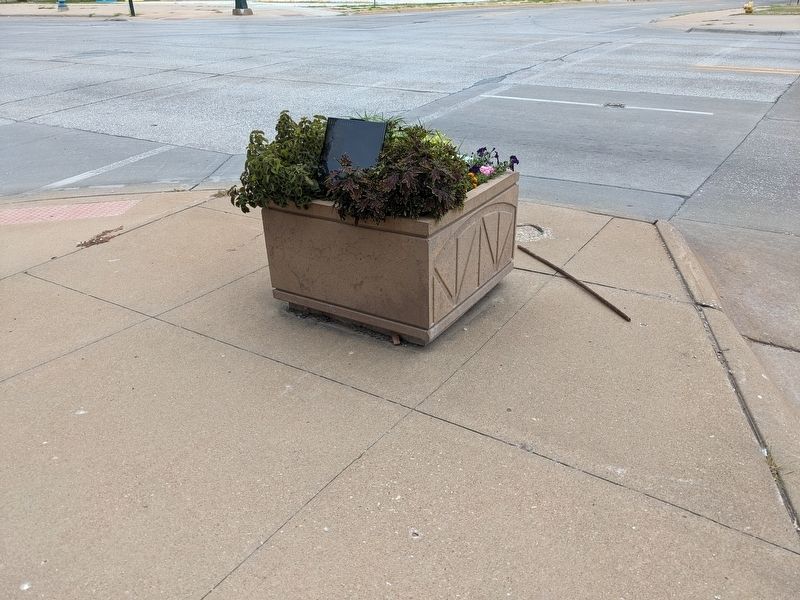
Photographed by Cajun Scrambler, July 25, 2023
2. Chief Keokuk Marker

Regionally, this marker is in Southern Iowa. It is also in the American Midwest, in the Corn Belt, and in the Great River Road Region. Globally, it is in North America, the Western Hemisphere, the Western World, and the Anglosphere. Historically, it finds itself in what was once the Viceroyalty of New France, the territory of the Mississippian Culture, and the Louisiana Purchase.
Other nearby markers. At least 8 other markers are within walking distance of this marker: National Association for Music Education (about 300 feet away, measured in a direct line); First Permanent Jewish House of Worship in Iowa (about 400 feet away); William "Bill" Logan (about 400 feet away); Judge William Logan (about 400 feet away); Burnham and Root (about 400 feet away); Charlotta Gordon Pyles (about 400 feet away); Elsa Maxwell (about 700 feet away); Mary Huiskamp Calhoun Wilkins (about 700 feet away). Touch for a list and map of all markers in Keokuk.
Credits. This page was last revised on August 4, 2023. It was originally submitted on August 4, 2023, by Cajun Scrambler of Assumption, Louisiana. This page has been viewed 671 times since then and 98 times this year. Photos: 1, 2. submitted on August 4, 2023, by Cajun Scrambler of Assumption, Louisiana.
