Rione X Campitelli in Roma in Città metropolitana di Roma Capitale, Latium, Rome, Italy — Central Italy (Tyrrhenian Coast)
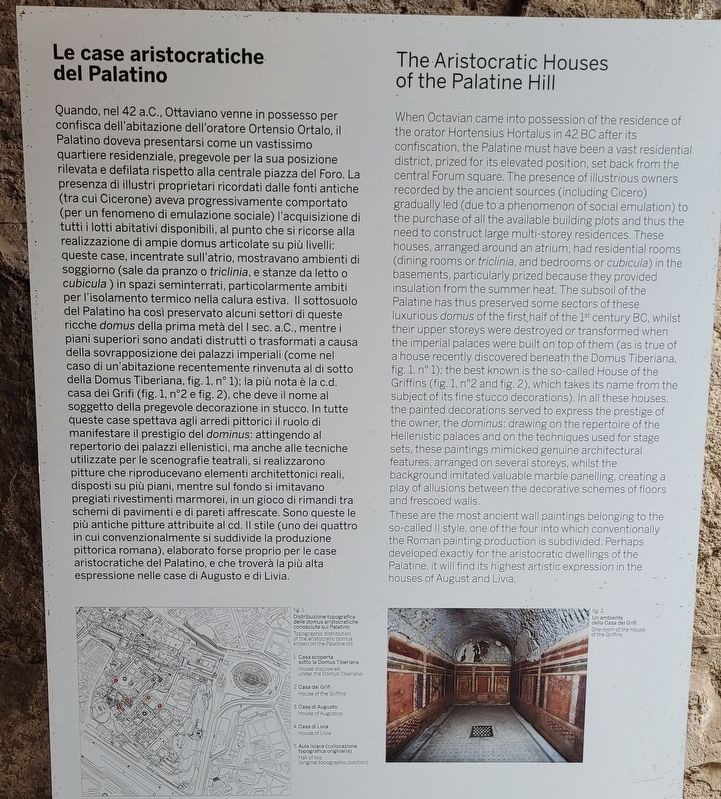
Le case aristocratiche del Palatino
⎯⎯⎯
The Aristocratic Houses of the Palatine Hill
Photographed by James Hulse, June 14, 2023
1. Le case aristocratiche del Palatino / The Aristocratic Houses of the Palatine Hill Marker

this page online
Didascalie
fig. 1 - Distribuzione topografica delle domus aristocratiche conosciute sul Palatino
1. Casa scoperta sotto la Domus Tiberiana
2. Casa del Grifi
3. Casa di Augusto
4. Casa di Livia
5. Aula Isiaca (collocazione topografica originaria)
fig. 2 - Un ambiente della Casa dei Grifi
When
Photographed by James Hulse, June 14, 2023
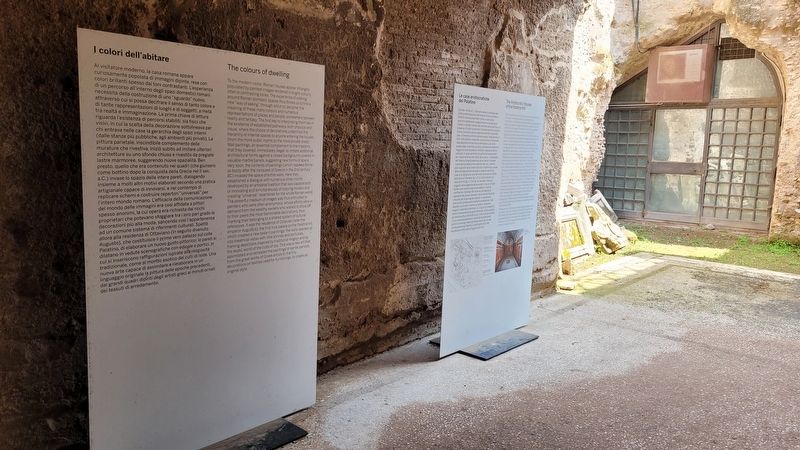
2. The Aristocratic Houses of the Palatine Hill Marker is the right marker of the two markers
Photographed by James Hulse, June 14, 2023
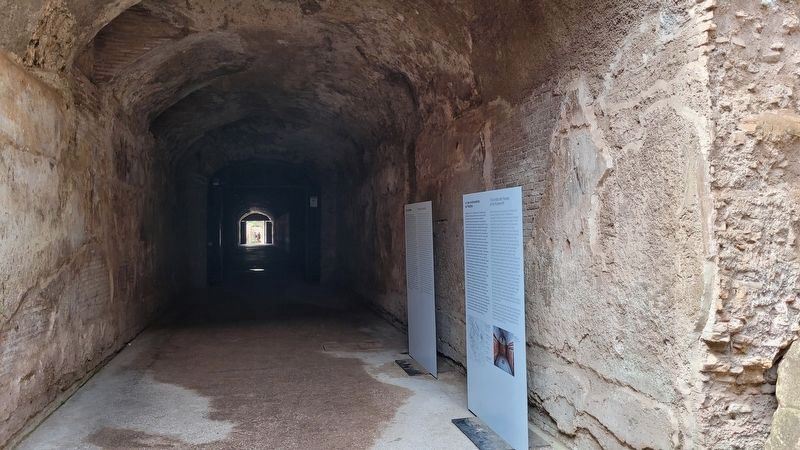
3. The view of the markers and the south entrance to the tunnel
These are the most ancient wall paintings belonging to the so-called II style, one of the four into which conventionally the Roman painting production is subdivided. Perhaps developed exactly for the aristocratic dwellings of the Palatine, it will find its highest artistic expression in the houses of August and Livia.
Captions
fig. 1 - Topographic distribution of the aristocratic domus known on the Palatine hill
1. House discovered under the Domus Tiberianal
2. House of the Griffins
3. House of Augustus
4. House of Livia
5. Hall of Isis (original topographic position)
fig. 2 - One room of the House of the Griffins
Topics. This historical marker is listed in these topic lists: Anthropology & Archaeology • Arts, Letters, Music. A significant historical year for this entry is 42 BCE.
Location. 41° 53.41′ N, 12° 29.217′ E. Marker is in Roma, Lazio (Latium, Rome), in Città metropolitana di Roma Capitale. It is in Rione X Campitelli. It is at the intersection of Via Sacra and Via Nova on Via Sacra. The marker is located south of the Arch of Titus in the tunnels under the Palatine Hill. Touch for map. Marker is in this post office area: Roma, Lazio 00186, Italy. Touch for directions.

Regionally, it is in Europe, the European Union, the Schengen Area, a coastal Mediterranean country, and the Western World. Historically, it finds itself in what was once the Roman Empire.
Other nearby markers. At least 8 other markers are within walking distance of this marker: I colori dell'abitare / The colours of dwelling (here, next to this marker); I giardini del XIX secolo / The gardens of the 19th century (a few steps from this marker); Palatino: Il Giardino dei Farnese / The Palatin Hills: the Farnese Garden (a few steps from this marker); Neronian Cryptoporticus / Criptoportico Neroniano (a few steps from this marker); Giacomo Boni sul Palatino / Giacomo Boni on the Palatine (within shouting distance of this marker); Le Rose del Viridarium / The Roses of the Viridarium (within shouting distance of this marker); Dal collezionismo all'archeologia / From collecting to archaeology (within shouting distance of this marker); Le ragioni dell'archeologia / The development of archaeology (within shouting distance of this marker). Touch for a list and map of all markers in Roma.
More about this marker. The marker is located in the Parco Archeologico del Colosseo (Roman Forum Archaeological Park) and it does require an entry fee to visit.
Also see . . . Parco Archeologico del Colosseo. Roma Turismo (Submitted on August 5, 2023, by James Hulse of Medina, Texas.)
Credits. This page was last revised on August 8, 2023. It was originally submitted on August 4, 2023, by James Hulse of Medina, Texas. This page has been viewed 222 times since then and 31 times this year. Photos: 1, 2, 3. submitted on August 6, 2023, by James Hulse of Medina, Texas.
