Pratt in Pratt County, Kansas — The American Midwest (Upper Plains)
McDonnell Douglas F-4C
"Phantom II"

Photographed by Cosmos Mariner, July 24, 2023
1. McDonnell Douglas F-4C Marker
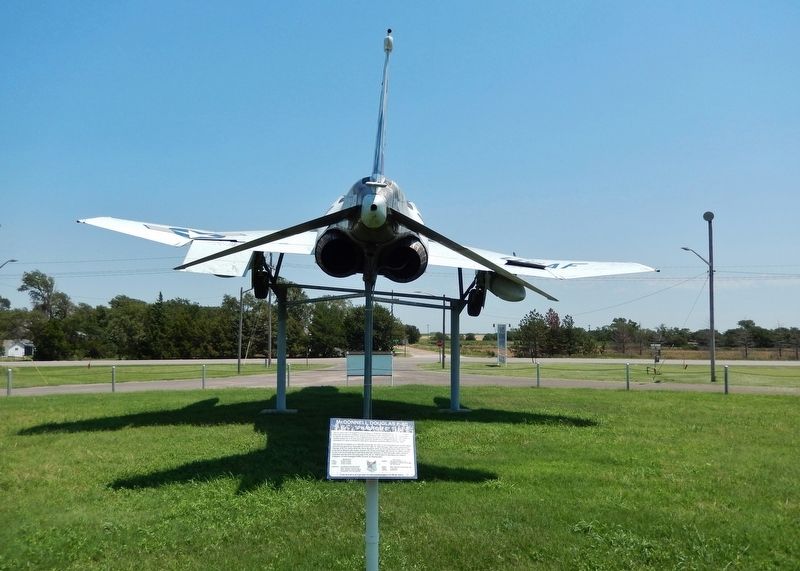
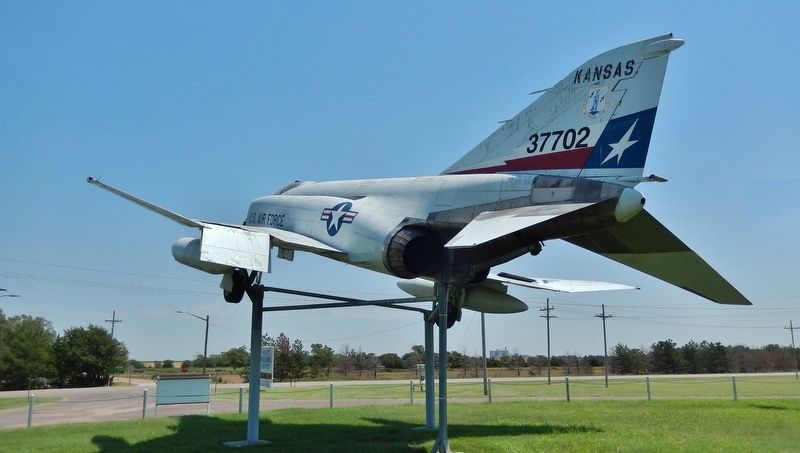
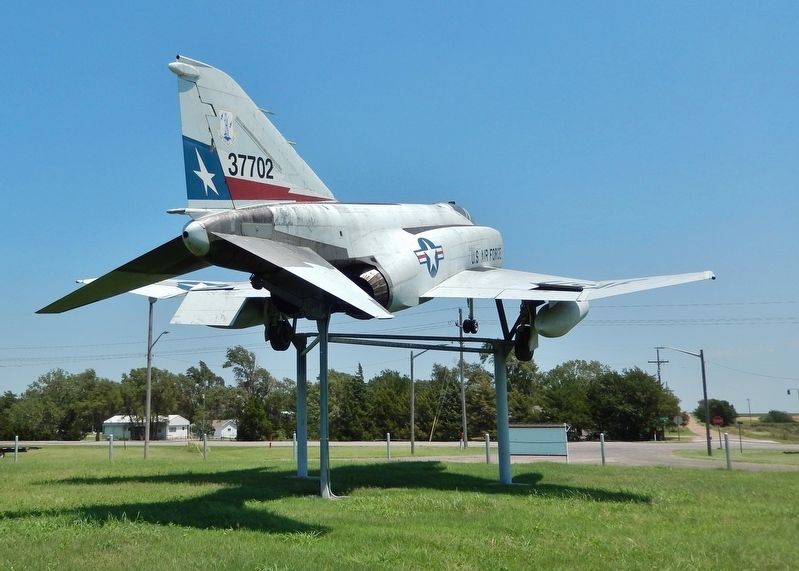
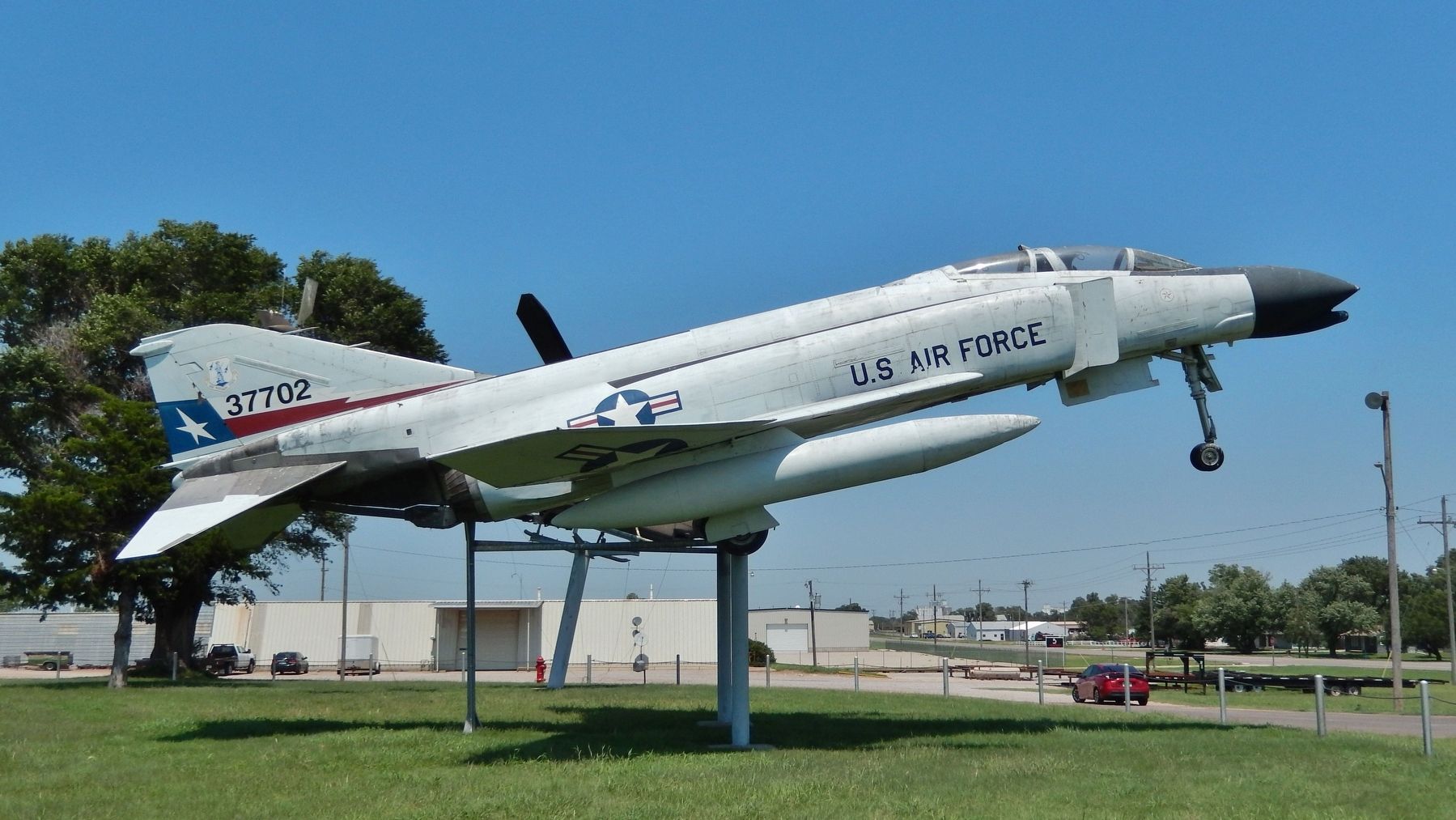
The F-4 was first developed for the US Navy in 1958 and entered service in 1961. In 1963, the USAF received a modified version of the Navy F-4B, called the F-4C. It was equipped to deliver an assortment of air-to-ground and air-to-air missiles, rockets, bombs, mines, or nuclear weapons. A 20 mm gun pod could be carried on a centerline pylon. The crew consisted of a pilot in the front seat and a weapons systems officer in the rear seat.
The aircraft on display is a F-4C(GF), Serial No. 63-7702. It was manufactured by McDonald Aircraft and gained by the USAF on 9 Feb 1965. In 1965 through 1967 it was stationed at George AFB, CA, Nellis AFB, NV, Davis Monthan AFB, AZ and Little Rock AFB, AR. In 1968 it served at Misawa AB, Japan, Kunsan AB, Korea and Taegu AB, Korea. In 1969 it served in the 12th Tactical Wing at Cam Ranh Bay AB, Vietnam. In 1970 through 1984, stations included George AFB, CA and Luke AFB, AZ. In 1985 it went to the Naval Air Station, Ellington, TX and Sheppard AFB, TX prior to display here.
Length: 58 feet, 2 inches
Height: 16 feet, 2 inches
Armament: (Air Defense role) One
this page online
Speed: Max 1,400 mph; Cruising 590 mph
Range: 1,750 miles
Ceiling: 59,600 feet
This aircraft is on loan from the National Museum of the US Air Force.
Topics. This historical marker is listed in these topic lists: Air & Space • War, Cold • War, Vietnam. A significant historical date for this entry is February 9, 1965.
Location. 37° 42.27′ N, 98° 44.401′ W. Marker is in Pratt, Kansas, in Pratt County. It can be reached from the intersection of U.S. 281 and Northeast 40th Street (Flint Road), on the left when traveling north. Marker is located in front of the B-29 All Veterans Memorial on the grounds of Pratt Regional Airport (the former Pratt Army Air Field). Touch for map. Marker is at or near this postal address: 40131 Barker Avenue, Pratt KS 67124, United States of America. Touch for directions.

Regionally, this marker is in Central Kansas. It is also in the American Midwest, in the Corn Belt, on the prairies, and on the Southern Plains. Globally,
Photographed by Cosmos Mariner, July 24, 2023
2. McDonnell Douglas F-4C Marker
Other nearby markers. At least 8 other markers are within walking distance of this marker: Bell AH-1F Cobra Helicopter (a few steps from this marker); Northrop AT-38B "Talon" (a few steps from this marker); Welcome to Historical World War II Pratt Army Airfield (within shouting distance of this marker); B-29 All Veterans Memorial (within shouting distance of this marker); Pratt Army Air Field (within shouting distance of this marker); 45th Bombardment Squadron (VH) Honored Dead (within shouting distance of this marker); 29th Bomb Group (within shouting distance of this marker); 58th Bomb Wing (within shouting distance of this marker). Touch for a list and map of all markers in Pratt.
Also see . . .
1. McDonnell Douglas F-4 Phantom II (Wikipedia). Excerpt:
American tandem two-seat, twin-engine, all-weather, long-range supersonic jet interceptor and fighter-bomber originally developed by McDonnell Aircraft for the United States Navy. Proving highly adaptable, it(Submitted on August 5, 2023, by Cosmos Mariner of Cape Canaveral, Florida.)entered service with the Navy in 1961 before it was adopted by the United States Marine Corps and the United States Air Force, and by the mid-1960s it had become a major part of their air arms. Phantom production ran from 1958 to 1981 with a total of 5,195 aircraft built, making it the most produced American supersonic military aircraft in history, and cementing its position as a signature combat aircraft of the Cold War.Photographed by Cosmos Mariner, July 24, 20233. McDonnell Douglas F-4C "Phantom II"
2. McDonnell F-4C Phantom II. Excerpt:
As the preeminent American combat aircraft of the 1960s, it fulfilled the roles of interceptor, air superiority fighter, tactical bomber, and reconnaissance aircraft. The F-4C version was developed specifically for the Air Force and was externally similar to the Navy F-4B, including the tailhook. Differences included full dual controls, low pressure tires and deeper wheel wells, anti-skid braking, revised radar systems, and a refueling boom receptacle.(Submitted on August 5, 2023, by Cosmos Mariner of Cape Canaveral, Florida.)
Photographed by Cosmos Mariner, July 24, 2023
4. McDonnell Douglas F-4C "Phantom II"
Photographed by Cosmos Mariner, July 24, 2023
5. McDonnell Douglas F-4C "Phantom II"
Credits. This page was last revised on August 5, 2023. It was originally submitted on August 5, 2023, by Cosmos Mariner of Cape Canaveral, Florida. This page has been viewed 180 times since then and 33 times this year. Photos: 1, 2, 3, 4, 5. submitted on August 5, 2023, by Cosmos Mariner of Cape Canaveral, Florida.
