Charleston in Kanawha County, West Virginia — The American South (Appalachia)
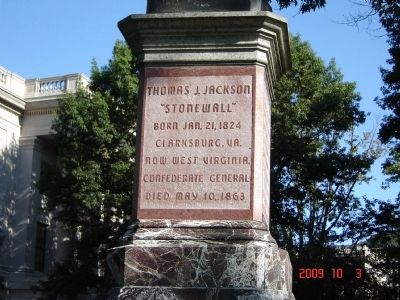
Thomas J. Jackson
"Stonewall"
Photographed by Michael Sean Nix, October 3, 2009
1. South Side, Thomas J. Jackson Marker
[South Side]
Clarksburg, VA.
Now West Virginia,
Confederate General
Died May 10, 1863
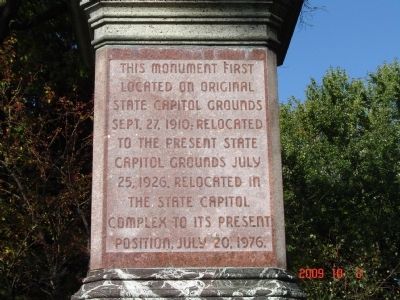
[East Side]
This monument first located on original state capitol grounds Sept. 27, 1910; relocated to the present state capitol grounds July 25, 1926. Relocated in the state capitol complex to its present position, July 20, 1976.
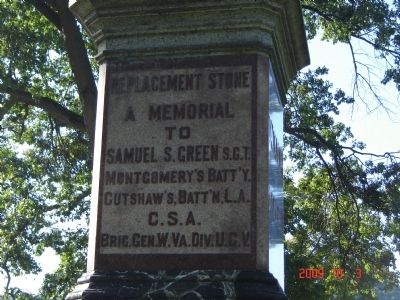
[North Side]
A memorial to Samuel S. Green S.G.T. Montgomery's
Batt'y, Cutshaw's, Batt'n, L.A. C.S.A.
Brig. Gen. W.VA. Div. U.C.V.
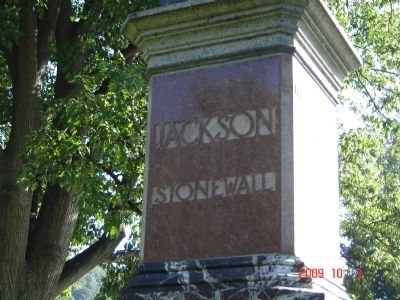
[West Side]
Stonewall
Erected as a
memorial
to the
Confederate
soldiers
1861-1865
by
Charleston
chapter
no. 151
United Daughters
of the Confederacy.
Erected 1910.
Topics and series. This historical marker is listed in this topic list: War, US Civil. In addition, it is included in the United Daughters of the Confederacy series list. A significant historical month for this entry is May 1856.
Location. 38° 20.127′ N, 81° 36.675′ W. Marker is in Charleston, West Virginia, in Kanawha County. It is at the intersection of Kanawha Boulevard and California Avenue, on the left when traveling east on Kanawha Boulevard. Marker located
this page online

Regionally, this marker is in the American South, specifically in the Upper South, in Appalachia, and specifically in Southern Appalachia. Globally, it is in North America, the Western Hemisphere, the Western World, and the Anglosphere. Historically, it finds itself in what was once the territory of the Mississippian Culture.
Other nearby markers. At least 8 other markers are within walking distance of this marker: The New Deal In Your Community (within shouting distance of this marker); State Capitol (about 400 feet away, measured in a direct line); Abraham Lincoln Walks At Midnight (about 400 feet away); Abraham Lincoln (about 400 feet away); Zero Mile Stone (about 400 feet away); West Virginia Home Guards (about 600 feet away); Dedicated to You, A Free Citizen in a Free Land (about 700 feet away); The Restoration Chestnut (about 700 feet away). Touch for a list and map of all markers in Charleston.
Regarding Thomas J. Jackson. The statue was commissioned and erected by the
Photographed by Michael Sean Nix, October 3, 2009
2. Thomas J. Jackson Marker
East Side
Confederacy. The marble for the base was quarried at Genoa; the bronze statue cast in Italy. A replacement stone was later added to the statue in memory of Brigadier General Samuel Green, who was a West Virginian fighting for the Confederacy during the Civil War. This monument was first placed on the lawn of the Old Capitol Building. The Old Capitol Building burned in Jan. 1921 and the monument was relocated on July 25, 1926 to the grounds of the new Capitol, then under construction. In 1976, it was relocated to its current site on the new Capitol grounds. At that time, the statue was restored and turned on its bronze plinth to face Kanawha Boulevard. It now faces away from the original stone base inscription.
Smithsonian American Art Museum Control Number Inventory of American Sculpture 76005913
Photographed by Michael Sean Nix, October 3, 2009
3. Thomas J. Jackson Marker
North Side
Photographed by Michael Sean Nix, October 3, 2009
4. Thomas J. Jackson Marker
West Side
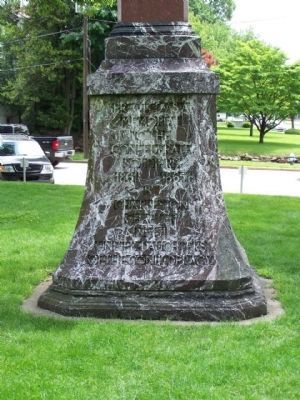
Photographed by Mike Stroud, May 18, 2011
5. Thomas J. Jackson Marker, west side UDC tribute
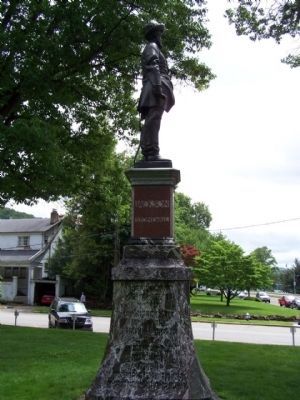
Photographed by Mike Stroud, May 18, 2011
6. Thomas J. Jackson Marker, west side
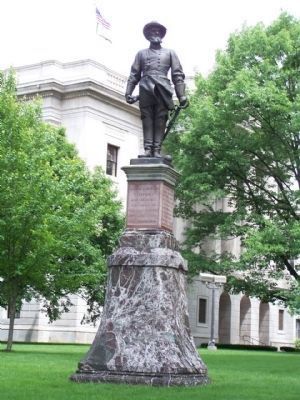
Photographed by Mike Stroud, May 18, 2011
7. Thomas J. Jackson , Artist: Sir Moses Jacob Ezekiel , 1844-1917, sculptor.
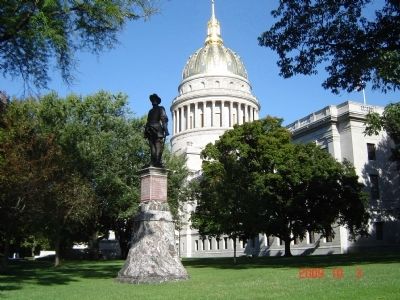
Photographed by Michael Sean Nix, October 3, 2009
8. Thomas J. Jackson Marker
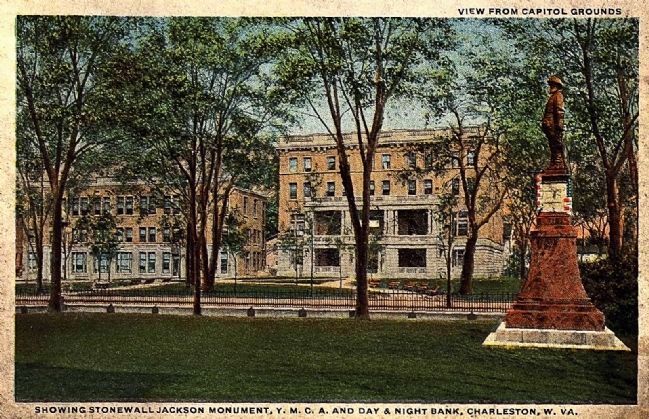
Photographed by S. Spencer Moore, Co., circa 1917
9. View from Capitol Grounds Showing Stonewall Jackson Monument, Y.M.C.A and Day & Night Bank
Historical postcard view showing the monument in its original location.
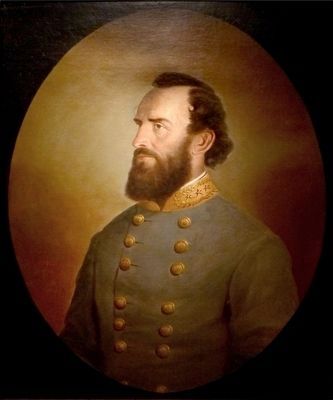
Photographed by Allen C. Browne, February 16, 2015
10. Thomas Jonathan Jackson
This 1864 portrait of Thomas J. Jackson by J. W. King hangs in the National Portrait Gallery in Washington, DC.
“At the First Battle of Manassas in July 18th, the unrelenting vigor with which Confederate General Thomas Jonathan Jackson held his position inspired a general nearby to rally his troops with the cry, ‘There is Jackson standing like a stone wall.’ From that moment on, he was known as ‘Stonewall’ Jackson, a name that he repeatedly lived up to, fighting under the command of General Robert E. Lee.
The deeply religious Jackson believed intensely in the righteousness of the southern cause, and a key to his success was his ability to instill his own fighting fervor in his men. One of his most brilliant victories came at Chancellorsville in the spring of 1863. Tragically for Jackson and the South, this would prove to be his last battle, as he died of wounds accidentally inflicted by his own men.” — National Portrait Gallery
“At the First Battle of Manassas in July 18th, the unrelenting vigor with which Confederate General Thomas Jonathan Jackson held his position inspired a general nearby to rally his troops with the cry, ‘There is Jackson standing like a stone wall.’ From that moment on, he was known as ‘Stonewall’ Jackson, a name that he repeatedly lived up to, fighting under the command of General Robert E. Lee.
The deeply religious Jackson believed intensely in the righteousness of the southern cause, and a key to his success was his ability to instill his own fighting fervor in his men. One of his most brilliant victories came at Chancellorsville in the spring of 1863. Tragically for Jackson and the South, this would prove to be his last battle, as he died of wounds accidentally inflicted by his own men.” — National Portrait Gallery
Credits. This page was last revised on September 12, 2022. It was originally submitted on October 5, 2009, by Michael Sean Nix of Spartanburg, South Carolina. This page has been viewed 2,277 times since then and 133 times this year. Photos: 1, 2, 3, 4. submitted on October 5, 2009, by Michael Sean Nix of Spartanburg, South Carolina. 5, 6, 7. submitted on May 19, 2011, by Mike Stroud of Bluffton, South Carolina. 8. submitted on October 5, 2009, by Michael Sean Nix of Spartanburg, South Carolina. 9. submitted on November 1, 2014. 10. submitted on September 1, 2015, by Allen C. Browne of Silver Spring, Maryland. • Craig Swain was the editor who published this page.
