Rione X Campitelli in Roma in Città metropolitana di Roma Capitale, Latium, Rome, Italy — Central Italy (Tyrrhenian Coast)
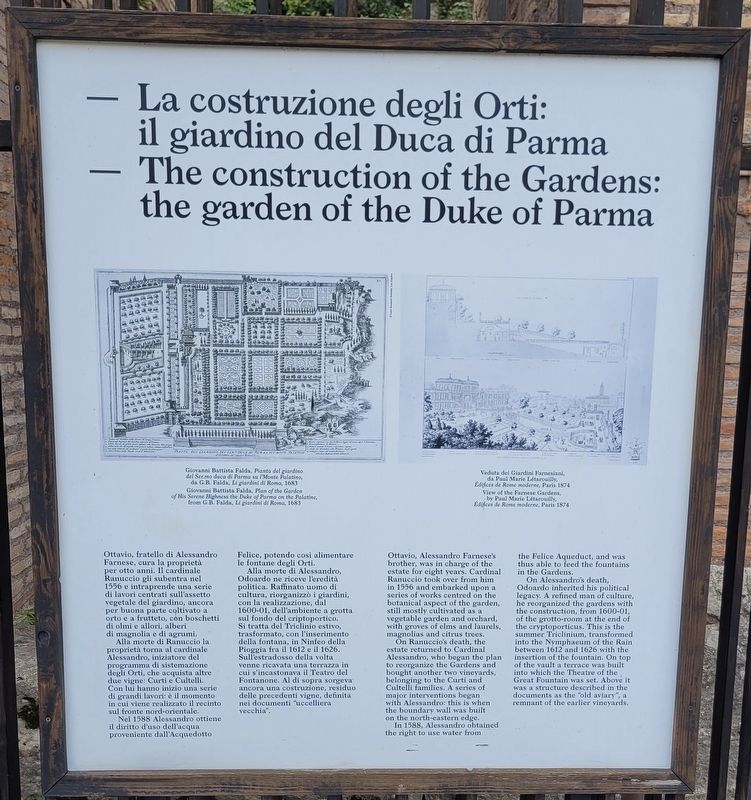
La costruzione degli Orti: il giardino del Duca di Parma
The construction of the Gardens: the garden of the Duke of Parma
Photographed by James Hulse, June 14, 2023
1. La costruzione degli Orti: il giardino del Duca di Parma Marker

Alla morte di Ranuccio la proprietà torna al cardinale Alessandro, iniziatore del programma di sistemazione degli Orti, che acquista altre due vigne: Curti e Cultelli. Con lui hanno inizio una serie di grandi lavori: è il momento in cui viene realizzato il recinto sul fronte nord-orientale.
Nel 1588 Alessandro ottiene il diritto d'uso dell'acqua proveniente dall'Acquedotto Felice, potendo così alimentare le fontane degli Orti.
Alla morte di Alessandro, Odoardo ne riceve l'eredità politica. Raffinato uomo di cultura, riorganizzò i giardini, con la realizzazione, dal 1600-01, dell'ambiente a grotta sul fondo del criptoportico. Si tratta del Triclinio estivo, trasformato, con l'inserimento della fontana, in Ninfeo della Pioggia fra il 1612 e il 1626. Sull'estradosso della volta venne ricavata una terrazza
this page online
Didascalie
Giovanni Battista Falda, Pianta del giardino del Ser.mo duca di Parma su l'Monte Palatino, da G.B. Falda, Li giardini di Roma, 1683
Veduta dei Giardini Farnesiani, da Paul Marie Létarouilly, Édifices de Rome moderne, Paris 1874
Ottavio, Alessandro Farnese's brother, was in charge of the estate for eight years. Cardinal Ranuccio took over from him in 1556 and embarked upon a series of works centred on the botanical aspect of the garden, still mostly cultivated as a vegetable garden and orchard, with groves of elms and laurels, magnolias and citrus trees.
On Ranuccio's death, the estate returned to Cardinal Alessandro, who began the plan to reorganize the Gardens and bought another two vineyards, belonging to the Curti and Cultelli families. A series of major interventions began with Alessandro: this is when the boundary wall was built on the north-eastern edge.
In 1588, Alessandro obtained the right to use water from the Felice Aqueduct,

Photographed by James Hulse, June 14, 2023
2. La costruzione degli Orti: il giardino del Duca di Parma Marker
On Alessandro's death, Odoardo inherited his political legacy. A refined man of culture, he reorganized the gardens with the construction, from 1600-01, of the grotto-room at the end of the cryptoporticus. This is the summer Triclinium, transformed into the Nymphaeum of the Rain between 1612 and 1626 with the insertion of the fountain. On top of the vault a terrace was built into which the Theatre of the Great Fountain was set. Above it was a structure described in the documents as the "old aviary", a remnant of the earlier vineyards.
Captions
Giovanni Battista Falda, Plan of the Garden of His Serene Highness the Duke of Parma on the Palatine, from G.B. Falda, Li giardini di Roma, 1683
View of the Farnese Gardens, by Paul Marie Létarouilly, Édifices de Rome moderne, Paris 1874
Topics. This historical marker is listed in these topic lists: Anthropology & Archaeology • Architecture • Horticulture & Forestry. A significant historical year for this entry is 1556.
Location. 41° 53.445′ N, 12° 29.259′ E. Marker is in Roma, Lazio (Latium, Rome), in Città metropolitana

Photographed by James Hulse, June 14, 2023
3. The Marker is the left marker of the two markers

Regionally, it is in Europe, the European Union, the Schengen Area, a coastal Mediterranean country, and the Western World. Historically, it finds itself in what was once the Roman Empire.
Other nearby markers. At least 8 other markers are within walking distance of this marker: La costruzione degli Orti: uccelliere e catene d'acqua (here, next to this marker); Buildings Opening Onto The Via Nova (a few steps from this marker); La riscoperta dell'antico: gli architetti / The rediscovery of antiquity: architects (a few steps from this marker); Il Casino del Belvedere e il giardino segreto / The Belvedere Lodge and the Secret Garden (a few steps from this marker); Il Teatro di ingresso / The entrance Theatre (a few steps from this marker); Il recinto con il suo portale / The boundary wall and its entrance (a few steps from this marker); Ritratto di famiglia / Portrait of a family (a few steps from this marker); L'ascesa dei Farnese / The rise of the Farnese (within shouting distance of this marker). Touch for a list and map of all markers in Roma.
More about this marker. The marker is located in the Parco Archeologico del Colosseo (Roman Forum Archaeological Park) and it does require an entry fee to visit.
Also see . . .
1. Parco Archeologico del Colosseo. Roma Turismo (Submitted on August 16, 2023, by James Hulse of Medina, Texas.)
2. Farnese Gardens. Wikipedia (Submitted on August 16, 2023, by James Hulse of Medina, Texas.)
Credits. This page was last revised on August 16, 2023. It was originally submitted on August 16, 2023, by James Hulse of Medina, Texas. This page has been viewed 164 times since then and 12 times this year. Photos: 1, 2, 3. submitted on August 16, 2023, by James Hulse of Medina, Texas.
