Rione X Campitelli in Roma in Città metropolitana di Roma Capitale, Latium, Rome, Italy — Central Italy (Tyrrhenian Coast)
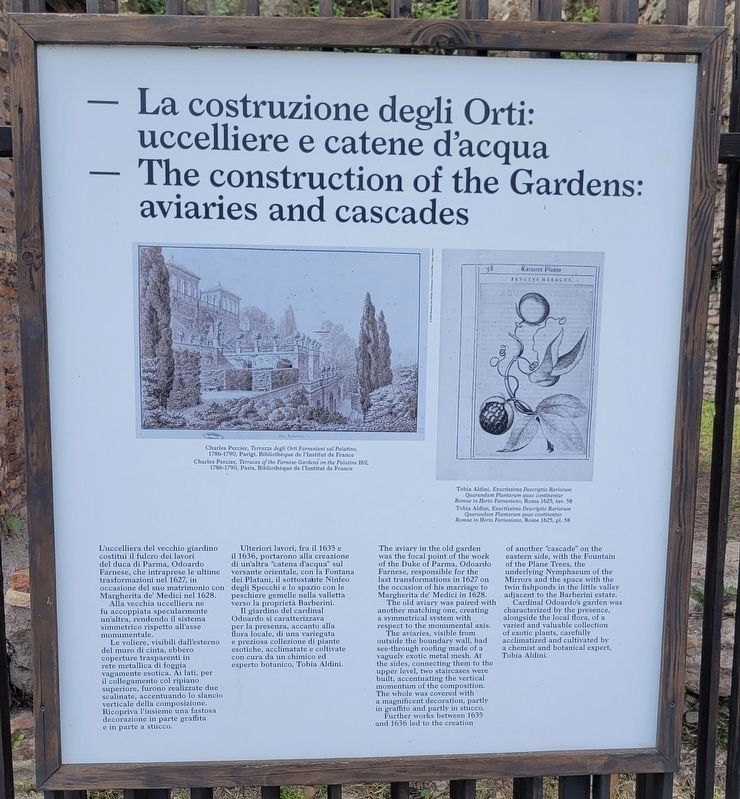
La costruzione degli Orti: uccelliere e catene d'acqua
The construction of the Gardens: aviaries and cascades
Photographed by James Hulse, June 14, 2023
1. La costruzione degli Orti: uccelliere e catene d'acqua Marker

Alla vecchia uccelliera ne fu accoppiata specularmente un'altra, rendendo il sistema simmetrico rispetto all'asse monumentale.
Le voliere, visibili dall'esterno del muro di cinta, ebbero coperture trasparenti in rete metallica di foggia vagamente esotica. Ai lati, per il collegamento col ripiano superiore, furono realizzate due scalinate, accentuando lo slancio verticale della composizione. Ricopriva l'insieme una fastosa decorazione in parte graffita e in parte a stucco.
Ulteriori lavori, fra il 1635 e il 1636, portarono alla creazione di un'altra "catena d'acqua" sul versante orientale, con la Fontana dei Platani, il sottostante Ninfeo degli Specchi e lo spazio con le peschiere gemelle nella valletta verso la proprietà Barberini.
Il giardino del cardinal Odoardo si caratterizzava per la presenza, accanto alla flora locale, di una variegata e preziosa collezione di piante esotiche, acclimatate
this page online
Didascalie
Charles Percier, Terrazze degli Orti Farnesiani sul Palatino, 1786-1790, Parigi, Bibliothèque de l'Institut de France
Tobia Aldini, Exactissima Descriptio Rariorum Quarundam Plantarum quae continentur Romae in Horto Farnesiano, Roma 1625, tav. 58
The aviary in the old garden was the focal point of the work of the Duke of Parma, Odoardo Farnese, responsible for the last transformations in 1627 on the occasion of his marriage to Margherita de' Medici in 1628.
The old aviary was paired with another matching one, creating a symmetrical system with respect to the monumental axis.
The aviaries, visible from outside the boundary wall, had see-through roofing made of a vaguely exotic metal mesh. At the sides, connecting them to the upper level, two staircases were built, accentuating the vertical momentum of the composition. The whole was covered with a magnificent decoration, partly in graffito and partly in stucco.
Further works between 1635 and 1636 led to the creation of another "cascade" on the eastern side, with the Fountain of
Photographed by James Hulse, June 14, 2023
2. La costruzione degli Orti: uccelliere e catene d'acqua Marker
Cardinal Odoardo's garden was characterized by the presence, alongside the local flora, of a varied and valuable collection of exotic plants, carefully acclimatized and cultivated by a chemist and botanical expert, Tobia Aldini.
Captions
Charles Percier, Terraces of the Farnese Gardens on the Palatine Hill, 1786-1790, Paris, Bibliothèque de l'Institut de France
Tobia Aldini, Exactissima Descriptio Rariorum Quarundam Plantarum quae continentur Romae in Horto Farnesiano, Rome 1625, pl. 58
Topics. This historical marker is listed in these topic lists: Anthropology & Archaeology • Architecture • Horticulture & Forestry. A significant historical year for this entry is 1627.
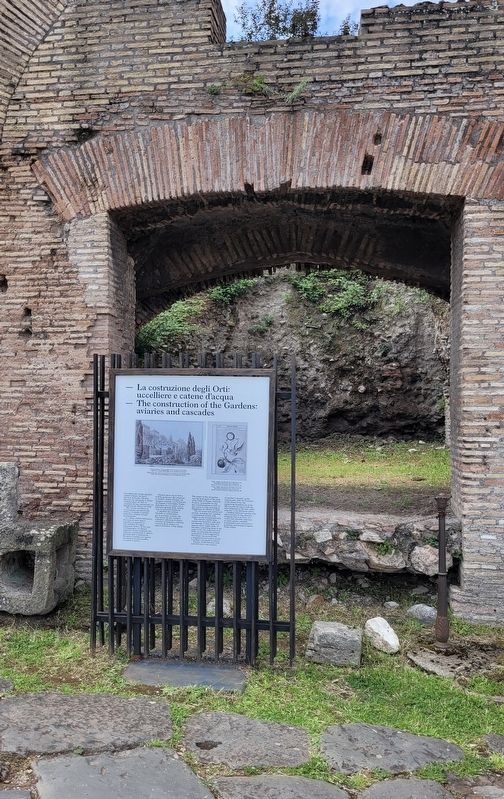
Location. 41° 53.445′ N, 12° 29.256′ E. Marker is in Roma, Lazio (Latium, Rome), in Città metropolitana di Roma Capitale. It is in Rione X Campitelli. It is at the intersection of Via Nova and Via Sacra on Via Nova. The marker is located west of the Arch of Titus in the Roman Forum. Touch for map. Marker is in this post office area: Roma, Lazio 00186, Italy. Touch for directions.

Regionally, it is in Europe, the European Union, the Schengen Area, a coastal Mediterranean country, and the Western World. Historically, it finds itself in what was once the Roman Empire.
Other nearby markers. At least 8 other markers are within walking distance of this marker: La costruzione degli Orti: il giardino del Duca di Parma (here, next to this marker); Buildings Opening Onto The Via Nova (here, next to this marker); La riscoperta dell'antico: gli architetti / The rediscovery of antiquity: architects (a few steps from this marker); Il Casino del Belvedere e il giardino segreto / The Belvedere Lodge and the Secret Garden
Photographed by James Hulse, June 14, 2023
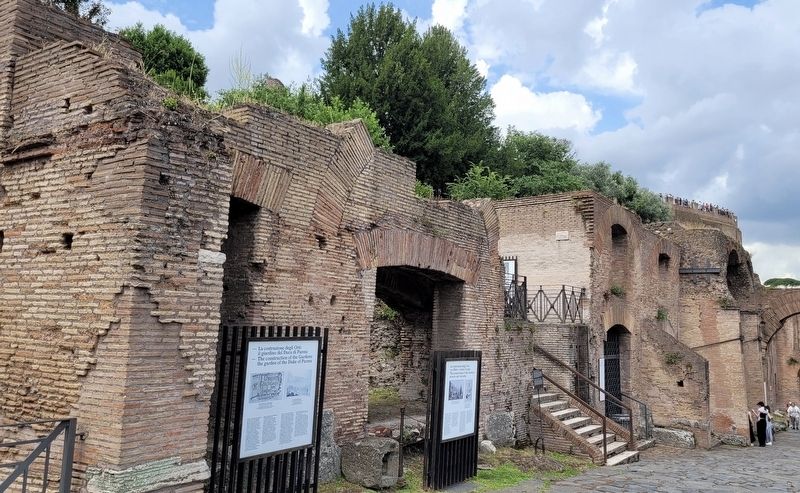
3. The marker is the last marker on the right
More about this marker. The marker is located in the Parco Archeologico del Colosseo (Roman Forum Archaeological Park) and it does require an entry fee to visit.
Also see . . .
1. Parco Archeologico del Colosseo. Roma Turismo (Submitted on August 16, 2023, by James Hulse of Medina, Texas.)
2. Farnese Gardens. Wikipedia (Submitted on August 16, 2023, by James Hulse of Medina, Texas.)
Credits. This page was last revised on August 16, 2023. It was originally submitted on August 16, 2023, by James Hulse of Medina, Texas. This page has been viewed 118 times since then and 6 times this year. Photos: 1, 2, 3. submitted on August 16, 2023, by James Hulse of Medina, Texas.
