Dayton's Bluff in Saint Paul in Ramsey County, Minnesota — The American Midwest (Upper Plains)
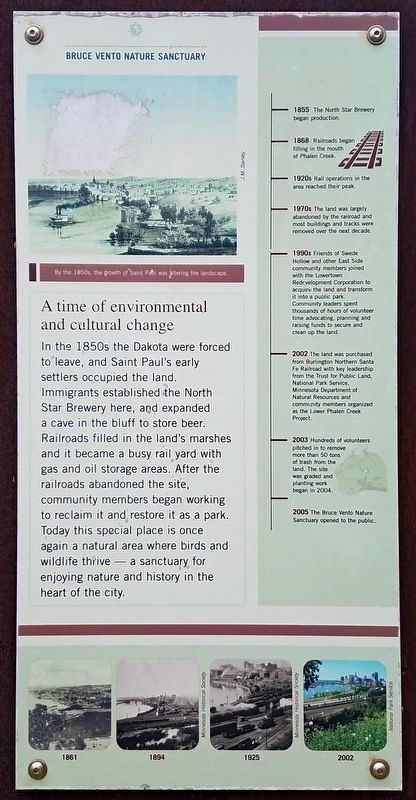
A time of environmental and cultural change
Bruce Vento Nature Sanctuary
Photographed by McGhiever, August 21, 2021
1. A time of environmental and cultural change Marker
By the 1850s, the growth of Saint Paul was altering the landscape.
In the 1850s the Dakota were forced to leave, and Saint Paul's early settlers occupied the land. Immigrants established the North Star Brewery here, and expanded a cave in the bluff to store beer. Railroads filled in the land's marshes and it became a busy rail yard with gas and oil storage areas. After the railroads abandoned the site, community members began working to reclaim it and restore it as a park. Today this special place is once again a natural area where birds and wildlife thrive — a sanctuary for enjoying nature and history in the heart of the city.
1855 The North Star Brewery began production.
1868 Railroads began filling in the mouth of Phalen Creek.
1920s Rail operations in the area reached their peak.
1970s The land was largely abandoned by the railroad and most buildings and tracks were removed over the next decade.
1990s Friends of Swede Hollow and other East Side community members joined with the Lowertown Redevelopment Corporation to acquire the land and transform it into a public park. Community leaders spent thousands of hours of volunteer time advocating, planning and raising funds to secure and clean up the land.
2002 The land was purchased from Burlington Northern Santa Fe Railroad with key leadership from the Trust for Public Land, National Park Service, Minnesota Department of Natural Resources and community members organized as the Lower Phalen Creek Project.
2003 Hundreds of volunteers pitched in to remove more than 50 tons of trash from the land. The site was graded and planting work began in 2004.
2005 The Bruce Vento Nature Sanctuary opened to the public.
Topics. This historical marker is listed in these topic lists: Environment • Industry & Commerce • Parks & Recreational Areas
this page online
Location. Marker has been reported permanently removed. It was located near 44° 57.157′ N, 93° 4.455′ W. Marker was in Saint Paul, Minnesota, in Ramsey County. It was in Dayton's Bluff. It could be reached from 4th Street East west of Commercial Street. The marker is in Bruce Vento Nature Sanctuary, a short walk southeast from the parking lot. Touch for map. Marker was at or near this postal address: 590 4th Street E, Saint Paul MN 55106, United States of America.
We have been informed that this marker is no longer there and will not be replaced. This page is an archival view of what was.
Regionally, this marker was in the Twin Cities Metropolitan Area. It was also in the American Midwest, in the Corn Belt, and in the Great River Road Region. Globally, it was in North America, the Western Hemisphere, the Western World, and the Anglosphere. Historically, it found itself in what was once Rupert’s Land, the territory of the Mississippian Culture, and the Louisiana Purchase.

Other nearby markers. At least 8 other markers are within walking distance
Photographed by McGhiever, August 21, 2021
2. A time of environmental and cultural change Marker
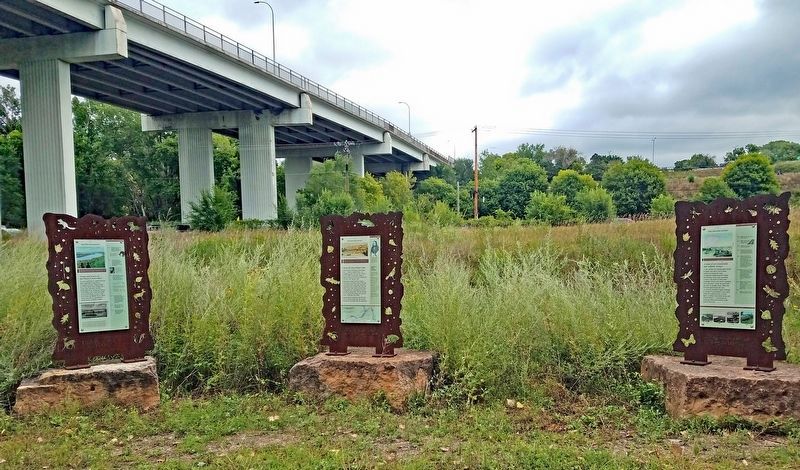
The marker is on the right in this view.
Other markers no longer nearby. Dakota life along Wakpa Tanka (was here, next to this marker but has been permanently removed); Preserving history on the land (was a few steps from this marker but has been permanently removed).
Credits. This page was last revised on September 9, 2026. It was originally submitted on August 21, 2023, by McGhiever of Minneapolis, Minnesota. This page has been viewed 171 times since then and 18 times this year. Photos: 1, 2. submitted on August 21, 2023, by McGhiever of Minneapolis, Minnesota. • J. Makali Bruton was the editor who published this page.
