
Madeleine in Paris in Département de Paris, Île-de-France, France — Western Europe
Le Général La Fayette
⎯⎯⎯
General Lafayette

Photographed by Andrew Ruppenstein, August 23, 2023
1. Le Général La Fayette / General Lafayette Marker

Le Général
La Fayette
Defenseur de la liberté
en Amérique
Un des fondateurs
de la liberté en France
Né le 6 septembre 1757
au Chateau de Chavagnac
en Auvergne
Est mort dans cette maison
le 20 mai 1834.
General Lafayette, defender of liberty in America and one of the founders of liberty in France, born on September 6, 1757, in Chateau de Chavagnac en Auvergne, died in this building on May 20, 1834.
Topics. This historical marker is listed in these topic lists: Civil Rights • War, US Revolutionary. A significant historical date for this entry is May 20, 1834.
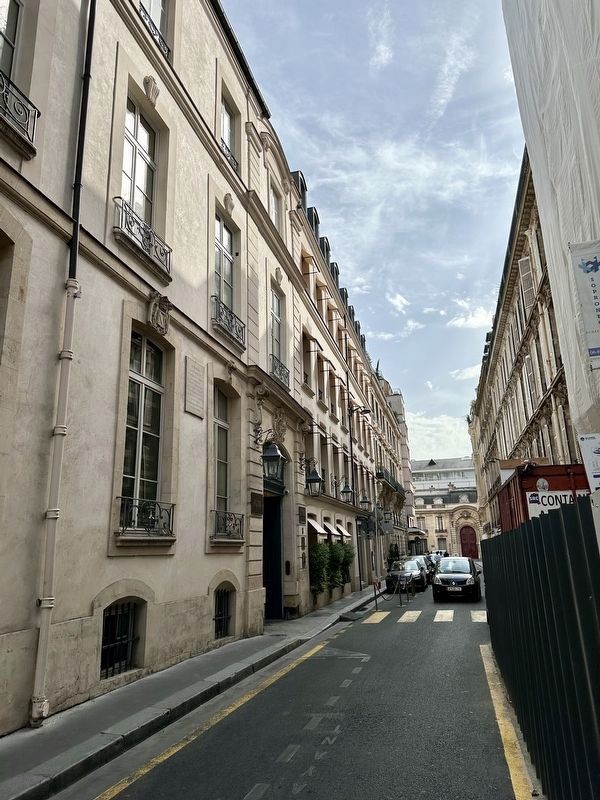
Location. 48° 52.191′ N, 2° 19.254′ E. Marker is in Paris, Île-de-France, in Département de Paris. It is in Madeleine. It is on Rue d'Anjou north of Rue du Faubourg Saint-Honoré, on the left. Touch for map. Marker is at or near this postal address: 8 Rue d'Anjou, Paris, Île-de-France 75008, France. Touch for directions.

Regionally, it is in the North Atlantic Region, Europe, the European Union, Atlantic Europe, the Schengen Area, Western Europe, a coastal Mediterranean country, and the Western World. Historically, it
this page online
Other nearby markers. At least 8 other markers are within walking distance of this marker: Orville J. Cunningham (about 90 meters away, measured in a direct line); Jean-Baptiste Lully (about 120 meters away); Andre Chantemesse (about 120 meters away); Jardin des Ambassadeurs (approx. 0.3 kilometers away); Jean-Roger Debrais (approx. 0.3 kilometers away); Alphonse Maury (approx. 0.4 kilometers away); Church / Eglise Notre-Dame-de-l’Assomption (approx. 0.4 kilometers away); Plan Marshall / The Marshall Plan (approx. 0.4 kilometers away). Touch for a list and map of all markers in Paris.
Also see . . . Gilbert du Motier, Marquis de Lafayette (Wikipedia).
Overview: Marie-Joseph Paul Yves Roch Gilbert du Motier de La Fayette, Marquis de La Fayette (6 September 1757 – 20 May 1834), known in the United States as Lafayette, was a French aristocrat, freemason, and military officer who volunteered to join the Continental Army, led by General George Washington, in the American Revolutionary War. Lafayette was ultimately permitted to command Continental Army(Submitted on August 23, 2023.)troops in the decisive Siege of Yorktown in 1781, the Revolutionary War's final major battle that secured American independence. After returning to France, Lafayette became a key figure in the French Revolution of 1789 and the July Revolution of 1830 and continues to be celebrated as a hero in both France and the United States.Photographed by Andrew Ruppenstein, August 23, 20232. Le Général La Fayette / General Lafayette Marker - wide viewThe marker is visible here on the building on the left.
Towards the French Revolution: The Estates General convened on 5 May 1789; debate began on whether the delegates should vote by head or by Estate. If by Estate, then the nobility and clergy would be able to outvote the commons; if by head, then the larger Third Estate could dominate. Before the meeting, as a member of the "Committee of Thirty", Lafayette agitated for voting by head, rather than estate. He could not get a majority of his own Estate to agree, but the clergy was willing to join with the commons, and on the 17th, the group declared itself the National Assembly. The loyalist response was to lock out the group, including Lafayette, while those who had not supported the Assembly met inside. This action led to the Tennis Court Oath, where the excluded members swore not to separate until a constitutionwas established. The Assembly continued to meet, and on 11 July 1789, Lafayette presented a draft of the "Declaration of the Rights of Man and of the Citizen" to the Assembly, written by himself in consultation with Jefferson. The next day, after the dismissal of Finance Minister Jacques Necker (who was seen as a reformer), lawyer Camille Desmoulins assembled between 700 and 1000 armed insurgents. The king had the royal army under the duc de Broglie surround Paris. On 14 July, the fortress known as the Bastille was stormed by the insurgents.Gondelfinger (courtesy BnF via Wikimedia Commons), 18343. The death of LafayetteLafayette spoke publicly for the last time in the Chamber of Deputies on 3 January 1834. The next month, he collapsed at a funeral from pneumonia. He recovered, but the following May was wet, and he became bedridden after being caught in a thunderstorm. He died at age 76 on 20 May 1834 on 6 rue d'Anjou-Saint-Honoré in Paris (now 8 rue d'Anjou in the 8th arrondissement of Paris). He was buried next to his wife at the Picpus Cemetery under soil from Bunker Hill, which his son Georges Washington sprinkled upon him. King Louis-Philippe ordered a military funeral in order to keep the public from attending, and crowds formed to protest their exclusion. - Wikipedia

Credits. This page was last revised on August 23, 2023. It was originally submitted on August 23, 2023, by Andrew Ruppenstein of Lamorinda, California. This page has been viewed 310 times since then and 33 times this year. Photos: 1, 2, 3. submitted on August 23, 2023, by Andrew Ruppenstein of Lamorinda, California.
