Downtown East in Minneapolis in Hennepin County, Minnesota — The American Midwest (Upper Plains)
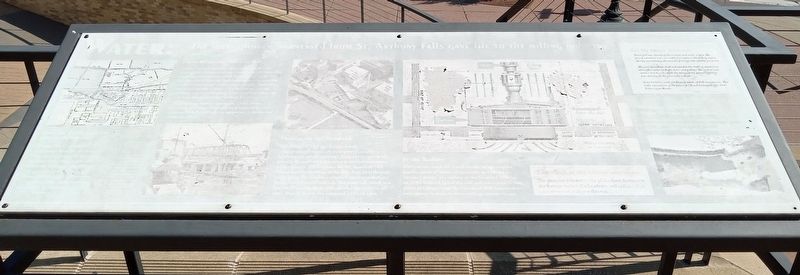
Water: The waterpower harnessed from St. Anthony Falls gave life to the milling industry
Photographed by McGhiever, August 4, 2023
1. Water: The waterpower harnessed from St. Anthony Falls gave life to the milling industry Marker
How did water turn the wheels of industry?
Without the direct drive waterpower from St. Anthony Falls, the Minneapolis riverfront we know today might not exist. From the 1850s into the 1900s, the strength of the Mississippi River allowed mill machinery to work around the clock, powering the growth of Minneapolis' milling industry.
From Mississippi River to Mill
Water was channeled to and from the riverfront mills through an elaborate series of canals and tunnels. The west-side waterpower canal, built to supply the mills on this side of the river with power, was dug into the ground and covered with wooden planks. The canal started above the falls near Fifth Avenue, moved through a series of headraces, and emptied below the falls near the present day Guthrie Theatre.
The canal was filled in during the 1960s, but a re-creation of what the plank road looked like can be seen on West River Parkway immediately downriver from this plaza.
Flowing to the Standard
The Standard Mill was supplied with water from the west-side waterpower canal by a headrace—a smaller channel designed to specifically provide the mill with
this page online
In the Turbine
Turbines are much like waterwheels, except they are smaller, made of metal, set vertically, and placed in enclosed spaces. The turbine at the Standard Mill was set in the bedrock below the mill and was turned by the power of falling water. The Standard Mill depended on waterpower to make its flour milling operation run.
Take a Look at the Ground Around You!
The patterns you see in the plaza floor demarcate the former routes of a headrace and tailrace that once powered mills on this site.
Tell Me About Turbines!
Water fell into the top of the turbine and made it spin. The fins of a turbine were curved to best capture the falling water thereby maximizing the amount of energy that could be put to use.
The central turbine shaft connected to the milling machinery through a series of shafts, belts, and pulleys. This system was similar to a bicycle, with the energy from spinning pedals transferring to the wheels by a chain.
Some turbines could produce upwards of 250 horsepower. That is the equivalent of the power produced by roughly five 1969 Volkswagen Beetles.
Headrace to Tailrace—Water Returns to the River
After
Photographed by McGhiever, August 4, 2023
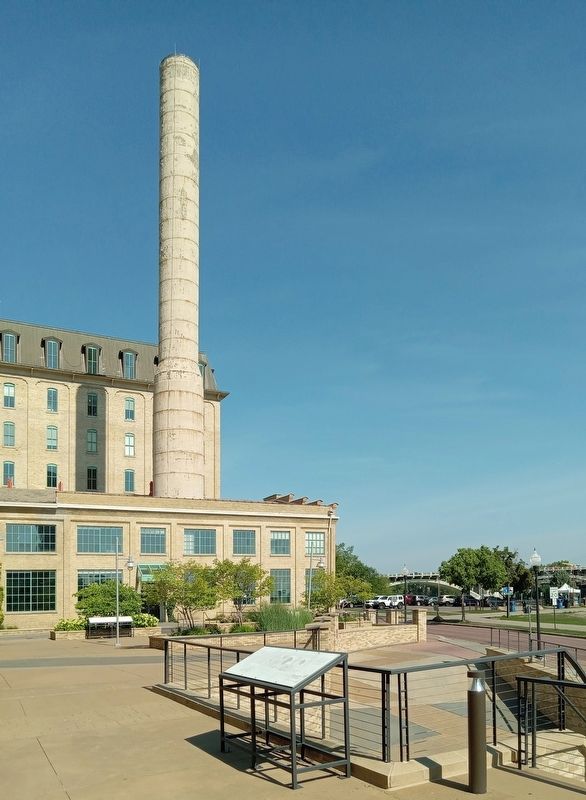
2. Water Marker in the plaza northeast of the Standard Mill (now Whitney Lofts)
Topics. This historical marker is listed in these topic lists: Industry & Commerce • Waterways & Vessels. A significant historical year for this entry is 1850.
Location. 44° 58.803′ N, 93° 15.525′ W. Marker is in Minneapolis, Minnesota, in Hennepin County. It is in Downtown East. It is at the intersection of Portland Avenue and West River Parkway, on the left when traveling north on Portland Avenue. The marker is at the northeast corner of the Whitney Lofts Plaza. Touch for map. Marker is at or near this postal address: 150 Portland Avenue, Minneapolis MN 55401, United States of America. Touch for directions.

Regionally, this marker is in the Twin Cities Metropolitan Area. It is also in the American Midwest, in the Corn Belt, and in the Great River Road Region. Globally, it is in North America, the Western Hemisphere, the Western World, and the Anglosphere. Historically, it finds itself in what was once Rupert’s Land, the territory of the Mississippian Culture, and the Louisiana Purchase.
Other nearby markers. At least 8 other markers are within walking distance of this marker: Bricks and Mortar (a few steps from this marker); A Changing Landscape (within shouting distance of this marker); Mills and Millraces (within shouting distance of this marker); Historic Milling District (within shouting distance of this marker); Stone Arch Bridge (about 300 feet away, measured in a direct line); Giants in the Land: The Power of Minneapolis Mills and Millers (about 300 feet away); Minneapolis Underground (about 400 feet away); Bridges of the St. Anthony Falls Area (about 400 feet away). Touch for a list and map of all markers in Minneapolis.
More about this marker. The marker is extremely faded.
Credits. This page was last revised on August 28, 2023. It was originally submitted on August 27, 2023, by McGhiever of Minneapolis, Minnesota. This page has been viewed 295 times since then and 26 times this year. Photos: 1, 2. submitted on August 27, 2023, by McGhiever of Minneapolis, Minnesota. • J. Makali Bruton was the editor who published this page.
