West Cook in Cook County, Minnesota — The American Midwest (Upper Plains)
This Log
Photographed by McGhiever, August 19, 2023
1. This Log Marker
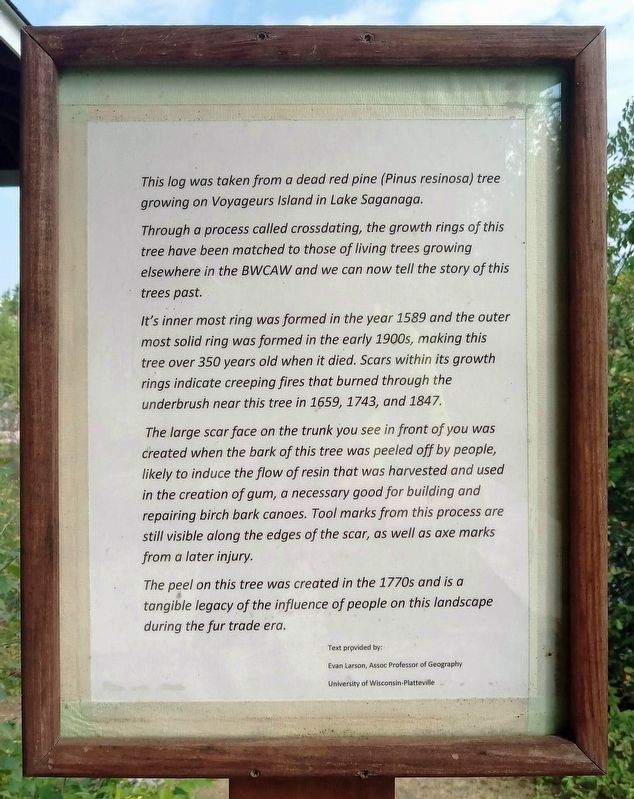
Through a process called crossdating, the growth rings of this tree have been matched to those of living trees growing elsewhere in the BWCAW and we can now tell the story of this trees [sic] past.
It's [sic] inner most ring was formed in the year 1589 and the outer most solid ring was formed in the early 1900s, making this tree over 350 years old when it died. Scars within its growth rings indicate creeping fires that burned through the underbrush near this tree in 1659, 1743, and 1847.
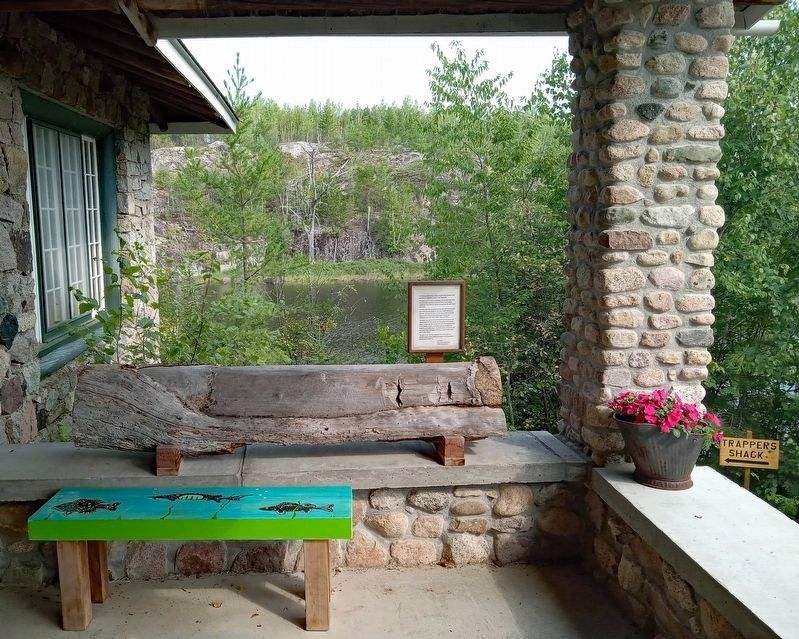
The large scar face on the trunk you see in front of you was created when the bark of this tree was peeled off by people, likely to induce the flow of resin that was harvested and used in the creation of gum, a necessary good for building and repairing birch bark canoes. Tool marks from this process are still visible along the edges of the scar, as well as axe marks from a later injury.
The peel on this tree was created in the 1770s and is a tangible legacy of the influence of people on this landscape during the fur trade era.
Text provided by:
Evan Larson, Assoc Professor of Geography
University of Wisconsin-Platteville
Erected by Chik-Wauk
this page online
Topics and series. This historical marker is listed in these topic lists: Anthropology & Archaeology • Environment. In addition, it is included in the Historic Trees series list. A significant historical year for this entry is 1589.
Location. 48° 10.128′ N, 90° 52.846′ W. Marker is in West Cook, Minnesota, in Cook County. It can be reached from Moose Pond Drive (County Road 81). Marker is on the porch of the Chik-Wauk Museum. Touch for map. Marker is at or near this postal address: 28 Moose Pond Dr, Grand Marais MN 55604, United States of America. Touch for directions.

Regionally, this marker is on the Boundary Waters Canoe Area Wilderness, in the Arrowhead Region, in the Iron Range, and in the North Shore. It is also in the American Midwest and in the Corn Belt. Globally, it is in North America, in the Great North Woods, on the Great Lakes, on Lake Superior’s North Shore, in the Western Hemisphere, in the Western World, and in the Anglosphere. Historically, it finds itself in what was once the Viceroyalty of New France, Rupert’s Land, the territory of the Mississippian Culture, and the
Photographed by McGhiever, August 19, 2023
2. Marker and log on the porch of the Chik-Wauk Museum
Other nearby markers. At least 8 other markers are within 9 miles of this marker, measured as the crow flies: The Trapper Shack (a few steps from this marker); The American Plan Cabin (within shouting distance of this marker); Step back in time... (about 500 feet away, measured in a direct line); Portage Canoe Rest (about 600 feet away); History of Saganaga Lake (approx. 0.3 miles away); a different marker also named History of Saganaga Lake (approx. 0.3 miles away); Gunflint Lake Scenic Overlook (approx. 8.3 miles away); The 2007 Ham Lake Fire (approx. 8.3 miles away). Touch for a list and map of all markers in West Cook.
Credits. This page was last revised on October 24, 2024. It was originally submitted on August 28, 2023, by McGhiever of Minneapolis, Minnesota. This page has been viewed 181 times since then and 21 times this year. Photos: 1, 2. submitted on August 28, 2023, by McGhiever of Minneapolis, Minnesota. • J. Makali Bruton was the editor who published this page.
