Downtown West in Minneapolis in Hennepin County, Minnesota — The American Midwest (Upper Plains)
Bridge Square to the Gateway
| — | Saint Anthony Falls Heritage Trail | — |
Photographed by McGhiever, May 20, 2023
1. Bridge Square to the Gateway Marker
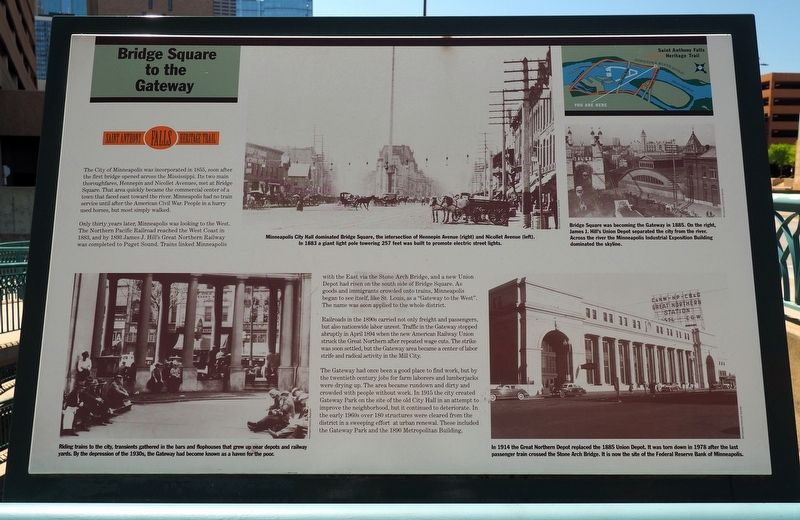
Only thirty years later, Minneapolis was looking to the West. The Northern Pacific Railroad reached the West Coast in 1883, and by 1893 James J. Hill's Great Northern Railway was completed to Puget Sound. Trains linked Minneapolis with the East via the Stone Arch Bridge, and a new Union Depot had risen on the south side of Bridge Square. As goods and immigrants crowded onto trains, Minneapolis began to see itself, like St. Louis, as a "Gateway to the West". The name was soon applied to the whole district.
Railroads in the 1890s carried not only freight and passengers, but also nationwide labor unrest. Traffic in the Gateway stopped abruptly in April 1894 when the new American Railway Union struck the Great Northern after
this page online
The Gateway had once been a good place to find work, but by the twentieth century jobs for farm laborers and lumberjacks were drying up. The area became rundown and dirty and crowded with people without work. In 1915 the city created Gateway Park on the site of the old City Hall in an attempt to improve the neighborhood, but it continued to deteriorate. In the early 1960s over 180 structures were cleared from the district in a sweeping effort at urban renewal. These included the Gateway Park and the 1890 Metropolitan Building.
Minneapolis City Hall dominated Bridge Square, the intersection of Hennepin Avenue (right) and Nicollet Avenue (left). In 1883 a giant light pole towering 257 feet was built to promote electric street lights.
Riding trains to the city, transients gathered in the bars and flophouses that grew up near depots and railway yards. By the depression of the 1930s, the Gateway had become known as a haven for the poor.
Bridge Square was becoming the Gateway in 1885. On the right, James J. Hill's Union Depot separated the city from the river. Across the river the Minneapolis Industrial Exposition Building dominated the skyline.
In 1914 the Great Northern Depot replaced the 1885 Union Depot. It was torn down in 1978 after the last passenger train crossed the Stone Arch Bridge. It is now the site of the Federal Reserve Bank of Minneapolis.
Topics.

Photographed by McGhiever, May 20, 2023
2. Bridge Square to the Gateway Marker
Location. 44° 59.068′ N, 93° 15.919′ W. Marker is in Minneapolis, Minnesota, in Hennepin County. It is in Downtown West. It is on Hennepin Avenue north of 1st Street S., on the right when traveling east. The marker is at the top of a pedestrian ramp from the Hennepin Avenue Bridge down to West River Parkway. Touch for map. Marker is in this post office area: Minneapolis MN 55401, United States of America. Touch for directions.

Regionally, this marker is in the Twin Cities Metropolitan Area. It is also in the American Midwest, in the Corn Belt, and in the Great River Road Region. Globally, it is in North America, the Western Hemisphere, the Western World, and the Anglosphere. Historically, it finds itself in what was once Rupert’s Land, the territory of the Mississippian Culture, and the Louisiana Purchase.
Other nearby markers. At least 8 other markers are within walking distance of this marker: Bridging the Stream (within shouting distance of this marker); Stevens House (about 400 feet away, measured in a direct line); The House of John H. Stevens (about 400 feet away); Indians at the Falls (about 700 feet away); Gothic Storage Facility (about 700 feet away); Father Louis Hennepin Bridge (approx. 0.2 miles away); William de la Barre (approx. 0.2 miles away); Nicollet Island Businesses (approx. 0.2 miles away). Touch for a list and map of all markers in Minneapolis.
Credits. This page was last revised on August 30, 2023. It was originally submitted on June 5, 2023, by McGhiever of Minneapolis, Minnesota. This page has been viewed 765 times since then and 78 times this year. Last updated on August 29, 2023, by McGhiever of Minneapolis, Minnesota. Photos: 1, 2. submitted on June 5, 2023, by McGhiever of Minneapolis, Minnesota. • J. Makali Bruton was the editor who published this page.
