Hagley Museum near Wilmington in New Castle County, Delaware — The American Northeast (Mid-Atlantic)
Hagley's Pollinator Garden
| — | #HagleyMuseum | — |
Photographed by William Fischer, Jr., August 30, 2023
1. Hagley's Pollinator Garden Marker
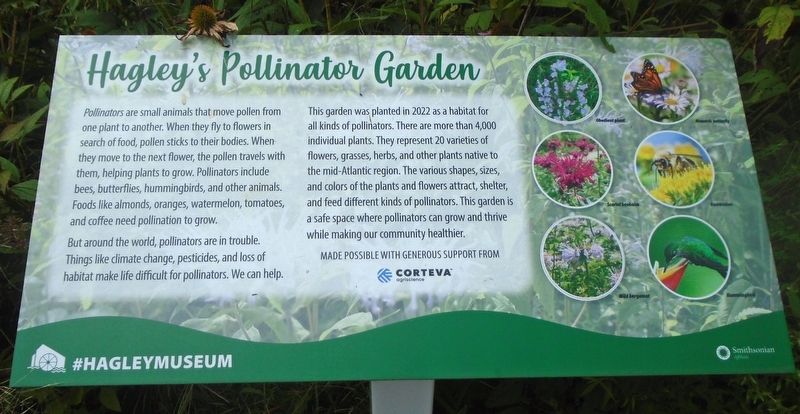
Pollinators are small animals that move pollen from one plant to another. When they fly to flowers in search of food, pollen sticks to their bodies. When they move to the next flower, the pollen travels with them, helping plants to grow. Pollinators include bees, butterflies, hummingbirds, and other animals. Foods like almonds, oranges, watermelon, tomatoes, and coffee need pollination to grow.
But around the world, pollinators are in trouble. Things like climate change, pesticides, and loss of habitat make life difficult for pollinators. We can help.
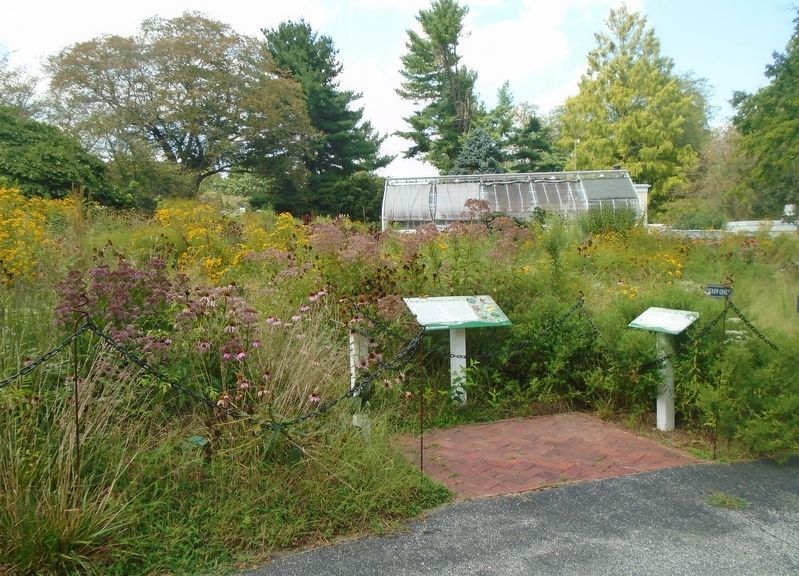
This garden was planted in 2022 as a habitat for all kinds of pollinators. There are more than 4,000 individual plants. They represent 20 varieties of flowers, grasses, herbs, and other plants native to the mid-Atlantic region. The various shapes, sizes, and colors of the plants and flowers attract, shelter, and feed different kinds of pollinators. This garden is a safe space where pollinators can grow and thrive while making our community healthier.
Erected by Hagley Museum and CORTEVA agriscience.
Topics. This historical marker is listed in these topic lists:
this page online
Location. 39° 47.072′ N, 75° 34.798′ W. Marker is near Wilmington, Delaware, in New Castle County. It is in Hagley Museum. It can be reached from Hagley Creek Road north of Blacksmith Hill Road, on the right when traveling north. Marker can only be reached by tram on the Hagley Museum house tour, after paying the entrance fee. Touch for map. Marker is at or near this postal address: 200 Hagley Creek Road, Wilmington DE 19807, United States of America. Touch for directions.

Regionally, this marker is in Greater Philadelphia. It is also in the American Mid-Atlantic, on the Delmarva Peninsula, and on the Eastern Seaboard. Globally, it is in the North Atlantic Region, North America, the Western Hemisphere, the Western World, and the Anglosphere. Historically, it finds itself in what was once New Netherland and also one of the original Thirteen Colonies.
Other nearby markers. At least 8 other markers are within walking distance of this marker: Gardens at Hagley (here, next to this marker); Cooper Shop (within shouting distance
Photographed by William Fischer, Jr., August 30, 2023
2. Hagley's Pollinator Garden Marker
Regarding Hagley's Pollinator Garden. Marker has limited historical information but highlights that the Hagley Museum only created this garden in 2022.
Also see . . .
1. Hagley's Pollinator Garden Plant Guide. (Submitted on September 2, 2023, by William Fischer, Jr. of Reynoldsburg, Ohio.)
2. Pollinator Partnership Ecoregional Planting Guides. (Submitted on September 2, 2023, by William Fischer, Jr. of Reynoldsburg, Ohio.)
Photographed by William Fischer, Jr., August 30, 2023
3. Adjacent signage -- How You Can Help
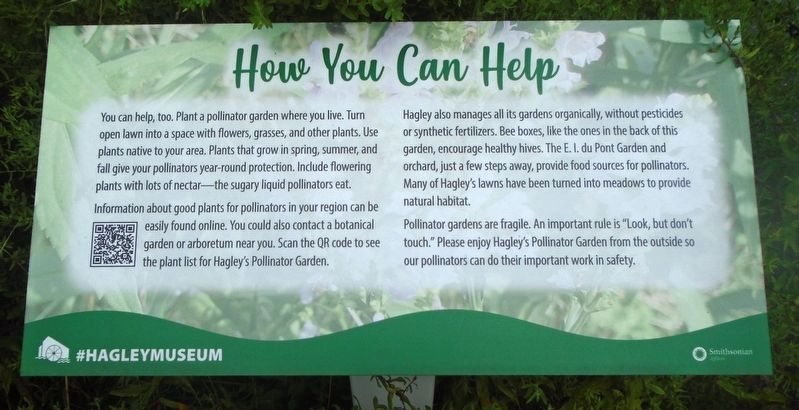
You can help, too. Plant a pollinator garden where you live. Turn
open lawn into a space with flowers, grasses, and other plants. Use plants native to your area. Plants that grow in spring, summer, and fall give your pollinators year-round protection. Include flowering plants with lots of nectar-the sugary liquid pollinators eat.
Information about good plants for pollinators in your region can be easily found online. You could also contact a botanical garden or arboretum near you. Scan the QR code to see the plant list for Hagley's Pollinator Garden.
Hagley also manages all its gardens organically, without pesticides or synthetic fertilizers. Bee boxes, like the ones in the back of this garden, encourage healthy hives. The E. I. du Pont Garden and orchard, just a few steps away, provide food sources for pollinators. Many of Hagley's lawns have been turned into meadows to provide natural habitat.
Pollinator gardens are fragile. An important rule is "Look, but don't touch.” Please enjoy Hagley's Pollinator Garden from the outside so our pollinators can do their important work in safety.
Information about good plants for pollinators in your region can be easily found online. You could also contact a botanical garden or arboretum near you. Scan the QR code to see the plant list for Hagley's Pollinator Garden.
Hagley also manages all its gardens organically, without pesticides or synthetic fertilizers. Bee boxes, like the ones in the back of this garden, encourage healthy hives. The E. I. du Pont Garden and orchard, just a few steps away, provide food sources for pollinators. Many of Hagley's lawns have been turned into meadows to provide natural habitat.
Pollinator gardens are fragile. An important rule is "Look, but don't touch.” Please enjoy Hagley's Pollinator Garden from the outside so our pollinators can do their important work in safety.
Credits. This page was last revised on April 30, 2025. It was originally submitted on September 2, 2023, by William Fischer, Jr. of Reynoldsburg, Ohio. This page has been viewed 255 times since then and 19 times this year. Photos: 1, 2, 3. submitted on September 2, 2023, by William Fischer, Jr. of Reynoldsburg, Ohio.
