Linden Hills in Frederick in Frederick County, Maryland — The American Northeast (Mid-Atlantic)
Battle of Frederick
Buying Vital Time
| — | Early's 1864 Attack on Washington | — |
Photographed by Mike McKeown
1. Battle of Frederick Marker
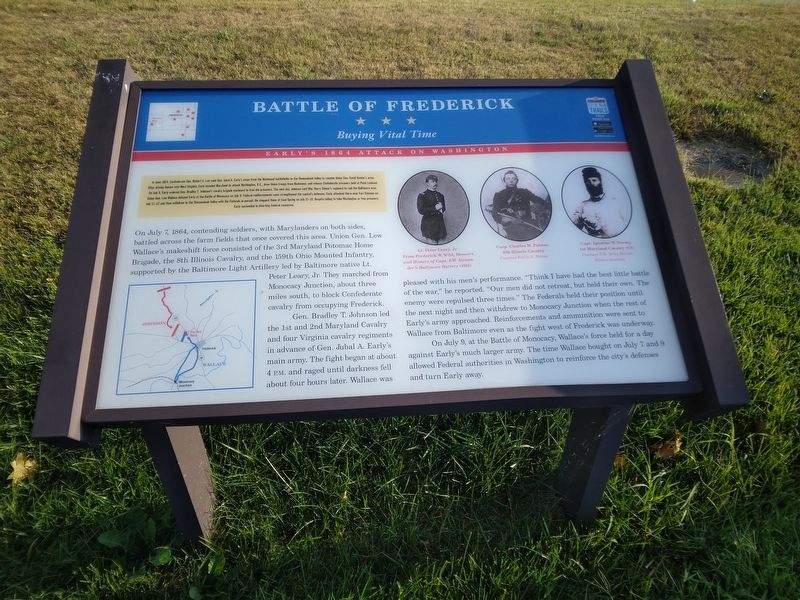
(preface) In June 1864, Confederate Gen. Robert E Lee sent Gen. Jubal A. Early's corps from the Richmond battlefields to the Shenandoah Valley to counter Union Gen. David Hunter's army. After driving Hunter into West Virginia, Early invaded Maryland to attack Washington. D.C., draw Union troops from Richmond, and release Confederate prisoners held at Point Lookout. On July 9, Early ordered Gen. Bradley T. Johnson's cavalry brigade eastward to free the prisoners. The next day, Johnson sent Maj. Harry Gilmor's regiment to raid the Baltimore area. Gen. Lew Wallace delayed Early at the Battle of Monocacy on July 9. Federal reinforcements soon strengthened the capital's defenses. Early attacked there near Fort Stevens on July 11—12 and then withdrew to the Shenandoah Valley with the Federals in pursuit. He stopped them at Cool Spring on July 17—18. Despite failing to take Washington or free prisoners, Early succeeded in diverting Federal resources.
On July 7, 1864, contending soldiers, with Marylanders on both sides, battled across the farm fields that once covered this area. Union Gen. Lew Wallace's makeshift force consisted
this page online
Gen. Bradley T. Johnson led the 1st and 2nd Maryland Cavalry and four Virginia cavalry regiments in advance of Gen. Jubal A. Early's main army. The fight began at about 4 P.M. and raged until darkness fell about four hours later. Wallace was pleased with his men's performance. "Think I have had the best little battle of the war," he reported. "Our men did not retreat, but held their own. The enemy were repulsed three times." The Federals held their position until the next night and then withdrew to Monocacy Junction when the rest of Early's army approached. Reinforcements and ammunition were sent to Wallace from Baltimore even as the fight west of Frederick was underway.
On July 9, at the Battle of Monocacy, Wallace's force held for a day against Early's much larger army. The time Wallace bought on July 7 and 9 allowed Federal

Photographed by Mike McKeown, November 10, 2024
2. Battle of Frederick Marker
Marker in parking lot
(captions) Lt. Peter Leary, Jr. From Frederick W. Wild, Memoirs and History of Capt. E.W. Alexander's Baltimore Battery (1912)
Corp. Charles H. Palmer, 8th Illinois Cavalry Courtesy Emily S. Palmer
Capt. Ignatius W. Dorsey, 1st Maryland Cavalry (CS) Courtesy U.S. Army Military History Institute
Erected by Maryland Civil War Trails.
Topics and series. This historical marker is listed in this topic list: War, US Civil. In addition, it is included in the Maryland Civil War Trails series list. A significant historical date for this entry is July 7, 1864.
Location. 39° 24.949′ N, 77° 26.267′ W. Marker is in Frederick, Maryland, in Frederick County. It is in Linden Hills. It can be reached from the intersection of Linden Avenue and West Patrick Street (U.S. 40), on the right when traveling north. Located in the parking lot on the north side of the Red Horse Restaurant. Touch for map. Marker is at or near this postal address: 996 West Patrick St, Frederick MD 21702, United States of America. Touch for directions.

Regionally, this marker is in the Washington Metropolitan Area and in Central Maryland. It is also in the American Mid-Atlantic. Globally, it is in North America, the Western Hemisphere, the Western World, and the Anglosphere. Historically, it finds itself in what was once one of the original Thirteen Colonies and also the Antebellum South.
Other nearby markers. At least 8 other markers are within walking distance of this marker: Maj. Gen. Edward Braddock (about 600 feet away, measured in a direct line); PFC James Moore Jr (approx. 0.7 miles away); a different marker also named PFC James Moore Jr (approx. ¾ mile away); Lloyd C. Culler (approx. 0.8 miles away); Schifferstadt (approx. 0.8 miles away); Schifferstadt Architectural Museum (approx. 0.8 miles away); Gettysburg Campaign (approx. 0.8 miles away); Meade Takes Command (approx. 0.8 miles away). Touch for a list and map of all markers in Frederick.
Another marker is no longer nearby. Battle of Frederick (has been replaced with this marker).
Related marker. Click here for another marker that is related to this marker. Old Marker At this location also titled "Battle of Frederick"
Credits. This page was last revised on November 23, 2024. It was originally submitted on September 5, 2023, by Mike McKeown of Baltimore, Maryland. This page has been viewed 492 times since then and 57 times this year. Photos: 1. submitted on September 5, 2023, by Mike McKeown of Baltimore, Maryland. 2. submitted on November 10, 2024, by Mike McKeown of Baltimore, Maryland. • Bernard Fisher was the editor who published this page.
