West End in Durham in Durham County, North Carolina — The American South (South Atlantic)
Pauli
Photographed by Duane and Tracy Marsteller, August 31, 2023
1. Pauli Marker, Side One
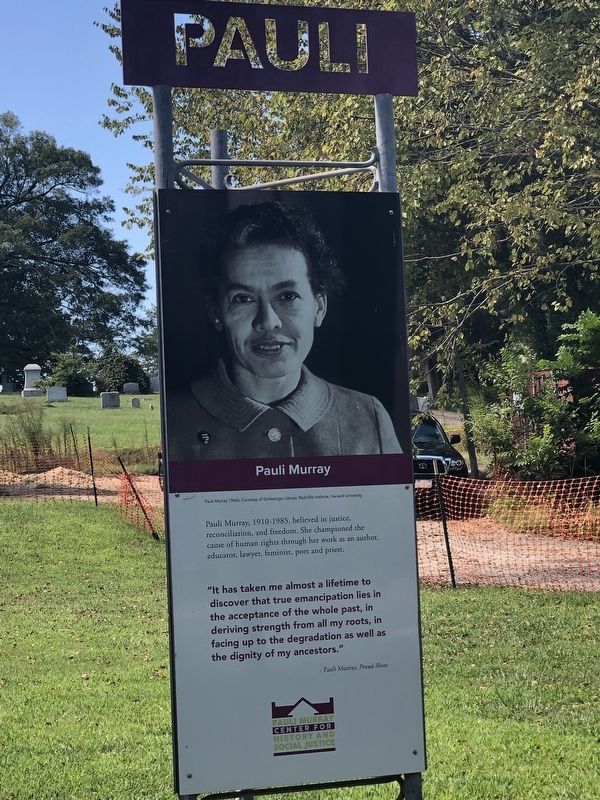
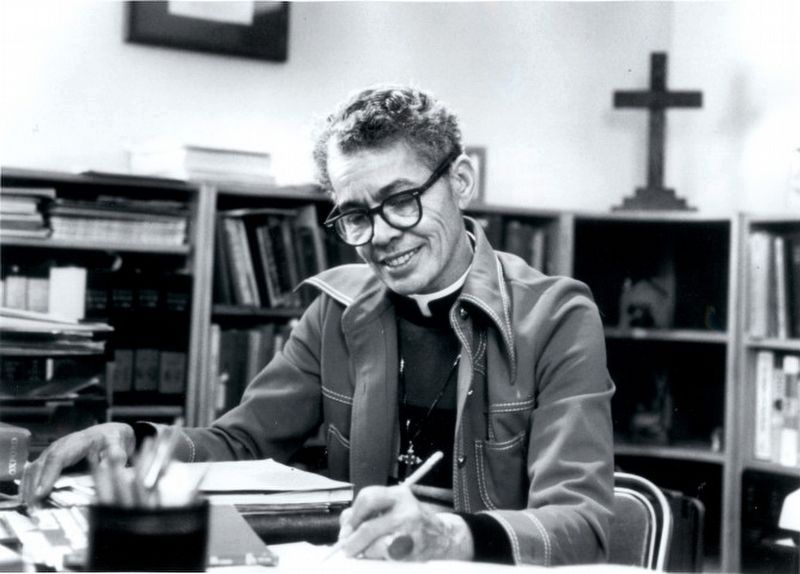
Pauli Murray, 1910-1985, believed in justice, reconciliation, and freedom. She championed the cause of human rights through her work as an author, educator, lawyer, feminist, poet and priest.
“It has taken me almost a lifetime to discover that true emancipation lies in the acceptance of the whole past, in deriving strength from all my roots, in facing up to the degradation as well as the dignity of my ancestors.” – Pauli Murray, Proud Shoesphoto caption:
Pauli Murray, 1960s. Courtesy of Schlessinger Library, Radcliffe Institute, Harvard University.
second panel:
Living by Word and Deed
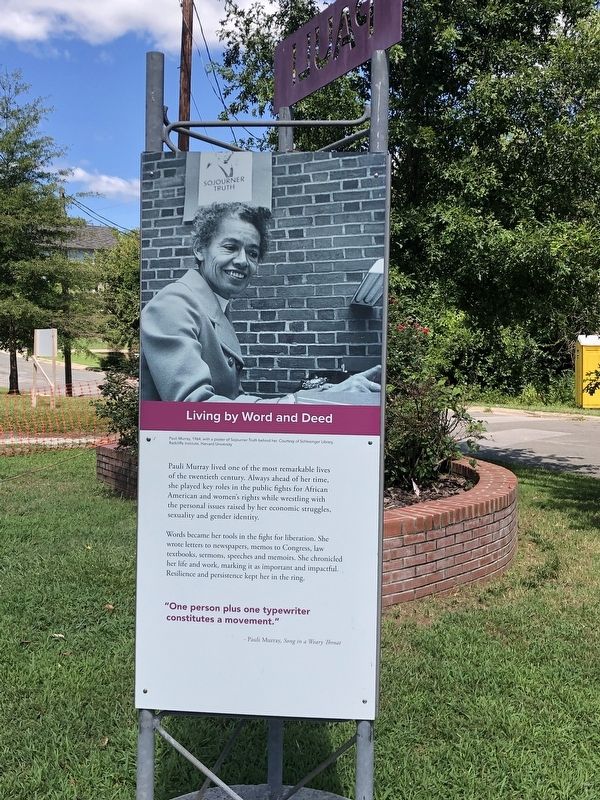
Pauli Murray lived one of the most remarkable lives of the twentieth century. Always ahead of her time, she played key roles in the public fights for African American and women's rights while wrestling with the personal issues raised by her economic struggles, sexuality and gender identity.
Words became her tools in the fight for liberation. She wrote letters to newspapers, memos to Congress, law textbooks, sermons, speeches and memoirs. She chronicled her life and work, marking it as important
this page online
“One person plus one typewriter constitutes a movement.” – -Pauli Murray, Song in a Weary Throatphoto caption:
Pauli Murray, 1964, with a poster of Sojouner Truth behind her. Courtesy of Schlessinger Library, Radcliffe Institute, Harvard University.
third panel:
A Vision for Justice and Equity
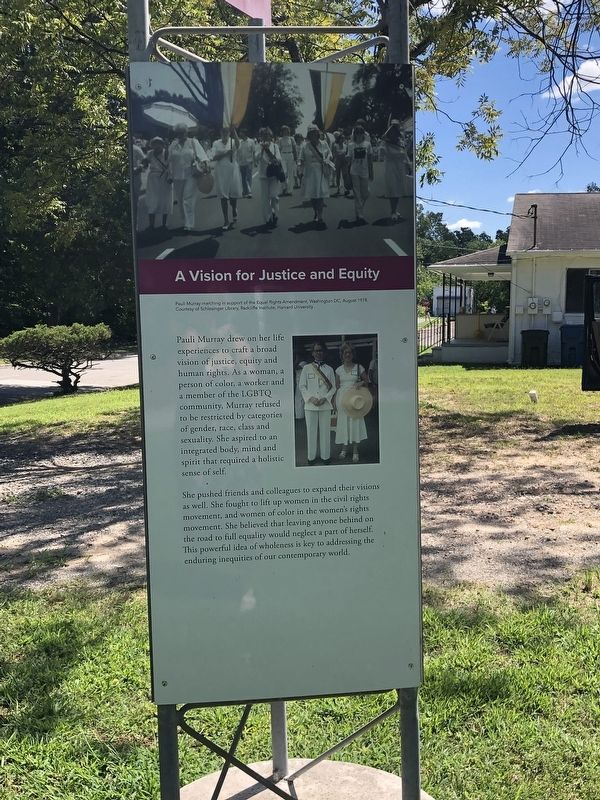
Pauli Murray drew on her life experiences to craft a broad vision of justice, equity and human rights. As a woman, a person of color, a worker and a member of the LGBTQ community, Murray refused to be restricted by categories of gender, race, class and sexuality. She aspired to an integrated body, mind and spirit that required a holistic sense of self.
She pushed friends and colleagues to expand their visions as well. She fought to lift up women in the civil rights movement, and women of color in the women's rights movement. She believed that leaving anyone behind on the road to full equality would neglect a part of herself. This powerful idea of wholeness is key to addressing the enduring inequities of our contemporary world.
photo caption:
Pauli
Photographed by Duane and Tracy Marsteller, August 31, 2023
2. Pauli Marker, Side Two
Erected by Pauli Murray Center for History and Social Justice.
Topics. This historical marker is listed in these topic lists: African Americans • Arts, Letters, Music • Civil Rights • Women. A significant historical year for this entry is 1910.
Location. 35° 59.562′ N, 78° 54.962′ W. Marker is in Durham, North Carolina, in Durham County. It is in West End. It is on Carroll Street north of Morehead Avenue, on the left when traveling north. Touch for map. Marker is at or near this postal address: 906 Carroll St, Durham NC 27701, United States of America. Touch for directions.

Regionally, this marker is in North Carolina’s Piedmont and in the Research Triangle. It is also in the American South and specifically in the Upper South. Globally, it is in North America, the Western Hemisphere, the Western World, and the Anglosphere. Historically, it finds itself in what was once the territory of the Mississippian Culture, one of the original Thirteen
Photographed by Duane and Tracy Marsteller, August 31, 2023
3. Pauli Marker, Side Three
Other nearby markers. At least 8 other markers are within walking distance of this marker: Impact (here, next to this marker); Family (here, next to this marker); Home (a few steps from this marker); J.T. & Mamie Christian House (approx. ¼ mile away); Pauli Murray (approx. 0.3 miles away); William Albert Wilkerson House (approx. 0.4 miles away); John Sprunt Hill (approx. 0.4 miles away); American Tobacco Trail (approx. 0.6 miles away). Touch for a list and map of all markers in Durham.
Also see . . .
1. Who is the Rev. Dr. Pauli Murray?. Throughout the 1930s, Murray actively questioned his gender and sex. He repeatedly asked physicians for hormone therapy and exploratory surgery to investigate his reproductive organs, but he was denied gender-affirming medical care. (Pauli Murray Center for History and Social Justice) (Submitted on September 10, 2023, by Duane and Tracy Marsteller of Murfreesboro, Tennessee.)
2. The Pioneering Pauli Murray: Lawyer, Activist, Scholar and Priest. Pauli Murray was first in her class at Howard University
Photographed by Duane and Tracy Marsteller, August 31, 2023
4. Pauli Marker
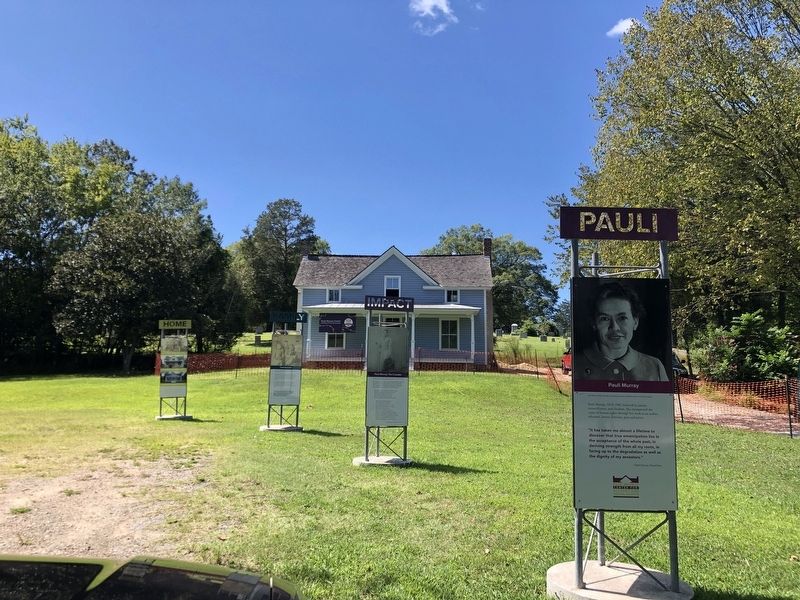
Featured marker is on the right. Murray's childhood home is in the background.
Credits. This page was last revised on March 23, 2026. It was originally submitted on September 10, 2023, by Duane and Tracy Marsteller of Murfreesboro, Tennessee. This page has been viewed 223 times since then and 52 times this year. It was the Marker of the Week June 14, 2026. Photos: 1, 2, 3, 4, 5. submitted on September 10, 2023, by Duane and Tracy Marsteller of Murfreesboro, Tennessee.
