Downtown San Jose in Santa Clara County, California — The American West (Pacific Coastal)
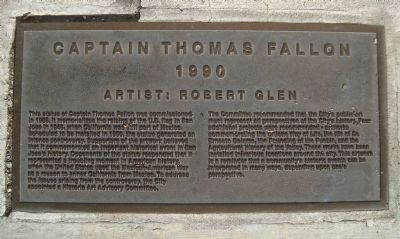
Captain Thomas Fallon
Photographed by Barry Swackhamer, February 8, 2012
1. Captain Thomas Fallon Marker
The Committee recommended that the City’s public art must represent all perspectives of the City’s history. Four additional projects were recommended — artwork commemorating the Ohlone Way of Life, the life of Dr. Ernesto Galarza, the Founding of the Pueblo, and the Agricultural History of the Valley. These works have been installed in various locations around the city. This artwork is a reminder that the community’s historic events can be interpreted in many ways, depending
this page online
Erected 1990 by Historic Art Advisory Committee; and artist Robert Glen.
Topics. This historical marker is listed in these topic lists: Notable Events • War, Mexican-American. A significant historical year for this entry is 1988.
Location. Marker has been reported permanently removed. It was located near 37° 20.252′ N, 121° 53.784′ W. Marker was in San Jose, California, in Santa Clara County. It was in Downtown San Jose. It was at the intersection of St. James Street and Julian Street on St. James Street. Touch for map. Marker was at or near this postal address: 183 St James Street, San Jose CA 95110, United States of America.
We have been informed that this marker is no longer there and will not be replaced. This page is an archival view of what was.
Regionally, this marker was in California’s San Francisco Bay Area, in Silicon Valley, and on the Coast Ranges. It was also on the American Pacific Coast. Globally, it was in North America, on the Ring of Fire, on the Pacific Rim, in the Western Hemisphere, in the Western World, and in the Anglosphere. Historically, it found itself

Photographed by Barry Swackhamer, January 30, 2012
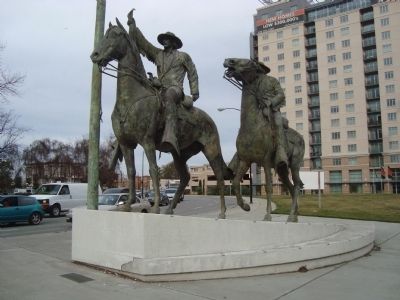
2. Captain Thomas Fallon Marker
The marker is in the sidewalk in front of the statue.
Other nearby markers. At least 8 other markers are within walking distance of this location: Site of "City Gardens" Nursery of Louis Pellier (within shouting distance of this marker); Thomas Fallon House (about 500 feet away, measured in a direct line); The Juan Bautista de Anza Trail (about 600 feet away); International Business Machines : RAMAC (about 600 feet away); Luis María Peralta Adobe (about 700 feet away); Henry's Hi-Life (approx. 0.2 miles away); Birthplace of A.P. Giannini (approx. 0.2 miles away); The Palomar Ballroom (approx. 0.2 miles away). Touch for a list and map of all markers in San Jose.
Another marker is no longer nearby. Pellier Park (was within shouting distance of this marker but has been confirmed missing).
More about this marker. This statue was removed in April 2023. Sources:
1) https://www.google.com/maps/@37.3371062,-121.8967502,3a,75y,25.34h,82.26t/data=!3m7!1e1!3m5!1sUJlgPCzvVoEiwXQiQj11kw!2e0!5s20230801T000000!7i16384!8i8192?entry=ttu
2) https://www.nbcbayarea.com/news/local/thomas-fallon-statue-san-jose/3208493/
3) https://www.mercurynews.com/2023/04/25/infamous-san-jose-statue-of-thomas-fallon-is-taken-down/
Regarding Captain Thomas Fallon. This
Photographed by Barry Swackhamer, February 8, 2012
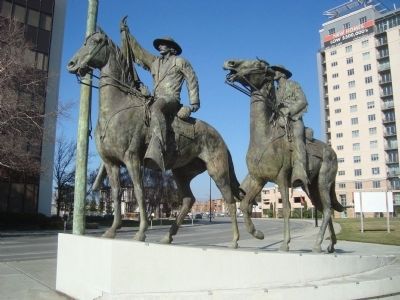
3. Captain Thomas Fallon Statue
Photographed by Barry Swackhamer, February 8, 2012
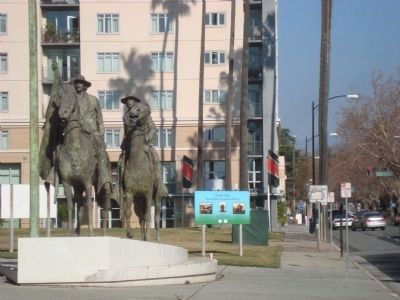
4. Captain Thomas Fallon Statue in Pellier Park
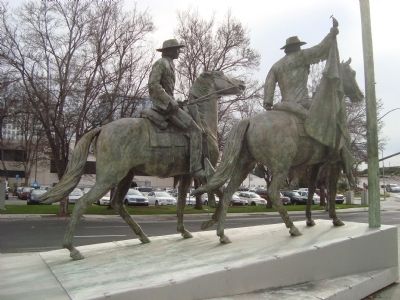
Photographed by Barry Swackhamer, January 30, 2012
5. Captain Thomas Fallon Statue
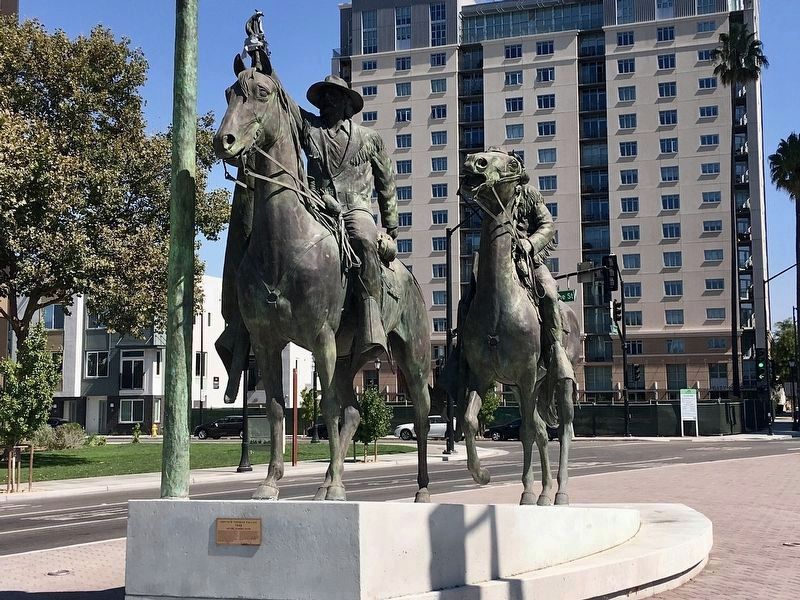
Photographed by Craig Baker, September 22, 2021
6. Statue Moved to Median
During reconstruction of Pellier Park (in the background).
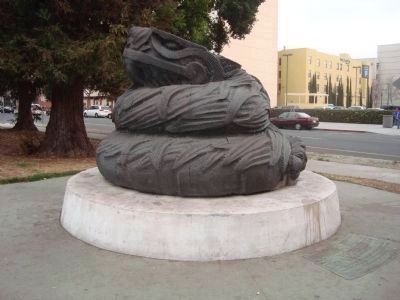
Photographed by Barry Swackhamer, February 6, 2012
7. Quetzacoatl, the Plumed Serpent
"The Plumed Serpent is one embodiment of Quetzalcóatl, an important mythological figure to the Mesoamerican pantheon. Depictions of Quetzalcóatl as a plumed serpent are found in Mesoamerica from the beginning of the Olmec period (circa 1200 BC) through the arrival of Hernán Cortes and the Spanish conquistadors and into the modern period.
Quetzalcóatl, when depicted as a plumed serpent, symbolizes the blending of heaven and earth. Quetzalcóatl associated with the planet Venus, the wind and breath of life, the discovering of corn, the invention of writing and the arts, birth and renewal. Quetzalcóatl is derived from quetzal meaning feather and catl, meaning snake."
Quetzalcóatl, when depicted as a plumed serpent, symbolizes the blending of heaven and earth. Quetzalcóatl associated with the planet Venus, the wind and breath of life, the discovering of corn, the invention of writing and the arts, birth and renewal. Quetzalcóatl is derived from quetzal meaning feather and catl, meaning snake."
Credits. This page was last revised on September 20, 2023. It was originally submitted on February 14, 2012, by Barry Swackhamer of Brentwood, California. This page has been viewed 1,676 times since then and 53 times this year. Last updated on September 17, 2023, by Robert Holmstrom of Rocklin, California. Photos: 1, 2, 3, 4, 5. submitted on February 14, 2012, by Barry Swackhamer of Brentwood, California. 6. submitted on October 9, 2021, by Craig Baker of Sylmar, California. 7. submitted on February 14, 2012, by Barry Swackhamer of Brentwood, California. • Bill Pfingsten was the editor who published this page.
