
Ludlow in Shropshire, England, United Kingdom — Northwestern Europe (the British Isles)
Mill Street
Photographed by Stephen Palmer, September 17, 2023
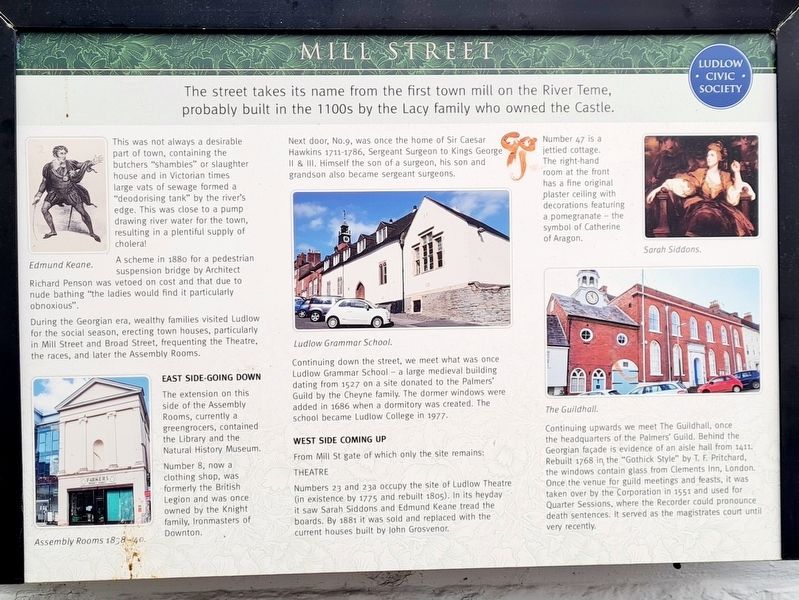
1. Mill Street Marker
The street takes its name from the first town mill on the River Teme, probably built in the 1100s by the Lacy family who owned the Castle.
This was not always a desirable part of town, containing the butchers "shambles" or slaughter house and in Victorian times large vats of sewage formed a "deodorising tank" by the river's edge. This was close to a pump drawing river water for the town, resulting in a plentiful supply of cholera!
A scheme in 1880 for a pedestrian suspension bridge by Architect Richard Penson was vetoed on cost and that due to nude bathing "the ladies would find it particularly obnoxious".
During the Georgian era, wealthy families visited Ludlow for the social season, erecting town houses, particularly in Mill Street and Broad Street, frequenting the Theatre, the races, and later the Assembly Rooms.
East Side Going Down
The extension on this side of the Assembly Rooms, currently a greengrocers, contained the Library and the Natural History Museum.
Number 8, now a clothing shop, was formerly the British Legion and was once owned by the Knight family, Ironmasters of Downton.
Next door, No.9, was
this page online
Continuing down the street, we meet what was once Ludlow Grammar School - a large medieval building dating from 1527 on a site donated to the Palmers' Guild by the Cheyne family. The dormer windows were added in 1686 when a dormitory was created. The school became Ludlow College in 1977.
West Side Coming Up
From Mill St gate of which only the site remains:
THEATRE
Numbers 23 and 23a occupy the site of Ludlow Theatre (in existence by 1775 and rebuilt 1805). In its heyday it saw Sarah Siddons and Edmund Keane tread the boards. By 1881 it was sold and replaced with the current houses built by John Grosvenor.
Number 47 is a jettied cottage. The right-hand room at the front has a fine original plaster ceiling with decorations featuring a pomegranate - the symbol of Catherine of Aragon.
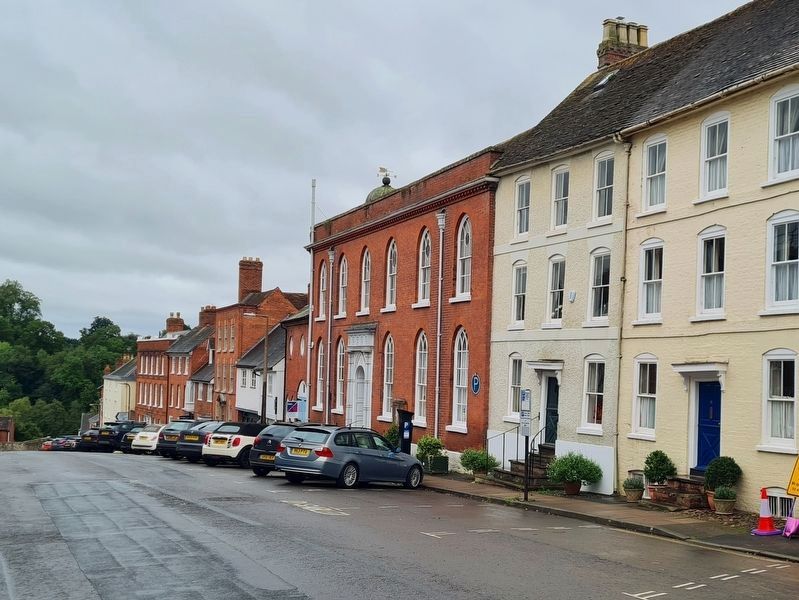
Continuing upwards we meet The Guildhall, once the headquarters of the Palmers' Guild. Behind the Georgian façade is evidence of an aisle hall from 1411. Rebuilt 1768 in, the "Gothick
Photographed by Stephen Palmer, September 17, 2023
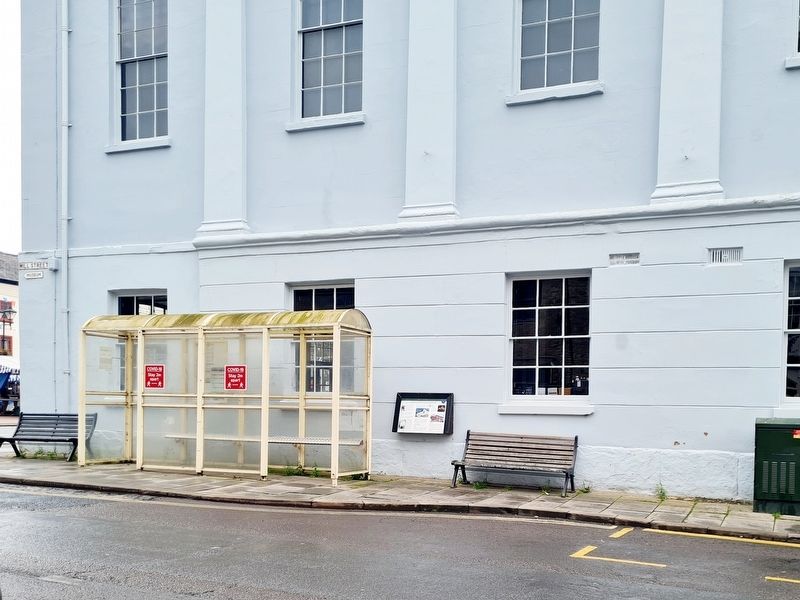
2. Mill Street Marker
Erected by Ludlow Civic Society.
Topics. This historical marker is listed in these topic lists: Architecture • Education • Entertainment • Law Enforcement.
Location. 52° 22.024′ N, 2° 43.254′ W. Marker is in Ludlow, England, in Shropshire. It is on Mill Street. Marker is next to the bus shelter at the top of Mill Street. Touch for map. Marker is at or near this postal address: 1 Mill Street, Ludlow, England SY8 1AZ, United Kingdom. Touch for directions.

Regionally, this marker is in England’s Midlands. It is also on the British Marches. Globally, it is on the Atlantic Ocean, in the North Atlantic Region, in Europe, in Atlantic Europe, on one of the British Isles, in the Western World, and in the Anglosphere. Historically, it finds itself

Photographed by Stephen Palmer, September 19, 2023
3. Mill Street
Other nearby markers. At least 8 other markers are within walking distance of this marker: 11-13 Castle Street (a few steps from this marker); 2 Dinham (within shouting distance of this marker); Edward V (within shouting distance of this marker); Castle Square (within shouting distance of this marker); 7 Dinham (within shouting distance of this marker); Ludlow Town (within shouting distance of this marker); 8 High Street (within shouting distance of this marker); Dinham Hall (about 90 meters away, measured in a direct line). Touch for a list and map of all markers in Ludlow.

Photographed by Stephen Palmer, September 19, 2023
4. Mill Street
Photographed by Stephen Palmer, September 19, 2023
5. Mill Street
Credits. This page was last revised on September 21, 2023. It was originally submitted on September 20, 2023, by Stephen Palmer of Ascot, England. This page has been viewed 171 times since then and 34 times this year. Photos: 1, 2, 3, 4, 5. submitted on September 20, 2023, by Stephen Palmer of Ascot, England. • Andrew Ruppenstein was the editor who published this page.
