Casco Viejo in Pamplona in Navarre, Spain — Southwestern Europe (Iberian Peninsula)
Labrit Bastion
Photographed by J. Makali Bruton, August 2, 2023
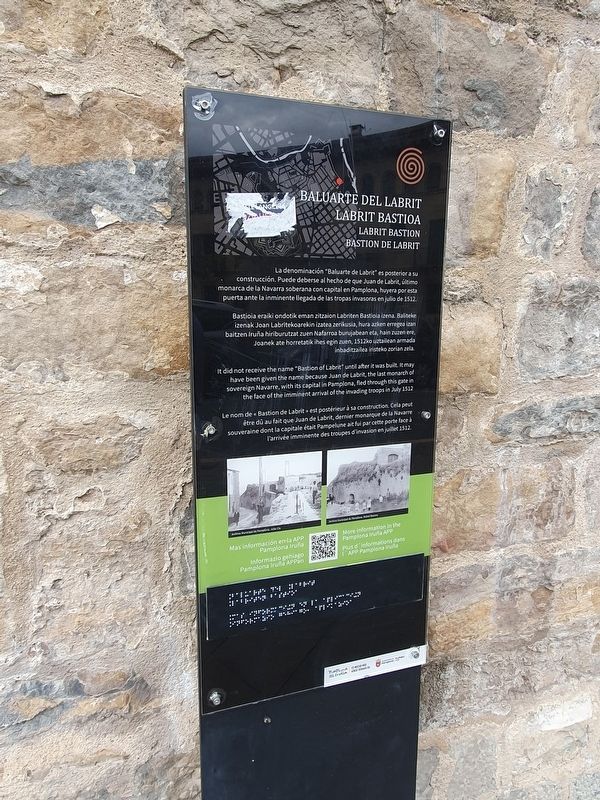
1. Labrit Bastion Marker

La denominación “Baluarte de Labrit” es posterior a su construcción. Puede deberse al hecho de que Juan de Labrit, último monarca de la Navarra soberana con capital en Pamplona, huyera por esta puerta ante la inminente llegada de las tropas invasoras en julio de 1512.
Labrit Bastioa
Bastioia eraiki ondotikeman zitzaion Labriten Bastioia izena. Baliteke izenak Joan Labritekoarekin izatea zerikusia, hura azken erregea izan baitzen Iruña hiriburutzat zuen Nafarroa burujabean eta, hain zuzen ere, Joanek ate horretatik ihes egin zuen, 1512ko uztailean armada inbaditzailea iristeko zorian zela.
Labrit Bastion
It did not receive the name “Bastion of Labrit” until after it was built. It may have been given the name because Juan de Labrit, the last monarch of sovereign Navarre, with its capital in Pamplona, fled through this gate in the face of the imminent arrival of the invading troops in July 1512.
Bastion de Labrit
Le nom de Bastion de Labrit es postérieur a sa construction. Cela puet etre du au fait que Juan de Labrit, dernier monarque de la Navarre souveraine don’t la capitae
this page online
Erected by Ayuntamiento de Pamplona.
Topics. This historical marker is listed in these topic lists: Forts and Castles • Wars, Non-US. A significant historical month for this entry is July 1512.
Location. 42° 49.071′ N, 1° 38.331′ W. Marker is in Pamplona, Navarra (Navarre). It is in Casco Viejo. It is at the intersection of Plaza Santa María la Real and Ronda Obispo Barbazán, on the right when traveling north on Plaza Santa María la Real. Touch for map. Marker is at or near this postal address: Plaza Sta María la Real 1-363, Pamplona, Navarra 31001, Spain. Touch for directions.

Regionally, it is in the North Atlantic Region, on the Atlantic Arc, in Europe, in the European Union, in Atlantic Europe, on the Iberian Peninsula, in the Schengen Area, in a coastal Mediterranean country, and in the Western World. Historically, it finds itself in what was once the Roman Empire.
Other nearby markers. At least 8 other markers are within walking distance of this marker: Archbishop's Palace (within shouting distance of this
Photographed by J. Makali Bruton, August 2, 2023
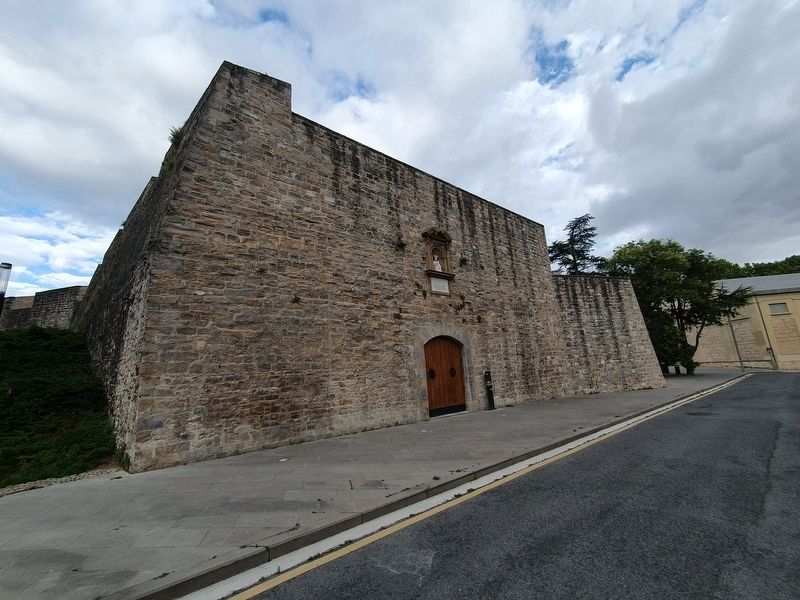
2. Labrit Bastion and Marker
Regarding Labrit Bastion. The 'invading troops of 1512' were the Aragonese troops of Ferdinand II. This invasion marked the beginning of the end of the independent Kingdom of Navarra and its incorporation into the growing nation-state of Spain.
Credits. This page was last revised on September 21, 2023. It was originally submitted on September 21, 2023, by J. Makali Bruton of Washington, District of Columbia. This page has been viewed 145 times since then and 14 times this year. Photos: 1, 2. submitted on September 21, 2023, by J. Makali Bruton of Washington, District of Columbia.
