Trevi in Roma in Città metropolitana di Roma Capitale, Latium, Rome, Italy — Central Italy (Tyrrhenian Coast)
Chiesa di Santa Maria di Loreto ⎯⎯⎯ Church of Santa Maria of Loreto
secc.: XVI, XVII, XIX
—
Architetti: A. da Sangallo il Giovane (1484-1546), J. Del Duca (1520-1601), L. Carimini (1830-1890)
—
Photographed by James Hulse, June 24, 2023
1. Chiesa di Santa Maria di Loreto / Church of Santa Maria of Loreto Marker
Inscription. La chiesa di S. Maria di Loreto insiste su un eminente sito archeologico, anticamente occupato quasi per intero dalle strutture del Tempio del Divo Traiano (fatto costruire da Adriano nel 11 sec. d.C.), alle spalle della Basilica Ulpia e della celebre colonna di Traiano. La facciata della chiesa, cui fa da perfetto pendant quella della chiesa pseudo-gemella del SS. Nome di Maria (XVIII sec.), si pone anzi come fondale allo spazio prospiciente qualificato dai noti resti archeologici. La fondazione del tempio è da ricollegare all'Università dei Fornari, creata ai primi del Cinquecento, dopo quella dei fornai tedeschi a Roma (1487). Nel 1501 papa Alessandro VI (1492- 1503) riconobbe la Confraternitas laicorum pistorum italorum de Urbe (la Corporazione dei Fornari e la Confraternita dei garzoni e panettieri), a cui concesse di poter svolgere il culto in una piccola chiesa situata nel Foro di Traiano. Nel 1507 papa Giulio II (1503-1513) diede il consenso per l'avvio della costruzione di una nuova chiesa sullo stesso sito, con la doppia dedicazione alla Madonna di Loreto (poiché nell'edificio del Foro se ne venerava un'immagine) ed alla Natività di Maria Vergine (poiché caro ai panettieri). La sede dei fornai si legava in tal modo ad una tradizione antica, infatti anche l'imperatore Traiano (53-117 d.C.) nella stessa zona aveva fatto collocare il mercato del pane, delle granaglie e delle farine, con l'attiguo collegium dei fornai (in latino pistores). Il primitivo progetto della chiesa è probabilmente ascrivibile al Bramante, ma i lavori si interruppero presto (erano state tracciate solo le fondamenta) per mancanza di fondi; il cantiere riaprì nel 1522 sotto la direzione di Antonio da Sangallo il Giovane, che condusse la costruzione del dado basamentale e della parte inferiore del corpo dell'edificio, con
Click or scan to see this page online
una provvisoria copertura a tetto. Nel 1534 il nuovo tempio, non ancora completato, fu consacrato, ma procedettero i lavori per la realizzazione della facciata. Dopo un nuovo periodo di stasi, nel 1573 la fabbrica fu affidata a Jacopo del Duca (allievo di Michelangelo e membro della Confraternita dei Fornai); il principale intervento dell'architetto siciliano fu di condurre a termine l'elevazione della cupola sull'alto tamburo, oltre all'erezione del piccolo e singolare campanile e alle opere di rifinitura sia all'interno che all'esterno. Nel 1577 la chiesa era compiuta: ne risultò un edificio dal marcato carattere ascensionale, accentuato dalle partiture esterne e dalla plastica lanterna svettante dalla cupola. Nei pressi della chiesa la Confraternita fece erigere anche l'ospedale dei Fornai, a cui fu annesso un oratorio (1577-1585). Alla morte del Del Duca rimanevano da realizzare l'apparato decorativo all'interno e la costruzione della tribuna, ossia della cappella dedicata alla Madonna di Loreto; del completamento strutturale si occupò fra il 1638 e il 1649 Gaspare De Vecchi, autore della sacrestia e della tribuna. I lavori si conclusero
Photographed by James Hulse, June 24, 2023
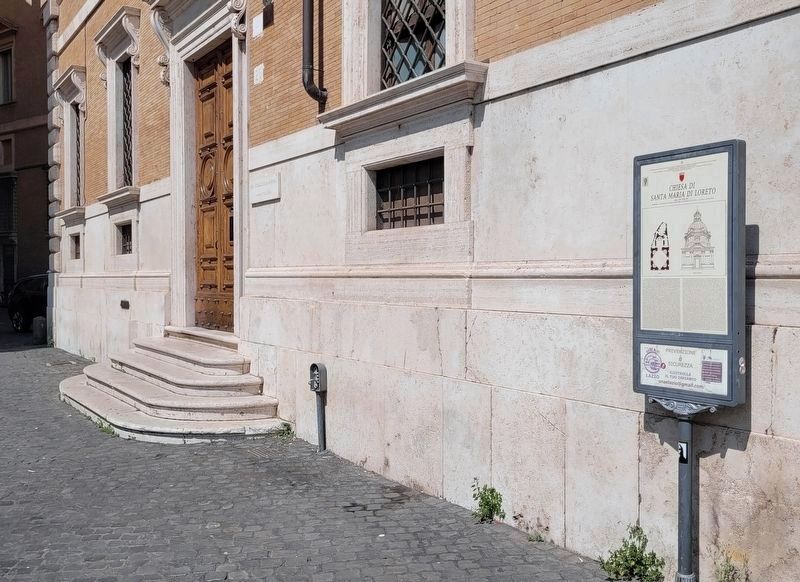
2. The side entrance to the Church of Santa Maria of Loreto and Marker
definitivamente tra il 1680 e il 1690, con la realizzazione delle stuccature nella calotta interna della cupola, eseguite in linea con il progetto del Del Duca. Alla fine del Settecento gravi problemi statici resero necessari nuovi interventi, a cui si aggiunsero gli ultimi restauri ottocenteschi di Luca Carimini, secondo un progetto di ripulitura che implicava anche una nuova decorazione dell'interno. La pianta ottagonale, scandita da quattro cappelle concepite come grandi nicchie e dalla tribuna resa come un corpo a sé stante, fu arricchita nel corso del Cinquecento e nella prima metà del secolo successivo dell'apparato decorativo, che ci appare oggi profondamente alterato dalle modifiche ottocentesche.
English: The Church of Santa Maria di Loreto stands over an important archaeological site, in ancient times almost entirely covered by the Temple of the God Trajan (built by Hadrian in the II cent. A.D.), behind the Basilica Ulpia and the famous Trajan's Column. The church façade is perfectly complemented by the pseudo-twin church of the Holy Name of Mary (XVIIIth cent.), and indeed makes a fine backdrop for the important archaeological
Photographed by James Hulse, June 24, 2023
3. The Church of Santa Maria of Loreto Marker along the side of the church
area in front. The founding of the church is associated with the University of the Fornari, created in the early XVIth cent., after the University of German Bakers in Rome (1487). In 1501, Pope Alexander VI (1492-1503) recognised the Confraternitas laicorum pistorum italorum de Urbe (Corporation of Bakers and Confraternity of Apprentices and Bakers), and allowed them to worship in a small church inside the Forum of Trajan. In 1507 Pope Julius IInd (1503-1513) granted permission to start building a new church on the same site, dedicated to the Madonna of Loreto (an image of which was worshipped inside the building in the Forum) and to the Birth of the Virgin Mary (greatly loved by bakers). This church of the bakers' gave new life to an ancient tradition as it was in this area that Emperor Trajan (53-117 a.D.) had set up the bread, corn and flour market, with the "collegium" of bakers nearby (pistores in Latin). The early church was probably designed by Bramante, but work soon came to a standstill through lack of funds when only the foundations had been laid; work began again in 1522 directed by Antonio da Sangallo the Younger, who supervised
Photographed by James Hulse, June 24, 2023
4. The Church of Santa Maria of Loreto
the building of the church base and the lower body of the building, with a temporary roof. In 1534 the unfinished new church was consecrated, though work continued to complete the façade. In 1573, after another stop, a Sicilian architect and pupil of Michelangelo called Jacopo del Duca (also a member of the Bakers' Confraternity) was put in charge of the job; he supervised the placing of the dome over the tall drum, had an unusual little bell tower built and added finishing touches to the church interior and exterior. In 1577, work concluded producing a church with a striking upward thrust, emphasised still further by the outer details and the lantern standing out above the dome. The Confraternity built the Bakers' Hospital nearby, with an Oratory next door (1577-1585). When Del Duca died, only the interior décor and the apse chapel dedicated to the Madonna of Loreto were still incomplete; from 1638 to 1649, structural work was executed by Gaspare De Vecchi, who also built the sacresty and the apse. The building was finished between 1680 and 1690, with the crafting of stucco-work in the inner calotte of the dome to Del Duca's designs. In the late XVIIIth cent., serious problems of stability made repair work necessary, and last of all in the XIXth cent. restoration was directed by Luca Carimini, as part of a cleaning project that included new interior decorations as well. The church with its octagonal ground plan comprised four chapels in the form of large niches and an apse built as a separate structure; decorative works were added in the XVIth cent, and in the first half of the XVII cent, though these are now entirely different as a result of extensive alterations made in the XIXth cent.
Erected by Ministero per i Beni e le Attività Culturali, Presidenza del Consiglio dei Ministri Dipartimento del Turismo, Soprintendenza per i Beni Ambientali e Architettonici di Roma, Comune di Roma, Assessorato alle Politiche Culturali, Sovraintendenza ai Beni Culturali, Assessorato al Turismo e Giubileo, Azienda di Promozione Turistica di Roma.
Location. 41° 53.764′ N, 12° 29.013′ E. Marker is in Roma, Lazio (Latium, Rome), in Città metropolitana di Roma Capitale. It is in Trevi. It is at the intersection of Piazza della Madonna di Loreto and Via dei Fornari, on the right when traveling north on Piazza della Madonna di Loreto. The marker is located northwest wall of the church. Touch for map. Marker is in this post office area: Roma, Lazio 00187, Italy. Touch for directions.
Regionally, it is in Europe, the European Union, the Schengen Area, a coastal Mediterranean country, and the Western World. Historically, it finds itself in what was once the Roman Empire.
Santa Maria di Loreto is a 16th-century church in Rome, central Italy, located just across the street from the Trajan's Column, near the giant Monument of Vittorio Emanuele II.
(Submitted on September 24, 2023, by James Hulse of Medina, Texas.)
Credits. This page was last revised on September 24, 2023. It was originally submitted on September 22, 2023, by James Hulse of Medina, Texas. This page has been viewed 238 times since then and 40 times this year. Photos:1, 2, 3, 4. submitted on September 24, 2023, by James Hulse of Medina, Texas.