Casco Viejo in Pamplona in Navarre, Spain — Southwestern Europe (Iberian Peninsula)
The Chapel of las Navas de Tolosa
Photographed by J. Makali Bruton, August 3, 2023
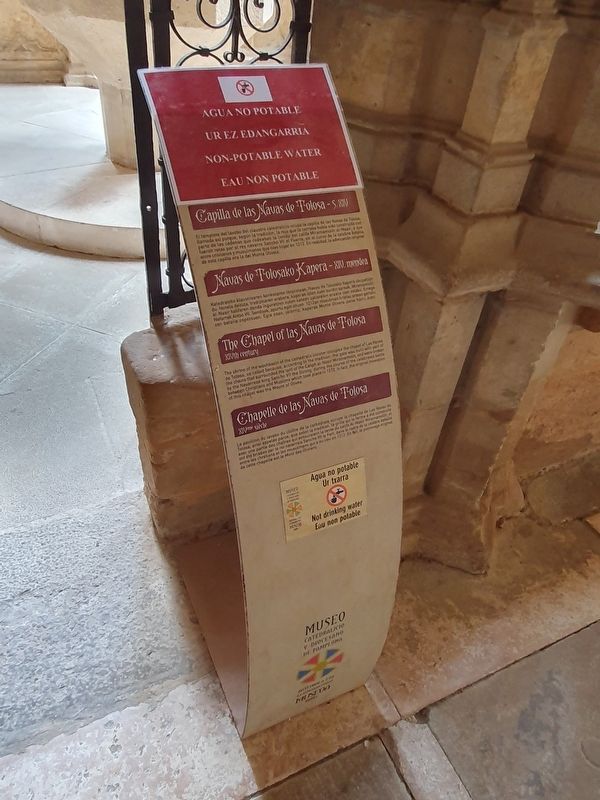
1. The Chapel of las Navas de Tolosa Marker

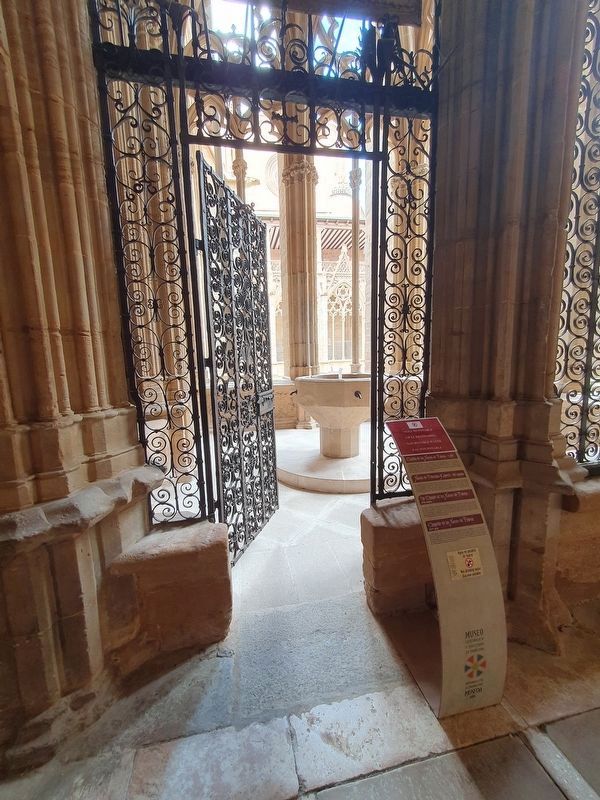
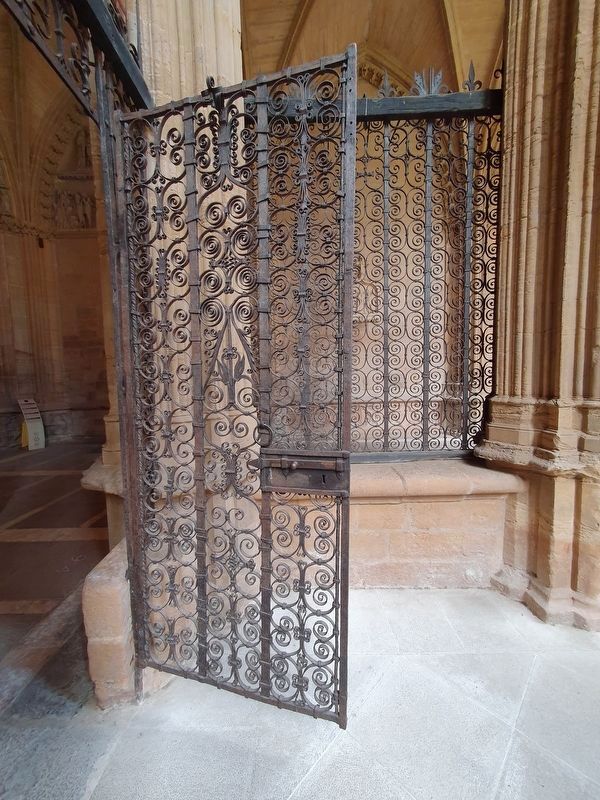
El templete del lavabo del claustro catedrático ocupa la capilla de las Navas de Tolosa, llamada así porque, según la tradición, la reja que la cerraba había sido construida con parte de las cadenas que rodeaban la tienda del califa Miramamolín al-Nasir y que fueron rotas por el rey navarro Sancho VII el Fuerte, en el curso de la célebre batalla entre cristianos y musulmanes que tuvo lugar en 1212. En realidad, la advocación original de esta capilla era la del Monte Olivete.
Navas de Tolosa Kapera – XIV.mendea
Katedraleko klaustroaren konketaren templeteak Navas de Tolosako Kapera okupatzen du. Honeia deitufa, tranizioaren arabere, kaperak isten zuen burdin areak. Miramamolin al-Nasier kalifaren dendeinguratzen zuten kateen zatiarekin eraikia izan zetako. Errega Narafarrak Antso VII. Sendoak, apurtu egin zituen 1217an musulman kristau arteen gertalu zen bataila ospetsuan. Egia esan, jatorriz, kaperak, Monte Oliveta izena hartu zuen.
The Chapel of las Navas de Tolosa
XIVth century
The shrine of the washbasin of the cathedral’s cloister occupies the chapel of
this page online
Chapelle de las Navas de Tolosa
XIVéme siècle
Le pavillion du lavabo du cloitre de la cathédrale occupe la chapelle de Las Navas de Tolosa, ainse appelée parce, que selon la tradition, la grille qui le ferme a été construite aven une partie des chaines que entouraient la tente du califa Al-Nasir Miramamolin, et ont été brisées par le roi navarrais Sancho VII le Fort, dans le cadre de la célébre bataille entre les chrétiens et les musulmans qui a eu lieu en 1212. En fait, le patronaje original de cette chapelle est le Mont des Oliviers.
Erected by Museo Catedralicio y Diocesano de Pamplona.
Topics. This historical marker is listed in these topic lists: Architecture • Wars, Non-US. A significant historical year for this entry is 1212.
Location. 42° 49.158′ N,
Photographed by J. Makali Bruton, August 3, 2023
2. The Chapel of las Navas de Tolosa Marker

Regionally, it is in the North Atlantic Region, on the Atlantic Arc, in Europe, in the European Union, in Atlantic Europe, on the Iberian Peninsula, in the Schengen Area, in a coastal Mediterranean country, and in the Western World. Historically, it finds itself in what was once the Roman Empire.
Other nearby markers. At least 8 other markers are within walking distance of this marker: The Courtyard of a Thousand Years (within shouting distance of this marker); Capilla Barbazana / Barbazana Chapel (within shouting distance of this marker); Julio Martín-Caro Soto (within shouting distance of this marker); Catedral de Santa María la Real (about 90 meters away, measured in a direct line); No Tengas Miedo (about 90 meters away); Pío Baroja (about
Photographed by J. Makali Bruton, August 3, 2023
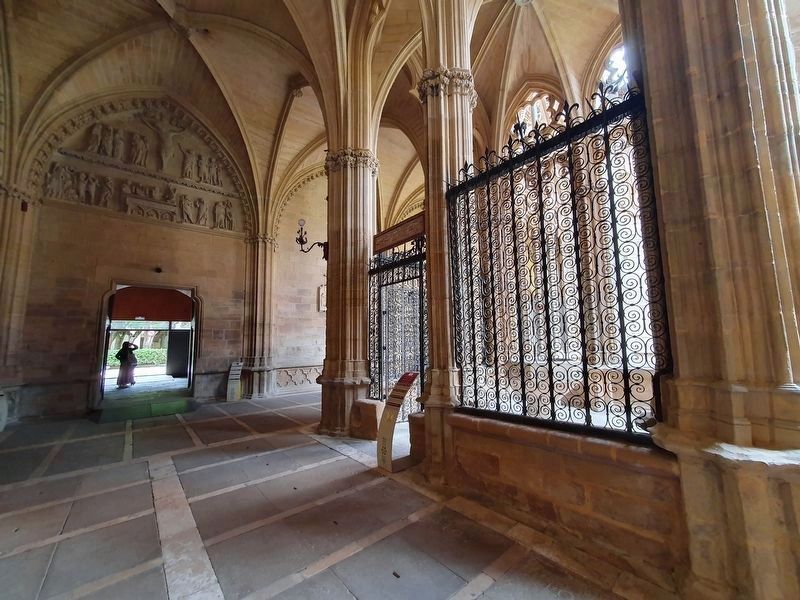
3. The Chapel of las Navas de Tolosa and Marker
The Puerta Arcedinato can be seen in the distance on the left.
Also see . . . Battle of las Navas de Tolosa at Wikipedia.
The Battle of Las Navas de Tolosa, known in Islamic history as the Battle of Al-Uqab (Arabic: معركة العقاب), took place on 16 July 1212 and was an important turning point in the Reconquista and the medieval history of Spain. The Christian forces of King Alfonso VIII of Castile, were joined by the armies of his rivals, Sancho VII of Navarre and Peter II of Aragon, in battle against the Almohad Muslim rulers of the southern half of the Iberian Peninsula. The caliph al-Nasir (Miramamolín in the Spanish chronicles) led the Almohad army, made up of people from all over the Almohad Caliphate.(Submitted on September 25, 2023.)
Photographed by J. Makali Bruton, August 3, 2023
4. The Chapel of las Navas de Tolosa Metalwork
Credits. This page was last revised on September 25, 2023. It was originally submitted on September 25, 2023, by J. Makali Bruton of Washington, District of Columbia. This page has been viewed 185 times since then and 39 times this year. Photos: 1, 2, 3, 4. submitted on September 25, 2023, by J. Makali Bruton of Washington, District of Columbia.
