Riverside in Cook County, Illinois — The American Midwest (Great Lakes)
Old River-Crossing
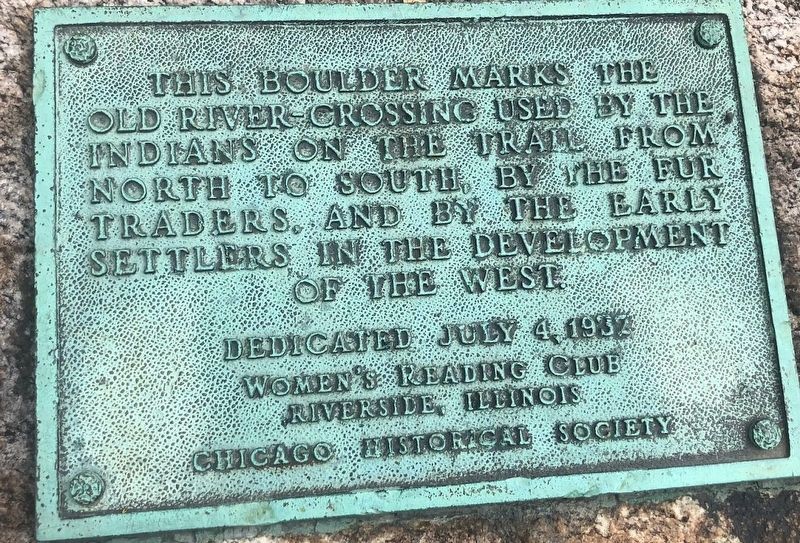
Photographed by Sean Flynn, September 25, 2023
1. Old River Crossing Marker
Erected 1932 by Women's Reading Club of Riverside, Illinois; Chicago Historical Society.
Topics. This historical marker is listed in these topic lists: Indigenous Peoples and Communities • Settlements & Settlers • Waterways & Vessels.
Location. 41° 49.349′ N, 87° 49.26′ W. Marker is in Riverside, Illinois, in Cook County. It is on Fairbank Road 0.1 miles east of Millbridge Road. The marker is between Fairbank Road and the parallel walking path, about a tenth of a mile east of the Millbridge Road crossing over the Des Plaines River. Touch for map. Marker is in this post office area: Riverside IL 60546, United States of America. Touch for directions.

Regionally, this marker is in Greater Chicago. It is also in the American Midwest. Globally, it is in North America, on the Great Lakes, in the Western Hemisphere, in the Western World, and in the Anglosphere.
this page online
Other nearby markers. At least 8 other markers are within walking distance of this marker: Hofmann Dam Removal (about 600 feet away, measured in a direct line); Hofmann Tower (about 700 feet away); The Hofmann Dam (approx. 0.2 miles away); Bourbon Spring (approx. ¼ mile away); Veterans Memorial (approx. ¼ mile away); Stephen Van Rensselaer Forbes Home Site (approx. 0.3 miles away); World War Memorial (approx. 0.3 miles away); Sergeant James P. Quinn (approx. 0.3 miles away). Touch for a list and map of all markers in Riverside.
Also see . . . History of Dams in Riverside, IL. From the Frederick Law Olmsted Society of Riverside:
Excerpt: "In 1827, the first dam at the Hofmann site was built by the Laughton Brothers. The dam was placed upon a natural waterfall along the Green Bay Trail of the Indian, also known as the Riverside Ford. The waterfall is formed by a limestone shelf which at one time, following the last Ice Age, marked the shores of Lake Chicago. The Laughtons(Submitted on September 26, 2023, by Sean P. Flynn of Oak Park, Illinois.)developed this geologic feature to power the first sawmill of Northeastern Illinois thus beginning a period of urban growth in the region. The Laughtons’ dam, of simple timber construction, was short lived and the sawmill is presumed to have closed around 1839."Photographed by Sean Flynn, September 25, 20232. Old River Crossing MarkerThe Des Plaines River is in the background.
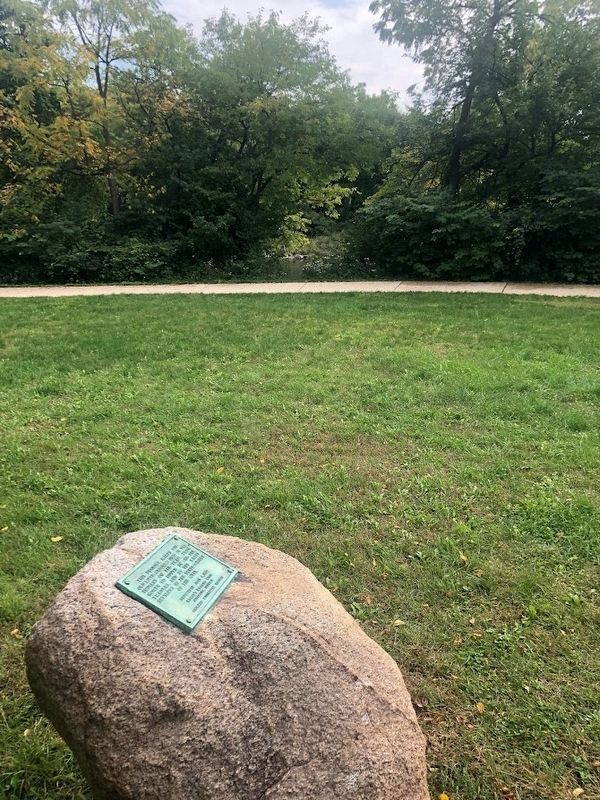
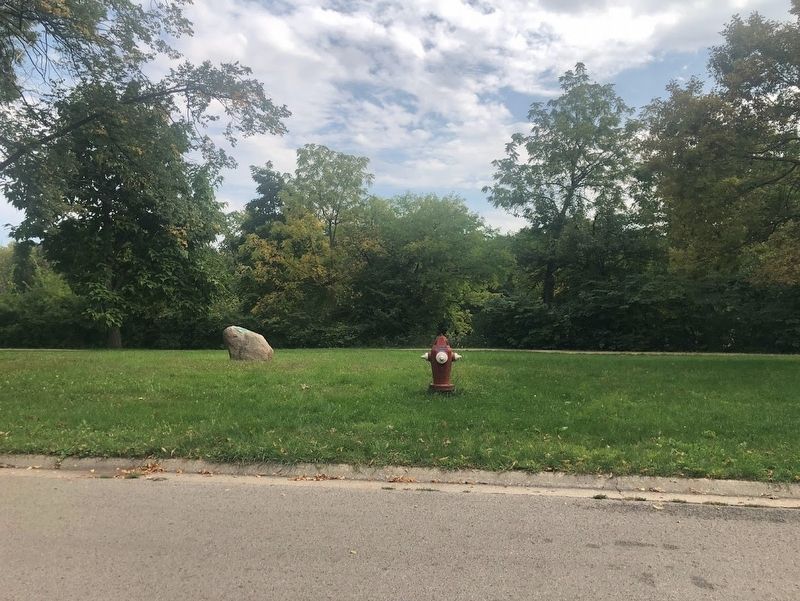
Photographed by Sean Flynn, September 25, 2023
3. Old River Crossing Marker view from Fairbank Road
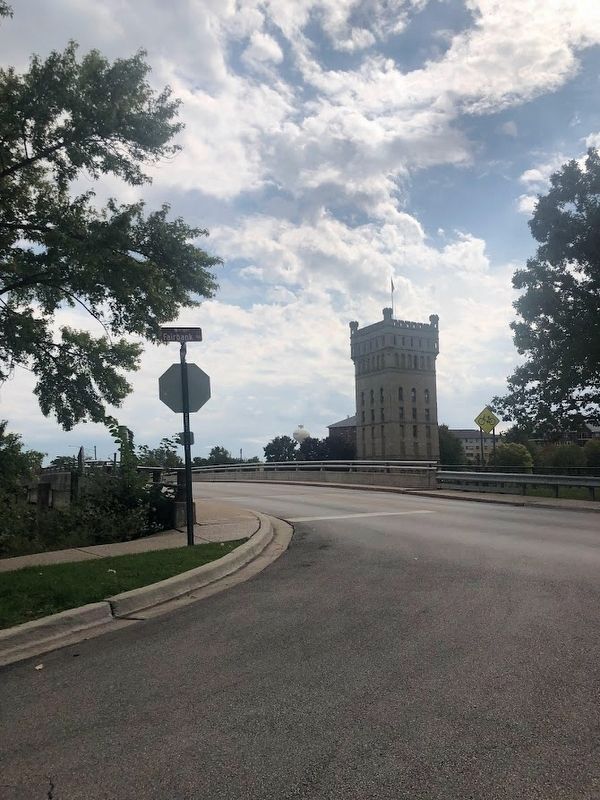
Photographed by Sean Flynn, September 25, 2023
4. Modern crossing over the Des Plaines River and Hoffman Tower
The modern crossing over the Des Plaines is about a tenth of a mile from the boulder and tablet. Hofmann Tower, located in Lyons, is visible in the rear of this photo.
Credits. This page was last revised on May 15, 2024. It was originally submitted on September 25, 2023, by Sean P. Flynn of Oak Park, Illinois. This page has been viewed 465 times since then and 42 times this year. Photos: 1, 2, 3, 4. submitted on September 25, 2023, by Sean P. Flynn of Oak Park, Illinois. • Andrew Ruppenstein was the editor who published this page.
