Woodbridge in Prince William County, Virginia — The American South (Mid-Atlantic)
Occoquan
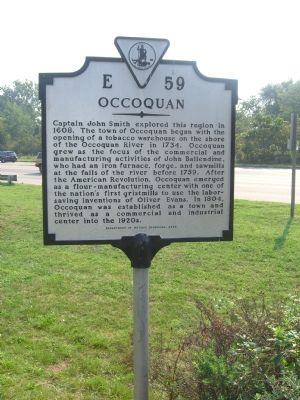
Photographed by Kevin White, September 6, 2007
1. Occoquan Marker
Erected 2000 by Department of Historic Resources. (Marker Number E-59.)
Topics and series. This historical marker is listed in these topic lists: Colonial Era • Industry & Commerce • Settlements & Settlers • War, US Revolutionary. In addition, it is included in the Virginia Department of Historic Resources (DHR) series list. A significant historical year for this entry is 1608.
Location. Marker has been permanently removed. It was located near 38° 39.926′ N, 77° 14.635′ W. Marker was in Woodbridge,
this page online
We have been informed that this marker is no longer there and will not be replaced. This page is an archival view of what was.
Regionally, this marker was in the Washington Metropolitan Area, in Northern Virginia, and in the Piedmont. It was also in the American South, specifically in the Upper South, in the Mid-Atlantic, and on the Eastern Seaboard. Globally, it was in the North Atlantic Region, North America, the Western Hemisphere, the Western World, and the Anglosphere. Historically, it found itself in what was once the territory of the Mississippian Culture, one of the original Thirteen Colonies, one of the Confederate States of America, and the Antebellum South.

Other nearby markers. At least 8 other markers are within 2 miles of this location, measured as the crow flies: A Near Tragedy (about 700 feet away, measured in a direct line); Colchester (approx.
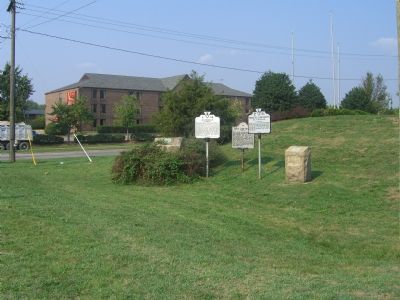
Photographed by Kevin White, September 6, 2007
2. Occoquan Marker
There are four other markers here, The First Courthouse of Prince William County, Early Land Patents, Fairfax County / Prince William County, and Jefferson Davis Highway.
Other markers no longer nearby. Early Land Patents (was here, next to this marker but has been permanently removed); The First Courthouse of Prince William County (was here, next to this marker but has been permanently removed); Fairfax County / Prince William County (was here, next to this marker but has been permanently removed).
Also see . . . History of Occoquan. Compiled by Nellie Curtis - published in the May 1993 newsletter of Historic Prince William. (Submitted on September 6, 2007, by Kevin W. of Stafford, Virginia.)
Additional commentary.
1. Earlier Marker
This marker replaces a previous marker, erected in 1927. The previous marker read:
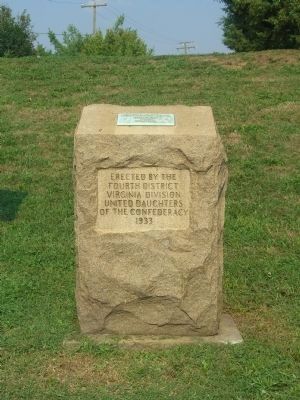
Photographed by Kevin White
3. Jefferson Davis Highway - Virginia Marker
Jefferson Davis Highway - Virginia
(Front of Marker)
Erected by the Fourth District
Virginia Division
United Daughters of the Confederacy
1933
— Submitted February 14, 2011, by Kevin W. of Stafford, Virginia.
Credits. This page was last revised on May 24, 2023. It was originally submitted on September 6, 2007, by Kevin W. of Stafford, Virginia. This page has been viewed 1,948 times since then and 38 times this year. Photos: 1, 2, 3. submitted on September 6, 2007, by Kevin W. of Stafford, Virginia. • J. J. Prats was the editor who published this page.
