Phillips in Minneapolis in Hennepin County, Minnesota — The American Midwest (Upper Plains)
Park Avenue Residential District
⎯⎯⎯
Distrito Residencial Avenida Park
The Museum in the Streets: Minneapolis, Minnesota
| — | Midtown: A Place to Call Home | — |
Photographed by McGhiever, November 2, 2022
1. Park Avenue Residential District / Distrito Residencial Avenida Park Marker

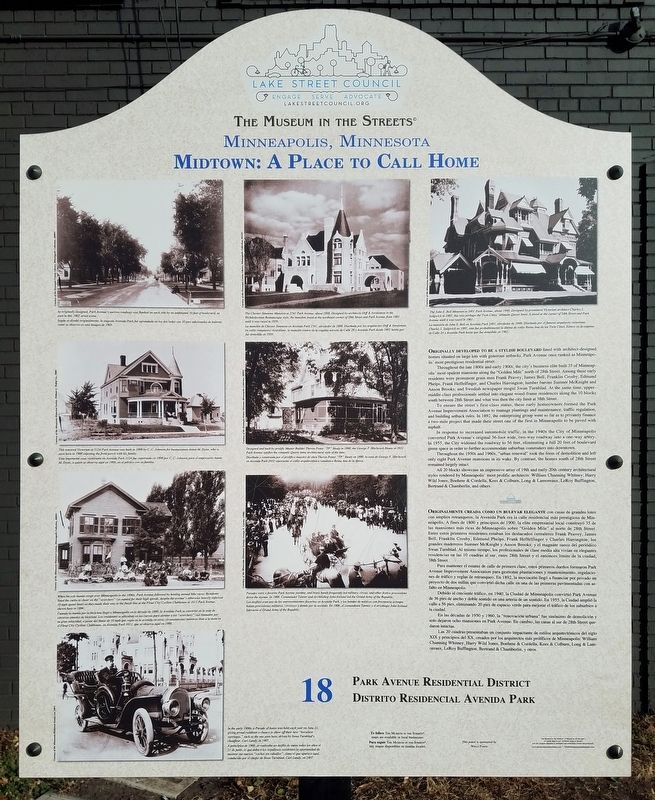
Originally developed to be a stylish boulevard lined with architect-designed homes situated on large lots with generous setbacks, Park Avenue once ranked as Minneapolis' most prestigious residential street.
Throughout the late 1800s and early 1900s, the city's business elite built 35 of Minneapolis' most opulent mansions along the "Golden Mile" north of 28th Street. Among these early residents were prominent grain men Frank Peavey, James Bell, Franklin Crosby, Edmund Phelps, Frank Heffelfinger, and Charles Harrington; lumber barons Sumner McKnight and Anson Brooks; and Swedish newspaper mogul Swan Turnblad. At the same time, upper-middle-class professionals settled into elegant wood-frame residences along the 10 blocks south between 28th Street and what was then the city limit at 38th Street.
To ensure the street's first-class status, these early homeowners formed the Park Avenue Improvement Association to manage plantings and maintenance, traffic regulation, and building setback rules. In 1892, the enterprising group went to far as to privately finance a two-mile project that made their street one of the first
this page online
In response to increased automobile traffic, in the 1940s the City of Minneapolis converted Park Avenue's original 36-foot wide, two-way roadway into a one-way artery. In 1955, the City widened the roadway to 56 feet, eliminating a full 20 feet of boulevard green space in order to further accommodate suburban commuters into downtown.
Throughout the 1950s and 1960s, "urban renewal" took the form of demolition and left only eight Park Avenue mansions in its wake. By contrast, the homes south of 28th Street remained largely intact.
All 20 blocks showcase an impressive array of 19th and early-20th century architectural styles rendered by Minneapolis' most prolific architects: William Channing Whitney, Harry Wild Jones, Boehme & Cordella, Kees & Colburn, Long & Lamoreaux, LeRoy Buffington, Bertrand & Chamberlin, and others.
Photographed by McGhiever, November 2, 2022
2. Park Avenue Residential District / Distrito Residencial Avenida Park Marker
Para mantener el estatus de calle de primera clase, estos primeros dueños formaron Park Avenue Improvement Association para gestionar plantaciones y mantenimiento, regulaciones de tráfico y reglas de retranqueo. En 1892, la asociación llegó a financiar por privado un proyecto de dos millas que convirtió dicha calle en una de las primeras pavimentadas con asfalto en Minneapolis.
Debido al creciente tráfico, en 1940, la Ciudad de Minneapolis convirtió Park Avenue de 36 peis de ancho y doble sentido en una arteria de un sentido. En 1955, la Ciudad amplió la calle a 56 pies, eliminando 20 pies de espacio verde para mejorar el tráfico de los suburbios a la ciudad.
En las décadas the 1950 y 1960, la "renovación urbana" fue sinónimo de demolición y solo dejaron ocho mansiones en Park Avenue. En cambio, las casas al sur de 28th Street quedaron intactas.
Las 20 cuadras presentaban un conjunto impactante de estilos aquitectónicos del siglo XIX y principios del XX, creados por los arquitectos más prolíficos de Minneapolis: William Channing Whitney, Harry Wild Jones, Boehme & Cordella, Kees & Colburn, Long & Lamoreaux, LeRoy Buffington, Bertrand & Chamberlin, y otros.
Erected by The Museum in the Streets®. (Marker Number 18.)
Topics and series. This historical marker is listed in these topic lists: Architecture • Roads & Vehicles. In addition, it is included in the The Museum in the Streets: Minneapolis, Minnesota series list. A significant historical year for this entry is 1890.
Location. 44° 56.912′ N, 93° 15.903′ W. Marker is in Minneapolis, Minnesota, in Hennepin County. It is in Phillips. It is at the intersection of Park Avenue and E. Lake Street, on the right when traveling north on Park Avenue. Touch for map. Marker is at or near this postal address: 700 E Lake Street, Minneapolis MN 55407, United States of America. Touch for directions.

Regionally, this marker is in the Twin Cities Metropolitan Area. It is also in the American Midwest, in the Corn Belt, and in the Great River Road Region. Globally, it is in North America, the Western Hemisphere, the Western World, and the Anglosphere. Historically, it finds itself in what was once Rupert’s Land, the territory of the Mississippian Culture, and the Louisiana Purchase.
Other nearby markers. At least 8 other markers are within walking distance of this marker: 3009 Park Avenue: Pauline and Thomane Fjelde (here, next to this marker); 2627-47 Chicago Avenue: Northwestern Hospital for Women and Children (about 600 feet away, measured in a direct line); 804 East Lake: Town Treat Café / Calle Lake Este 804: Cafetería Town Treat (about 700 feet away); Midtown: A Place to Call Home (approx. 0.2 miles away); Minneapolis in the Age of Grade Separation (approx. 0.2 miles away); 2947 10th Avenue South: St. Mary's Greek Orthodox Church (approx. ¼ mile away); 2845 10th Avenue South: Elevator X (approx. ¼ mile away); An Era of New Business on the Rail Corridor (approx. 0.3 miles away). Touch for a list and map of all markers in Minneapolis.
Credits. This page was last revised on October 16, 2023. It was originally submitted on October 3, 2023, by McGhiever of Minneapolis, Minnesota. This page has been viewed 307 times since then and 69 times this year. Photos: 1, 2. submitted on October 3, 2023, by McGhiever of Minneapolis, Minnesota. • Andrew Ruppenstein was the editor who published this page.
