Riverside in Cook County, Illinois — The American Midwest (Great Lakes)
Historic Riverside
Distinguishing Features
Photographed by Sean Flynn
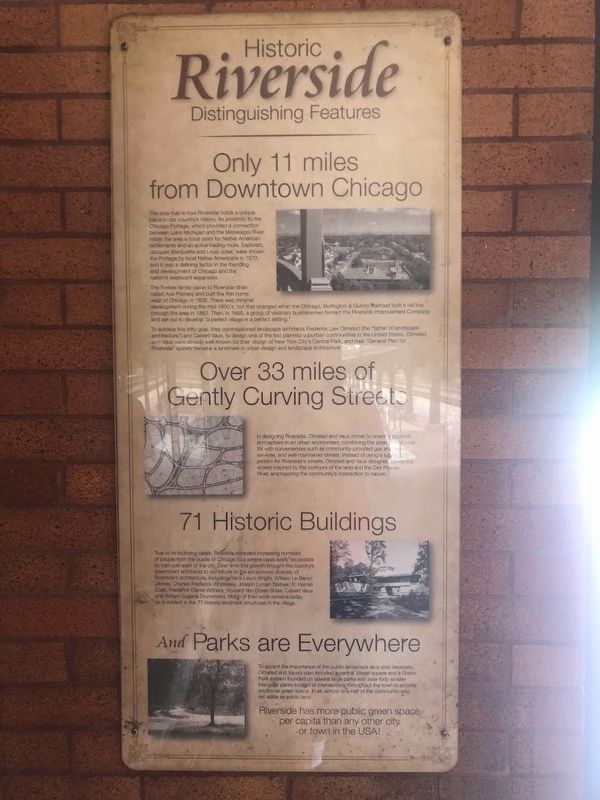
1. Historic Riverside Distinguishing Features Marker
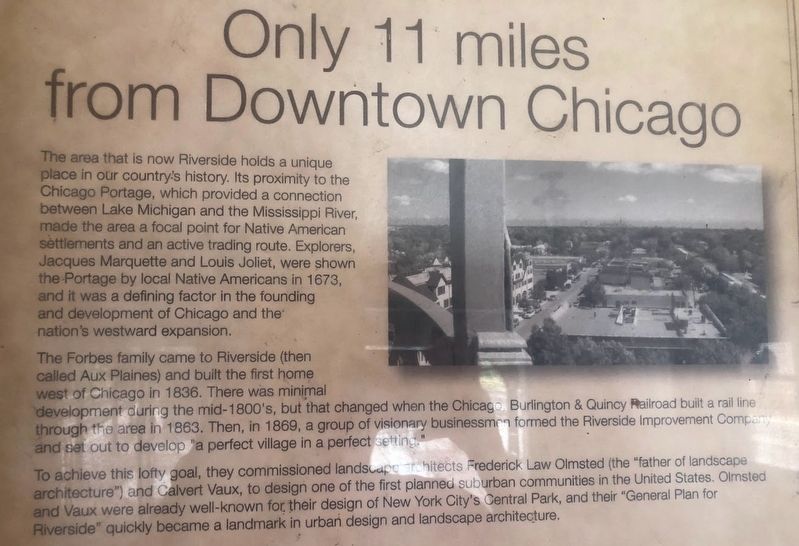
The area that is now Riverside holds a unique place in our country's history. Its proximity to the Chicago Portage, which provided a connection between Lake Michigan and the Mississippi River, made the area a focal point for Native American settlements and an active trading route. Explorers, Jacques Marquette and Louis Joliet, were shown the Portage by local Native Americans in 1673, and it was a defining factor in the founding and development of Chicago and the nation's westward expansion.
The Forbes family came to Riverside (then called Aux Plaines) and built the first home west of Chicago in 1836. There was minimal development during the mid-1800's, but that changed when the Chicago, Burlington & Quincy Railroad built a rail line through the area in 1863. Then, in 1869, a group of visionary businessmen formed the Riverside Improvement Company and set out to develop "a perfect village in a perfect setting."
To achieve this lofty goal, they commissioned landscape architects Frederick Law Olmsted (the "father of landscape architecture") and Calvert Vaux, to design one of the first
this page online
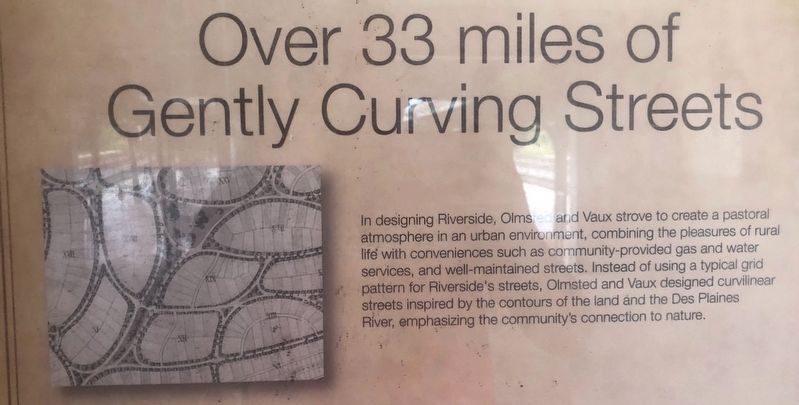
In designing Riverside, Olmsted and Vaux strove to create a pastoral atmosphere in an urban environment, combining the pleasures of rural life with conveniences such as community-provided gas and water services, and well-maintained streets. Instead of using a typical grid pattern for Riverside's streets, Olmsted and Vaux designed curvilinear streets inspired by the contours of the land and the Des Plaines River, emphasizing the community's connection to nature.
True to its founding ideals, Riverside attracted increasing numbers of people from the bustle of Chicago to a serene oasis easily accessible by train just west of the city. Over time this growth brought the country's preeminent architects to contribute to the exceptional diversity of Riverside's architecture, including Frank Lloyd Wright, William Le Baron Jenney,
Photographed by Sean Flynn
2. Historic Riverside Distinguishing Features Marker, top section
To accent the importance of the public landscape as a civic necessity, Olmsted and Vaux's plan included a central Village square and a Grand Park system founded on several large parks with over forty smaller triangular parks located at intersections throughout the town to provide additional green space. In all, almost one-half of the community was set aside as public land.
per capita than any other city
or town in the USA!
Topics and series. This historical marker is listed in these topic lists: Architecture • Exploration • Settlements & Settlers • Waterways & Vessels. In addition, it is included in the Frank Lloyd Wright series list. A significant historical year for this entry is 1673.
Location. 41° 49.652′ N, 87° 49.188′ W. Marker is in Riverside, Illinois, in Cook County. It is on Pine Avenue west
Photographed by Sean Flynn, September 25, 2023
3. Historic Riverside Distinguishing Features Marker, middle section

Regionally, this marker is in Greater Chicago. It is also in the American Midwest. Globally, it is in North America, on the Great Lakes, in the Western Hemisphere, in the Western World, and in the Anglosphere. Historically, it finds itself in what was once the Viceroyalty of New France, the territory of the Mississippian Culture, and the Northwest Territory.
Other nearby markers. At least 8 other markers are within walking distance of this marker: A different marker also named Historic Riverside (here, next to this marker); Brookfield Zoo (a few steps from this marker); Riverside (a few steps from this marker); Riverside, Illinois (within shouting distance of this marker); Private Albert Edward Moore (within shouting distance of this marker); Reverend Hedley Heber Cooper

Photographed by Sean Flynn, September 25, 2023
4. Historic Riverside Distinguishing Features Marker, bottom section

Photographed by Sean Flynn
5. Train depot pavilion and Historic Riverside marker.
This marker is on the left of the entryway. An east-bound BNSF Line train headed towards downtown Chicago is waiting outside.

Photographed by Sean Flynn
6. Discover Riverside map
This map is on the south wall of the pavilion, not far from the Distinguishing Features marker. Note the curved streets and parkland referenced in that marker. The train depot is the red number 11 on the map.
Credits. This page was last revised on May 21, 2025. It was originally submitted on October 3, 2023, by Sean P. Flynn of Oak Park, Illinois. This page has been viewed 193 times since then and 26 times this year. Photos: 1. submitted on October 3, 2023, by Sean P. Flynn of Oak Park, Illinois. 2, 3, 4, 5, 6. submitted on October 4, 2023, by Sean P. Flynn of Oak Park, Illinois. • Andrew Ruppenstein was the editor who published this page.
