Pittsboro in Chatham County, North Carolina — The American South (South Atlantic)
Lynching in America ⎯⎯⎯ Lynching in Chatham County
Community Remembrance Project
Photographed by Duane and Tracy Marsteller, September 2, 2023
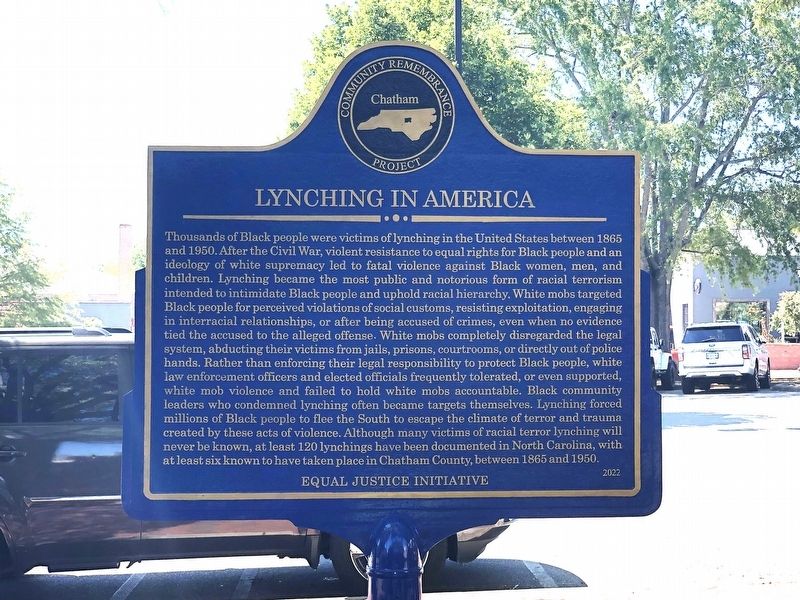
1. Lynching in America side of marker
Inscription.
Lynching in America
Thousands of Black people were victims of lynching in the United States between 1865 and 1950. After the Civil War, violent resistance to equal rights for Black people and an ideology of white supremacy led to fatal violence against Black women, men, and children. Lynching became the most public and notorious form of racial terrorism intended to intimidate Black people and uphold racial hierarchy. White mobs targeted Black people for perceived violations of social customs, resisting exploitation, engaging in interracial relationships, or after being accused of crimes, even when no evidence tied the accused to the alleged offense. White mobs completely disregarded the legal system, abducting their victims from jails, prisons, courtrooms, or directly out of police hands. Rather than enforcing their legal responsibility to protect Black people, white law enforcement officers and elected officials frequently tolerated, or even supported, white mob violence and failed to hold white mobs accountable. Black community leaders who condemned lynching often became targets themselves. Lynching forced millions
Click or scan to see this page online
of Black people to flee the South to escape the climate of terror and trauma created by these acts of violence. Although many victims of racial terror lynching will never be known, at least 120 lynchings have been documented in North Carolina, with at least six known to have taken place in Chatham County, between 1865 and 1950.
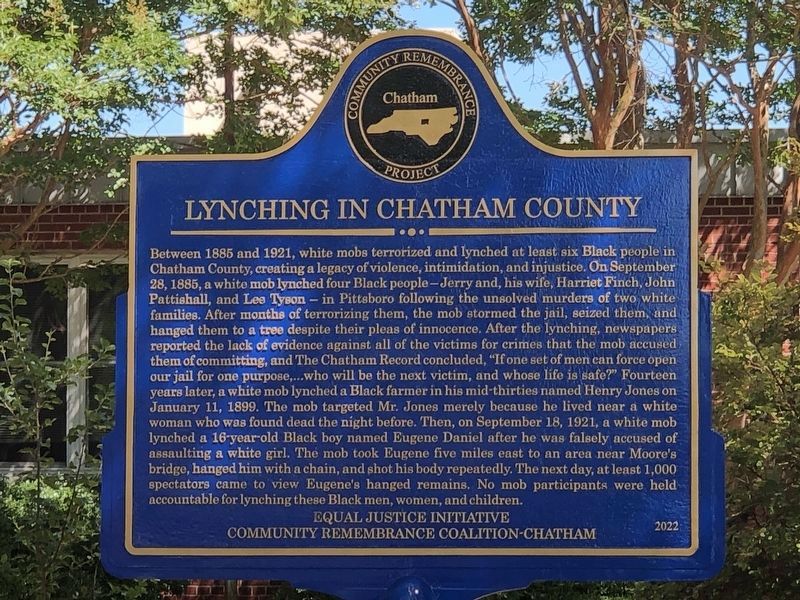
Lynching in Chatham County
Between 1885 and 1921, white mobs terrorized and lynched at least six Black people in Chatham County, creating a legacy of violence, intimidation, and injustice. On September 28, 1885, a white mob lynched four Black people – Jerry and, his wife, Harriet Finch, John Pattishall, and Lee Tyson - in Pittsboro following the unsolved murders of two white families. After months of terrorizing them, the mob stormed the jail, seized them, and hanged them to a tree despite their pleas of innocence. After the lynching, newspapers reported the lack of evidence against all of the victims for crimes that the mob accused them of committing, and The Chatham Record concluded, “If one set of men can force open our jail for one purpose, … who will be the next victim, and whose life is safe?” Fourteen
Photographed by Duane and Tracy Marsteller, September 2, 2023
2. Lynching in Chatham County side of marker
years later, a white mob lynched a Black farmer in his mid-thirties named Henry Jones on January 11, 1899. The mob targeted Mr. Jones merely because he lived near a white woman who was found dead the night before. Then, on September 18, 1921, a white mob lynched a 16-year-old Black boy named Eugene Daniel after he was falsely accused of assaulting a white girl. The mob took Eugene five miles east to an area near Moore's bridge, hanged him with a chain, and shot his body repeatedly. The next day, at least 1,000 spectators came to view Eugene's hanged remains. No mob participants were held accountable for lynching these Black men, women, and children.
Erected 2022 by Equal Justice Initiative • Community Remembrance Coalition-Chatham.
Topics and series. This historical marker is listed in these topic lists: African Americans • Civil Rights • Law Enforcement. In addition, it is included in the Lynching in America series list. A significant historical date for this entry is September 28, 1885.
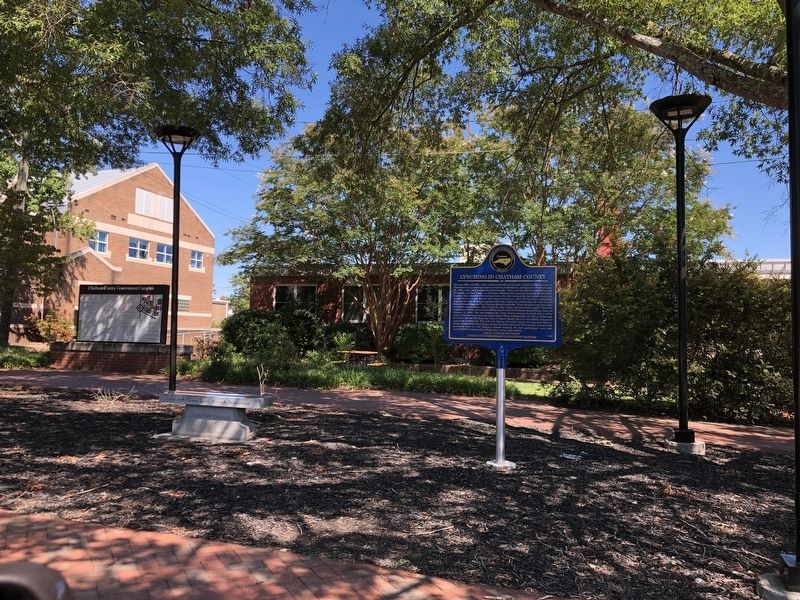
Location. 35° 43.169′ N, 79° 10.635′ W. Marker is in Pittsboro, North Carolina, in Chatham County. It is on South Street north of East Chatham Street
Photographed by Duane and Tracy Marsteller, September 2, 2023
3. Lynching in Chatham County / Lynching in America Marker
when traveling north. Marker is behind the Chatham County Government Annex. Touch for map. Marker is at or near this postal address: 45 South St, Pittsboro NC 27312, United States of America. Touch for directions.
Regionally, this marker is in the Piedmont. It is also in the American South and specifically in the Upper South. Globally, it is in North America, the Western Hemisphere, the Western World, and the Anglosphere. Historically, it finds itself in what was once the territory of the Mississippian Culture, one of the original Thirteen Colonies, one of the Confederate States of America, and the Antebellum South.
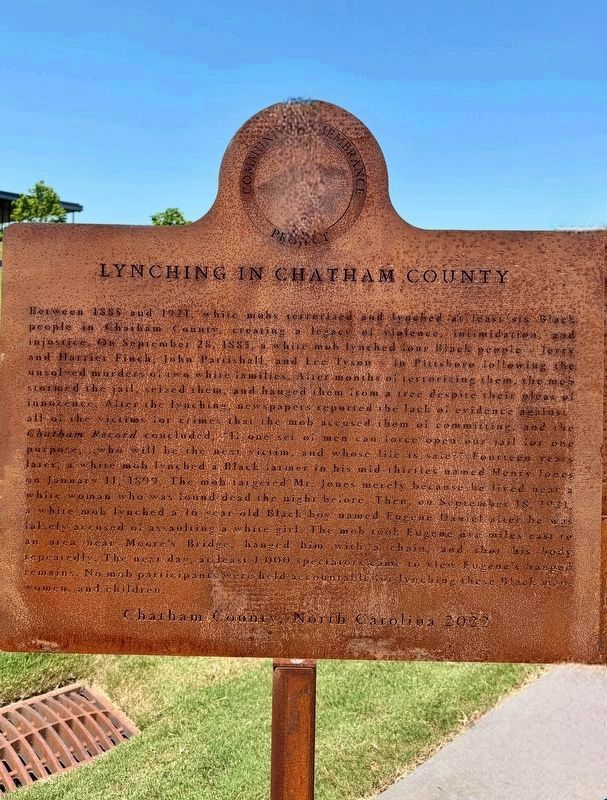
“A Replica marker of one side is located at the Equal Justice Initiatives' National Memorial for Peace and Justice in Montgomery, Alabama. The Equal Justice Initiative supports efforts to locally memorialize documented victims of racial violence and to educate communities about the history of racial injustice.” Mark Hilton
nearby. Our Confederate Heroes (was about 400 feet away, measured in a direct line but has been permanently removed).
Credits. This page was last revised on May 2, 2026. It was originally submitted on October 4, 2023, by Duane and Tracy Marsteller of Murfreesboro, Tennessee. This page has been viewed 494 times since then and 58 times this year. Photos:1, 2, 3. submitted on October 4, 2023, by Duane and Tracy Marsteller of Murfreesboro, Tennessee. 4. submitted on October 16, 2024, by Brandon D Cross of Flagler Beach, Florida.