Haute-Ville in Québec in Capitale-Nationale, — Central Canada (French-Canadian)
La Cathédrale Épiscopale de la Sainte-Trinité/ Cathedral of the Holy Trinity
Photographed by Tim Boyd, October 15, 2023
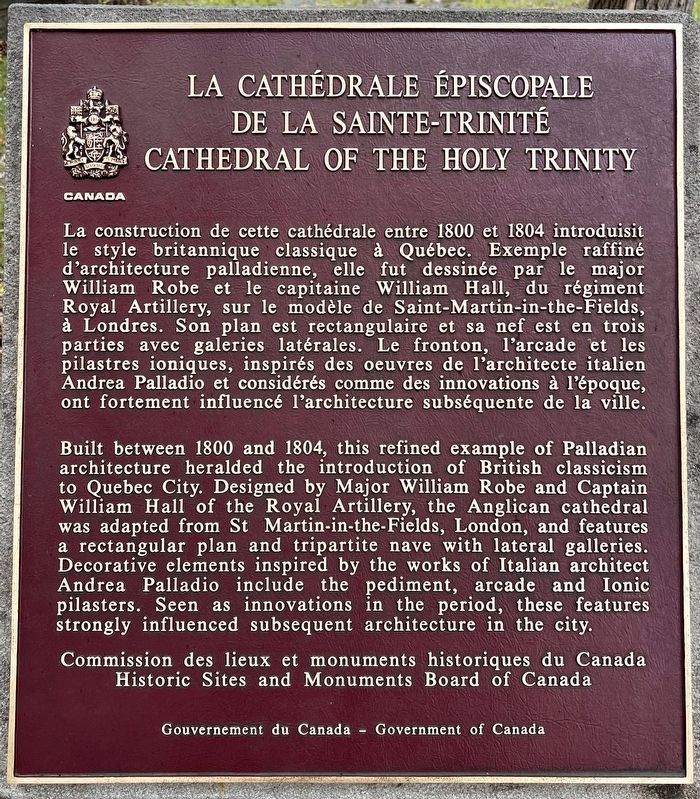
1. La Cathédrale Épiscopale de la Sainte-Trinité/ Cathedral of the Holy Trinity Marker

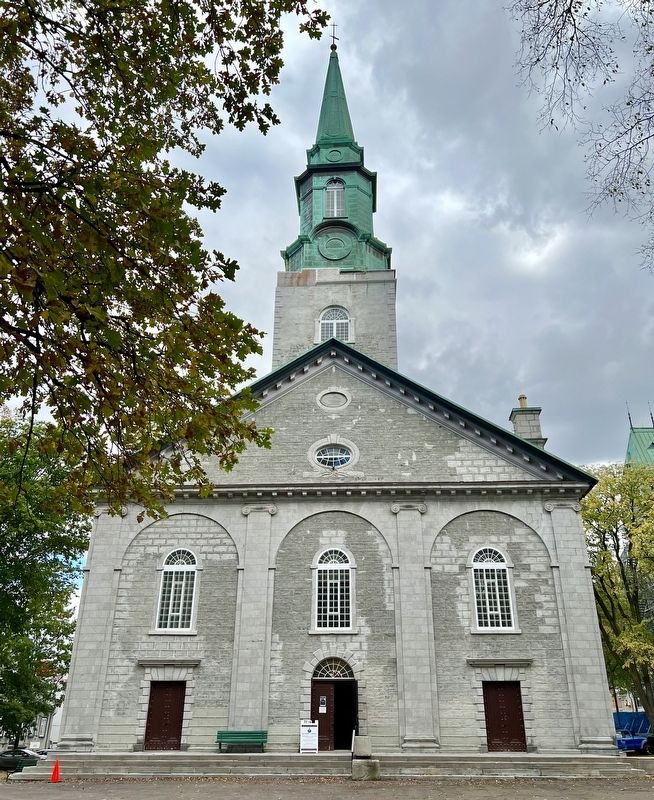
La construction de cette cathédrale entre 1800 et 1804 introduisit le style britannique classique à Québec. Exemple raffiné d'architecture palladienne, elle fut dessinée par le major William Robe et le capitaine William Hall, du régiment Royal Artillery, sur le modèle de Saint-Martin-in-the-Fields, à Londres. Son plan est rectangulaire et sa nef est en trois parties avec galeries latérales. Le fronton, l'arcade et les pilastres ioniques, inspirés des oeuvres de l'architecte italien Andrea Palladio et considérés comme des innovations à l'époque, ont fortement influencé l'architecture subséquente de la ville.
Built between 1800 and 1804, this refined example of Palladian architecture heralded the introduction of British classicism to Quebec City. Designed by Major William Robe and Captain William Hall of the Royal Artillery, the Anglican cathedral was adapted from St Martin-in-the-Fields, London, and features a rectangular plan and tripartite nave with lateral galleries. Decorative elements inspired by the works of Italian architect Andrea
this page online
Commission des lieux et monuments historiques du Canada
Historic Sites and Monuments Board of Canada
Gouvernement du Canada
Government of Canada
Erected by Historic Sites and Monuments Board of Canada.
Topics and series. This historical marker is listed in these topic lists: Architecture • Colonial Era • Religion & Religious Structures. In addition, it is included in the Canada, Historic Sites and Monuments Board series list. A significant historical year for this entry is 1800.
Location. 46° 48.779′ N, 71° 12.439′ W. Marker is in Québec, in Capitale-Nationale. It is in Haute-Ville. It is at the intersection of Rue des Jardins and Rue Sainte-Anne, on the right when traveling north on Rue des Jardins. Touch for map. Marker is at or near this postal address: Rue des Jardins, Québec, Canada. Touch for directions.

Regionally, this marker is in Central Canada. Globally, it is in North America, the Western Hemisphere, and the Western World. Historically,
Photographed by Tim Boyd, October 13, 2023
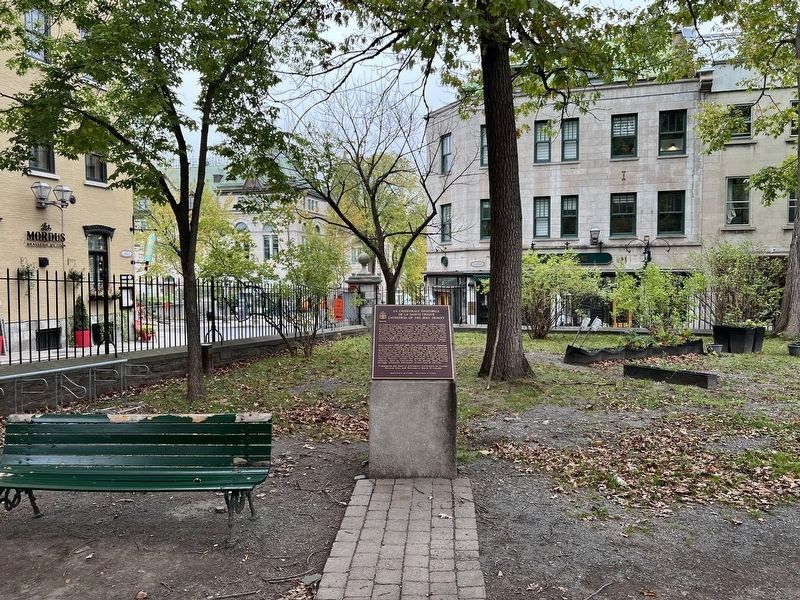
2. La Cathédrale Épiscopale de la Sainte-Trinité/ Cathedral of the Holy Trinity Marker
Other nearby markers. At least 8 other markers are within walking distance of this marker: Édifice Price / Price Building (within shouting distance of this marker); Mise en lumière de l'édifice Price à Québec / Illumination of the Price Building in Quebec City (within shouting distance of this marker); Collège des Jésuites / Jesuit College (within shouting distance of this marker); Pierre-Joseph-Olivier Chauveau (about 90 meters away, measured in a direct line); L'hôtel de Ville de Québec / Québec City Hall (about 90 meters away); Le Vieux-Québec, site du patrimoine mondial de l'UNESCO (about 90 meters away); Home of the Quebec Chronicle-Telegraph (about 120 meters away); hic iacet D D franciscus de Laval / Here lies D D Francis de Laval (about 120 meters away). Touch for a list and map of all markers in Québec.
Also see . . . Ville de Quebec - Cathedral of Holy Trinity.
From 1800 to 1804, the British government provided financial backing for construction of the Cathedral of(Submitted on October 16, 2023, by Tim Boyd of Hamilton, Ontario.)the Holy Trinity, a short distance from the former residence of the governor of New France. Surrounded by lovely gardens, it was erected on the site of the Recollect monastery whose chapel had been a place of worship for Catholics and Anglicans alike since 1760.Photographed by Tim Boyd, October 13, 20233. La Cathédrale Épiscopale de la Sainte-Trinité/ Cathedral of the Holy Trinity
Photographed by Tim Boyd, October 13, 2023
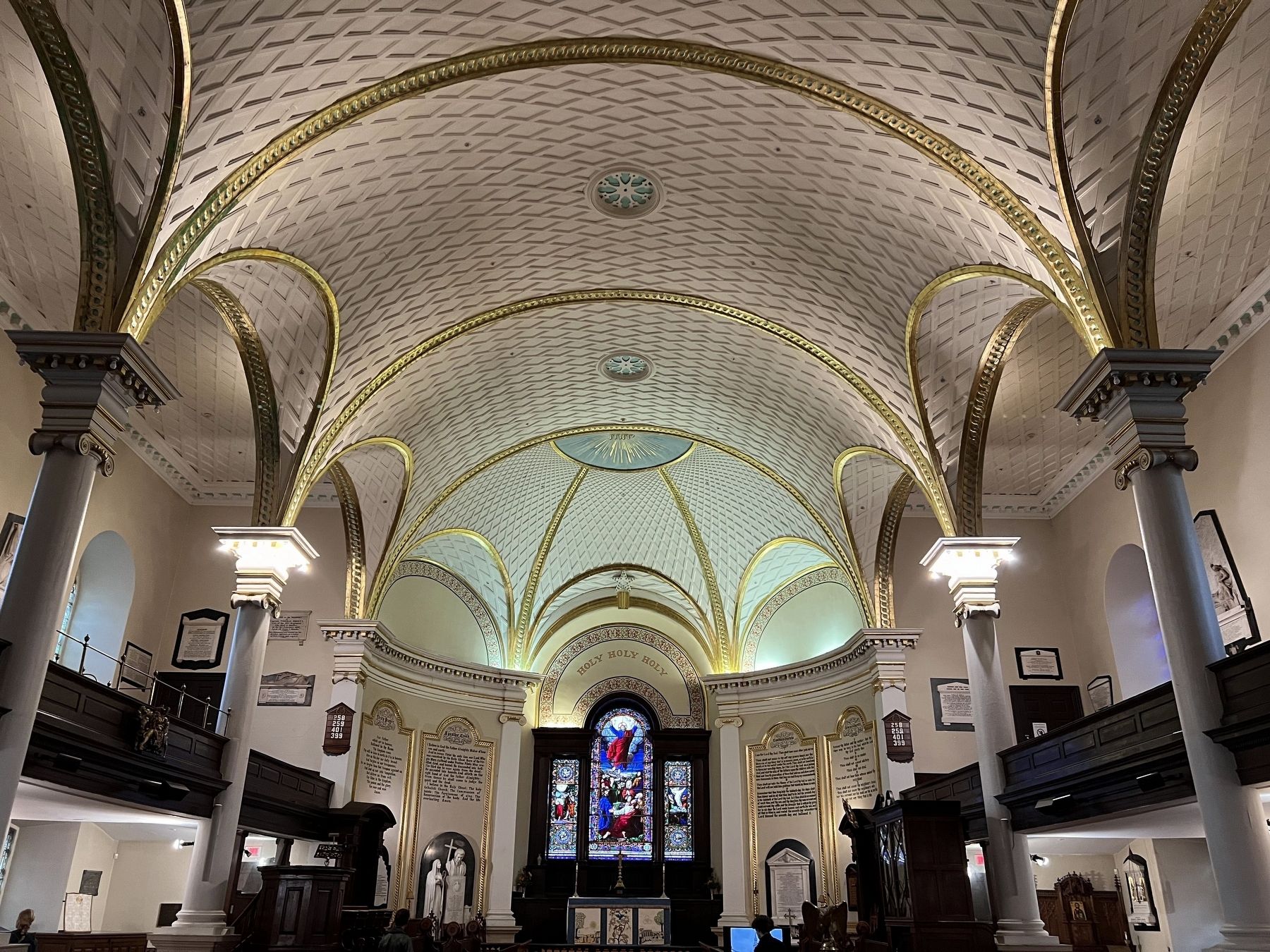
4. La Cathédrale Épiscopale de la Sainte-Trinité/ Cathedral of the Holy Trinity interior
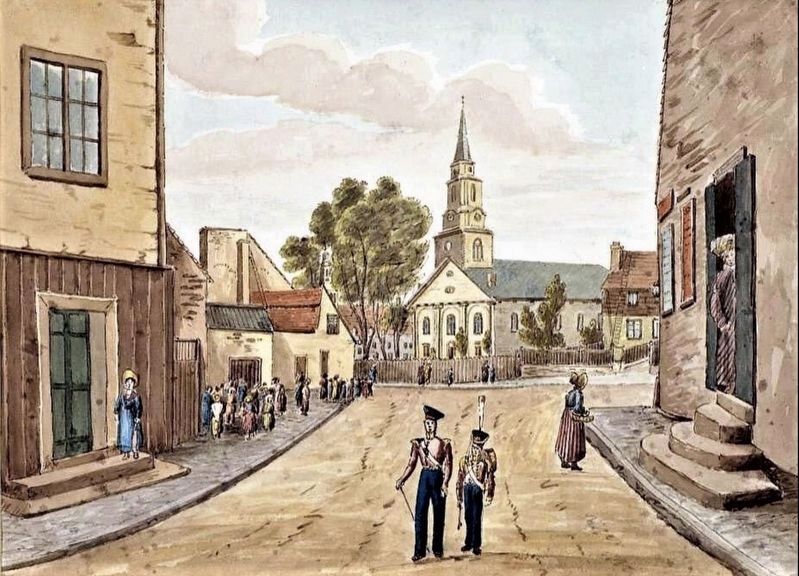
5. A view of Cathedral of the Holy Trinity, 1830
Credits. This page was last revised on December 21, 2025. It was originally submitted on October 16, 2023, by Tim Boyd of Hamilton, Ontario. This page has been viewed 238 times since then and 14 times this year. Photos: 1, 2, 3, 4, 5. submitted on October 16, 2023, by Tim Boyd of Hamilton, Ontario. • Andrew Ruppenstein was the editor who published this page.
