La Pointe in Ashland County, Wisconsin — The American Midwest (Great Lakes)
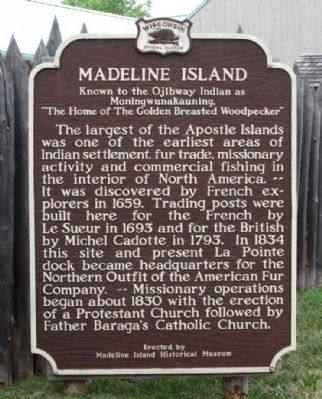
Madeline Island
Known to the Ojibway Indians as Moningwunakauning, "The Home of The Golden Breasted Woodpecker"
Photographed by Paul Fehrenbach, June 17, 2012
1. Madeline Island Marker
Erected 1961 by Madeline Island Historical Museum. (Marker Number 108.)
Topics and series. This historical marker is listed in these topic lists: Exploration • Indigenous Peoples and Communities • Industry & Commerce • Settlements & Settlers. In addition, it is included in the Wisconsin Historical Society series list. A significant historical year for this entry is 1659.
Location. Marker has been reported permanently removed. It was located near 46° 46.814′ N, 90° 47.297′ W. Marker was in La Pointe, Wisconsin, in Ashland County. It was
this page online
We have been informed that this marker is no longer there and will not be replaced. This page is an archival view of what was.
Regionally, this marker was on the North Shore. It was also in the American Midwest, in the Corn Belt, and on Lake Superior’s South Shore Region. Globally, it was in North America, in the Great North Woods, on the Great Lakes, in the Western Hemisphere, in the Western World, and in the Anglosphere. Historically, it found itself in what was once the Viceroyalty of New France, the territory of the Mississippian Culture, and the Northwest Territory.

Other nearby markers. At least 8 other markers are within 3 miles of this location, measured as the crow flies: Mooningwaanikaaning (here, next to
Photographed by Fitzie Heimdahl
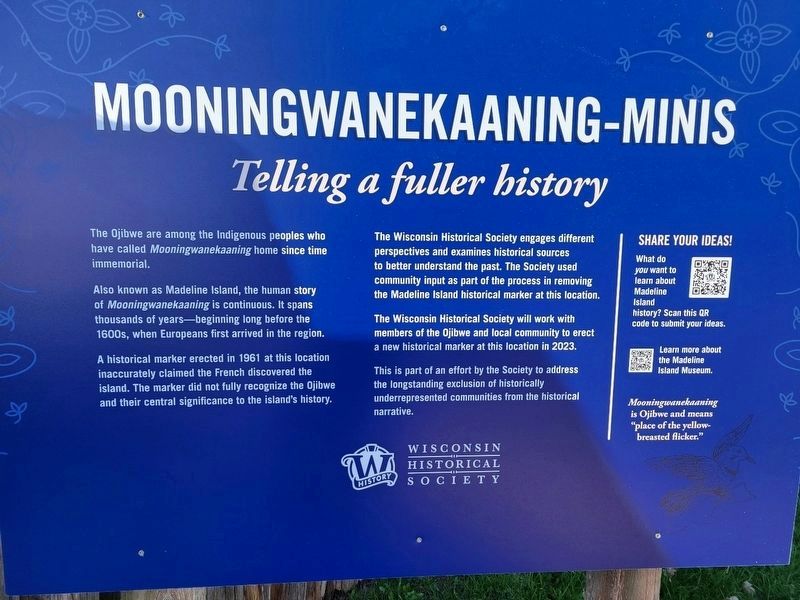
2. An additional Madeline Island Marker
Mooningwanekaaning-minis
Telling a fuller history
The Ojibwe are among the Indigenous peoples who have called Mooningwanekaaning home since time immemorial. Also known as Madeline Island, the human story of Mooningwanekaaning is continuous. It spans thousands of years-beginning long before the 1600s, when Europeans first arrived in the region. A historical marker erected in 1961 at this location inaccurately claimed the French discovered the island. The marker did not fully recognize the Ojibwe and their central significance to the island's history.
The Wisconsin Historical Society engages different perspectives and examines historical sources to better understand the past. The Society used community input as part of the process in removing the Madeline Island historical marker at this location. The Wisconsin Historical Society will work with members of the Ojibwe and local community to erect a new historical marker at this location in 2023. This is part of an effort by the Society to address the longstanding exclusion of historically underrepresented communities from the historical narrative.
Telling a fuller history
The Ojibwe are among the Indigenous peoples who have called Mooningwanekaaning home since time immemorial. Also known as Madeline Island, the human story of Mooningwanekaaning is continuous. It spans thousands of years-beginning long before the 1600s, when Europeans first arrived in the region. A historical marker erected in 1961 at this location inaccurately claimed the French discovered the island. The marker did not fully recognize the Ojibwe and their central significance to the island's history.
The Wisconsin Historical Society engages different perspectives and examines historical sources to better understand the past. The Society used community input as part of the process in removing the Madeline Island historical marker at this location. The Wisconsin Historical Society will work with members of the Ojibwe and local community to erect a new historical marker at this location in 2023. This is part of an effort by the Society to address the longstanding exclusion of historically underrepresented communities from the historical narrative.
Also see . . .
1. Madeline island History. (Submitted on July 20, 2012, by Paul Fehrenbach of Richfield, Wisconsin.)
2. Madeline Island Museum. (Submitted on July 20, 2012, by Paul Fehrenbach of Richfield, Wisconsin.)
Photographed by Paul Fehrenbach, June 17, 2012
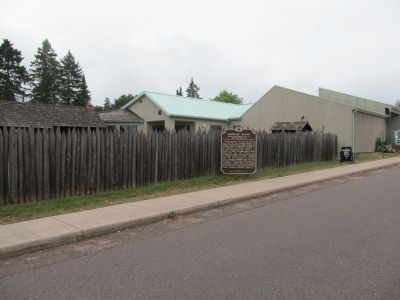
3. Madeline Island Marker
Photographed by Paul Fehrenbach, June 17, 2012
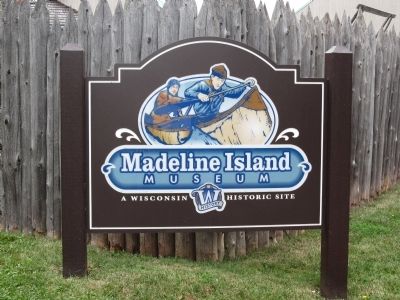
4. Madeline Island Historical Museum sign
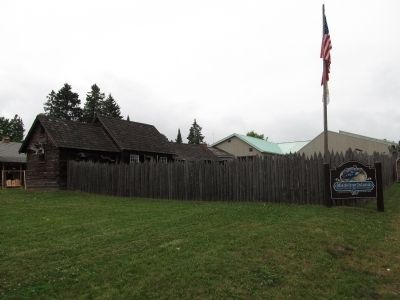
Photographed by Paul Fehrenbach, June 17, 2012
5. Madeline Island Museum grounds
Credits. This page was last revised on November 2, 2023. It was originally submitted on July 20, 2012, by Paul Fehrenbach of Richfield, Wisconsin. This page has been viewed 2,567 times since then and 92 times this year. Last updated on October 16, 2023, by Fitzie Heimdahl of Eau Claire, Wisconsin. Photos: 1. submitted on July 20, 2012, by Paul Fehrenbach of Richfield, Wisconsin. 2. submitted on May 26, 2022, by Fitzie Heimdahl of Eau Claire, Wisconsin. 3, 4, 5. submitted on July 20, 2012, by Paul Fehrenbach of Richfield, Wisconsin. • J. Makali Bruton was the editor who published this page.
