Magnificent Mile in Chicago in Cook County, Illinois — The American Midwest (Great Lakes)
First Wheat Cargo
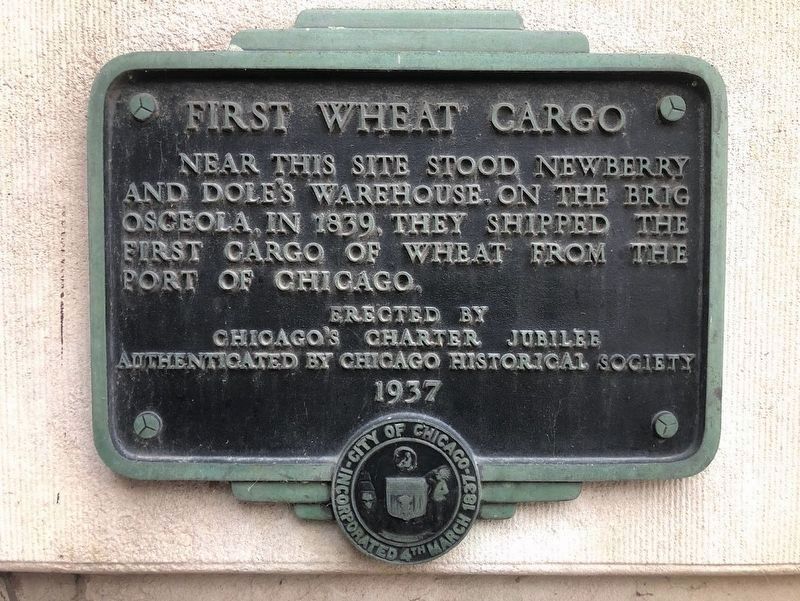
Photographed by Sean Flynn, October 18, 2023
1. First Wheat Cargo Marker
Chicago's Charter Jubilee
Authenticated by Chicago Historical Society
Erected 1937 by Chicago's Charter Jubilee.
Topics and series. This historical marker is listed in these topic lists: Agriculture • Industry & Commerce • Settlements & Settlers • Waterways & Vessels. In addition, it is included in the Chicago's Charter Jubilee series list. A significant historical year for this entry is 1839.
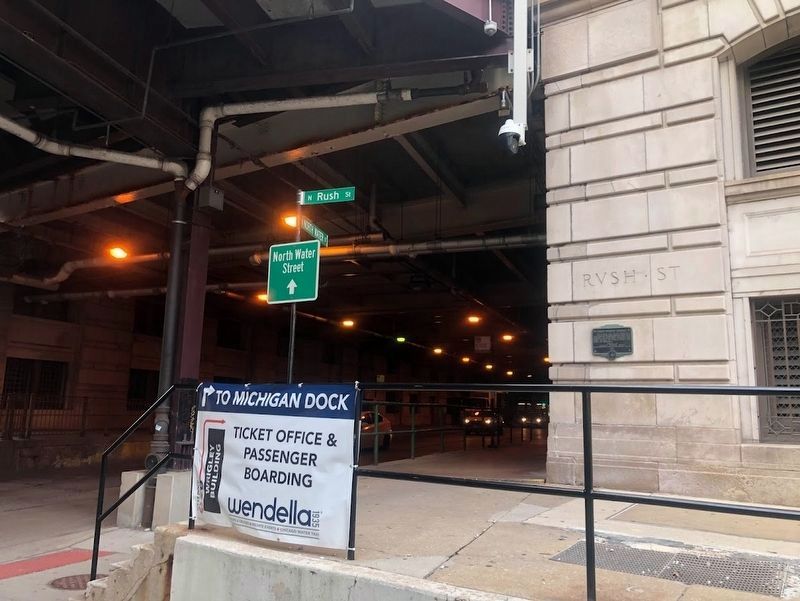
Location. 41° 53.371′ N, 87° 37.511′ W. Marker is in Chicago, Illinois, in Cook County. It is in Magnificent Mile. It is at the intersection of Rush Street and North Water Street on Rush Street. The marker is on the west-facing side of the Wrigley Building, at the lower-level intersection of North Water and Rush streets. It is right next to the opening for the below-street-level sections of Water, which leads to the lower-level section of Michigan Avenue. North Water Street's name changes to Kinzie Street from this point west. Touch for map. Marker is at
this page online

Regionally, this marker is on Chicago’s North Side. It is also in the American Midwest. Globally, it is in North America, on the Great Lakes, in the Western Hemisphere, in the Western World, and in the Anglosphere. Historically, it finds itself in what was once the Viceroyalty of New France, the territory of the Mississippian Culture, and the Northwest Territory.
Other nearby markers. At least 8 other markers are within walking distance of this marker: Green Bay Road (within shouting distance of this marker); The Pioneers (within shouting distance of this marker); Benito Juárez (within shouting distance of this marker); a different marker also named Benito Juárez (about 300 feet away, measured in a direct line); Louis Jolliet & Père Jacques Marquette (about 300 feet away); Wings of Mexico (about 300 feet away); The Discoverers (about 300 feet away); Jorge Marín (about 300 feet away). Touch for a list and map of all markers in Chicago.
More about this marker. This plaque is one of 78 placed throughout
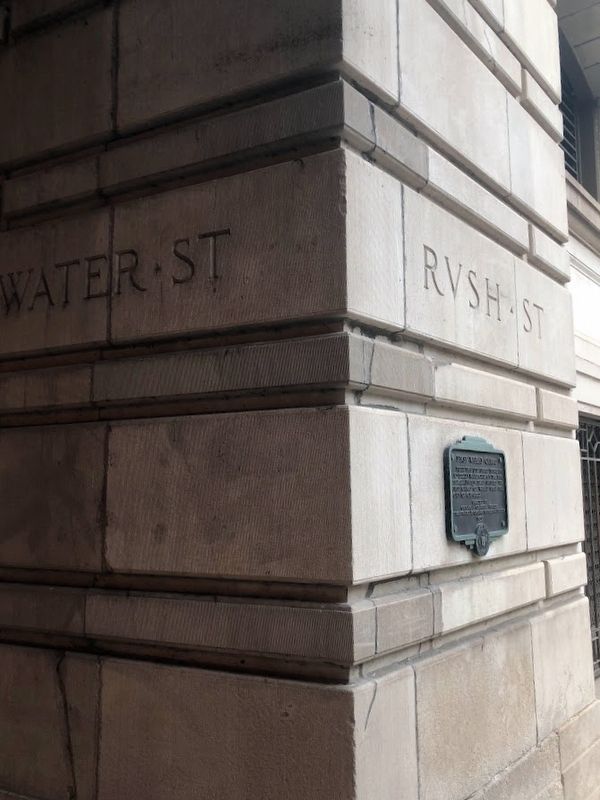
Photographed by Sean Flynn
2. First Wheat Cargo Marker
The marker is on the side of the Wrigley Building, at the intersection of Water and Rush streets.
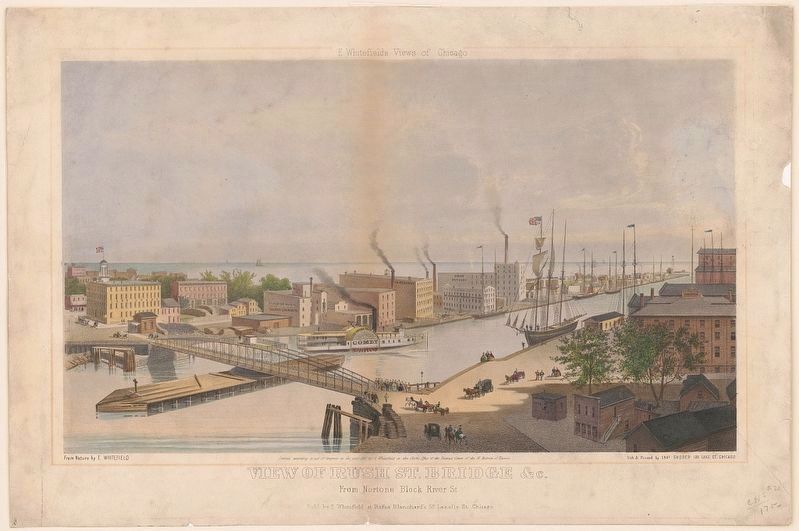
Regarding First Wheat Cargo. Newberry and Dole built their first grain elevator in Chicago at the Rush Street Bridge near this site in 1838, fast turning Chicago into the "Stacker of Wheat" that Carl Sandburg wrote about almost 80 years later.
Also see . . .
1. Historical Markers That Don’t Quite Hit the Mark. From WTTW (Channel 11) in Chicago, a look at the Chicago's Charter Jubilee historical markers posted in 1937. (Submitted on October 18, 2023, by Sean P. Flynn of Oak Park, Illinois.)
2. History of grain traffic on the Great Lakes. A look at the history of transporting wheat in the Great Lakes region.
Excerpts: "In October, 1839, the brig Osceola carried down from Chicago to Kingman & Durfee, of Black Rock, 1,678 bushels of wheat, this being the first shipment of grain in bulk from that port....(Submitted on October 18, 2023, by Sean P. Flynn of Oak Park, Illinois.)
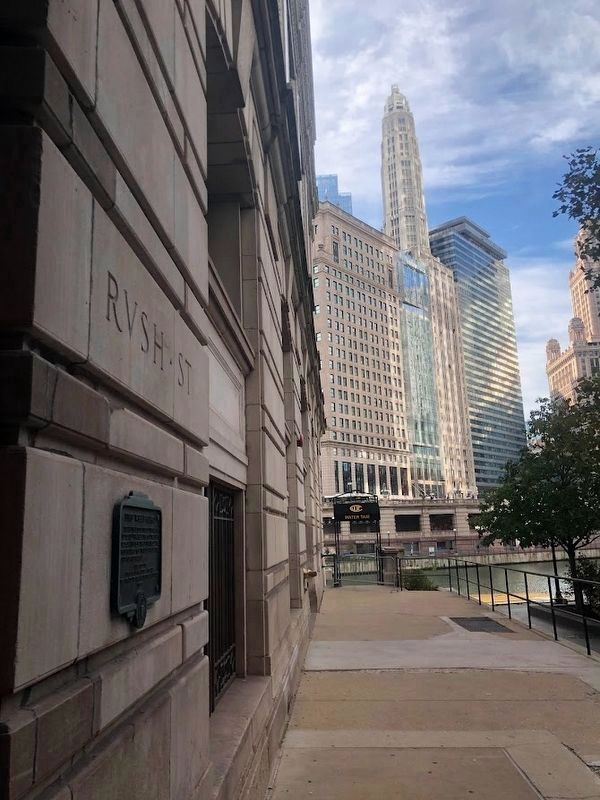
The first grain elevator at Chicagowas built by Newberry & Dole in 1839. It was located at the north end of Rush street bridge. The wheat was brought from farmers' wagons, and hoisted to an upper story by old-style pulley blocks and rope, by hand power. The problem of loading grain from this elevator to the big Osceola, in 1839, was solved by fixing a spout in one of the upper doors, and making it gradually narrower till it reached the deck, where the wheat was discharged into boxes holding four bushels, weighed and transferred to the hold of the vessel. From the bins holding the wheat in the upper story a row of men was formed to the spout and the wheat was passed in buckets. The same firm soon after built another elevator, and horse power succeeded man power, a bucket-belt being used to elevate the grain."Photographed by Sean Flynn, October 18, 20233. First Wheat Cargo MarkerIn the background a few historic buildings can be seen across the Chicago River: 75 East Wacker Drive, with its cylindrical top (Mather Tower, now a Club Quarters Hotel), the London Guarantee & Accident Building to its left on the other side of the glass building (the site of old Fort Dearborn, now the LondonHouse Hotel); and 35 East Wacker Drive, partially visible on the right (when built in 1926-1927, it was, at 40 stories, the tallest building outside of New York City).
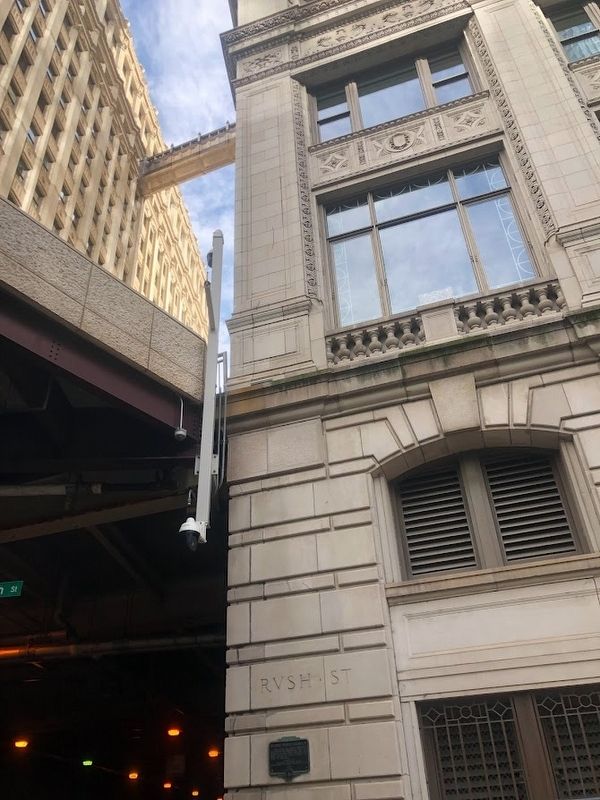
Photographed by Sean Flynn, October 18, 2023
4. First Wheat Cargo Marker and the Wrigley Building
A view of the marker's below-street-level location on the Wrigley Building.
Photographed by Sean Flynn, October 18, 2023
5. First Wheat Cargo Marker
The North Water Street entryway to the lower-level road next to the Wrigley Building, heading to Michigan Avenue.
Library of Congress, 1861
6. View of Rush St. Bridge &c. (circa 1860)
Published by E. Whitefield at Rufus Blanchard's around 1861, this drawing shows the view around the Rush Street Bridge, where Newberry and Dole had their grain elevator.
Photographed by Sean Flynn, October 23, 2023
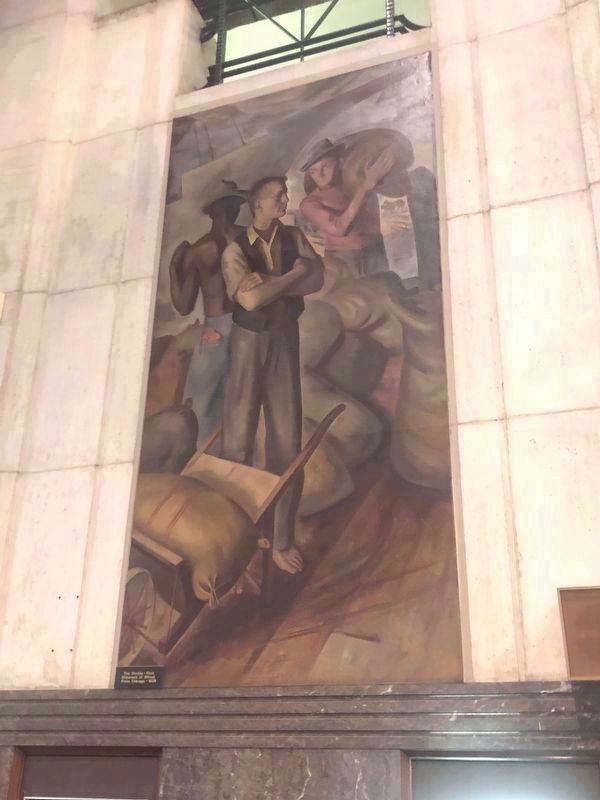
7. “The Oscelo — First Shipment of Wheat from Chicago — 1839”
This painting, inside the U.S. Post Office in suburban of Oak Park, about 9 miles west of the Wrigley Building, depicts the first wheat cargo in Chicago described by the historical marker. The title (with its own spelling of the ship involved) can be found in a small black box in the painting's bottom left. The painting is one of four pieces in the Oak Park post office completed in 1939 by J. Theodore Johnson, each depicting an important moment in the area’s history. They were commissioned by the Treasury Section of Fine Arts, a New Deal program.
Credits. This page was last revised on November 2, 2023. It was originally submitted on October 18, 2023, by Sean P. Flynn of Oak Park, Illinois. This page has been viewed 467 times since then and 52 times this year. Photos: 1, 2, 3, 4, 5, 6. submitted on October 18, 2023, by Sean P. Flynn of Oak Park, Illinois. 7. submitted on October 23, 2023, by Sean P. Flynn of Oak Park, Illinois. • Andrew Ruppenstein was the editor who published this page.
