
Santiago de Compostela in A Coruña, Galicia, Spain — Southwestern Europe (Iberian Peninsula)
Fonte do Franco
⎯⎯⎯
Fountain of Francis
Fuente de Franco
Photographed by Andrew Ruppenstein, September 13, 2023
1. Fonte do Franco / Fountain of Francis Marker

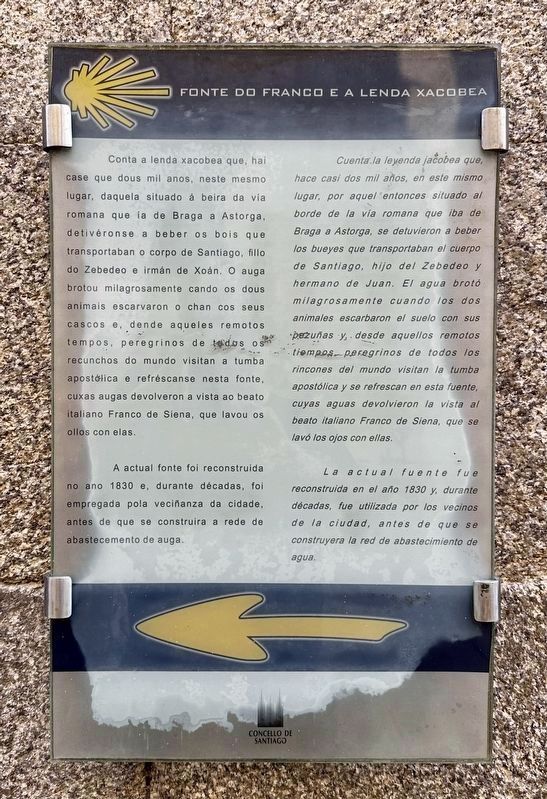
Fonte do Franco e a Lenda Xacobea
Conta a lenda xacobea que, hail case que dous mil anos, neste mesmo lugar, daquela situado à beira da via romana que la de Braga a Astorga, detivéronse a beber os bois que transportaban o corpo de Santiago, fillo do Zebedeo e irmán de Xoán. O augal brotou milagrosamente cando os dous animais escarvaron o chan cos seus cascos e, dende aqueles remotos tempos, peregrinos de todos os recunchos do mundo visitan a tumba apostólica e refrescanse nesta fonte, cuxas augas devolveron a vista ao beato italiano Franco de Siena, que lavou os ollos con elas.
Cuenta la leyenda jacobea que, hace casi dos mil años, en este mismo lugar, por aquel entonces situado al borde de la via romana que iba del Braga a Astorga, se detuvieron a beber los bueyes que transportaban el cuerpo de Santiago, hijo del Zebedeo y hermano de Juan. El agua brotó milagrosamente cuando los dos animales escarbaron el suelo con sus "pezuñas y, desde aquellos remotos tiempos peregrinos de todos los rincones del mundo visitan la tumba apostólica y se refrescan en esta fuente, cuyas aguas devolvieron la vista al beato italiano Franco de Siena, que se lavó los ojos con ellas.
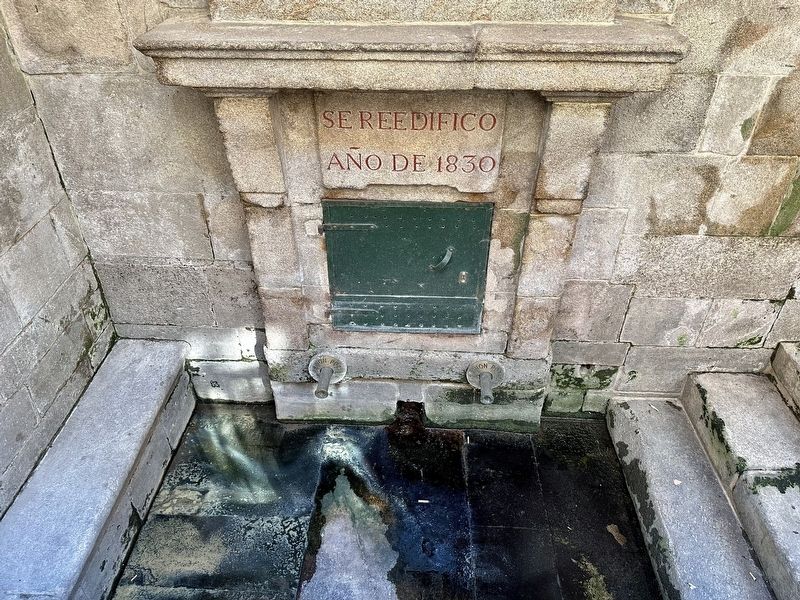
La actual fuente fue reconstruida en el año 1830 y, durante décadas, fue utilizada por los vecinos de la ciudad, antes de que se construyera la red de abastecimiento de agua.
(English translation:)
Fountain of Francis and the Legend of Saint James
The Jacobean (i.e., of Saint James) legend says that, almost two thousand years ago, in this same place, then located on the side of the Roman road from Braga to Astorga, the oxen that were transporting the body of Santiago (Saint James), son of Zebedee and brother of John, stopped to drink. The water miraculously sprang up when the two animals scratched the ground with their hooves and, and since those distant times, pilgrims from all corners of the world visit the apostolic tomb and refresh themselves in this fountain, whose waters restored the sight of the blessed Italian Francis of Siena, who washed his eyes with it.
The current fountain was rebuilt in 1830 and, for decades, was used by the city's neighborhood before the water supply network was built.
Erected by Concello
this page online
Topics. This historical marker is listed in these topic lists: Man-Made Features • Religion & Religious Structures. A significant historical year for this entry is 1830.
Location. 42° 52.75′ N, 8° 32.702′ W. Marker is in Santiago de Compostela, Galicia, in A Coruña. It is on Rúa do Franco, on the right when traveling north. Touch for map. Marker is at or near this postal address: Rúa do Franco 5, Santiago de Compostela, Galicia 15702, Spain. Touch for directions.

Regionally, it is in the North Atlantic Region, on the Atlantic Arc, in Europe, in the European Union, in Atlantic Europe, on the Iberian Peninsula, in the Schengen Area, in a coastal Mediterranean country, and in the Western World. Historically, it finds itself in what was once the Byzantine Empire, a Spanish colony, and the Roman Empire.
Other nearby markers. At least 8 other markers are within walking distance of this marker: Anxel Casal (within shouting distance of this marker); Aurelio Aguirre Galarraga (within shouting distance of this marker); Luis Seoane (within shouting distance of this marker); Casa do Deán, Oficina do Peregríno / House of the Dean, Office of the Pilgrims
Photographed by Andrew Ruppenstein, September 13, 2023
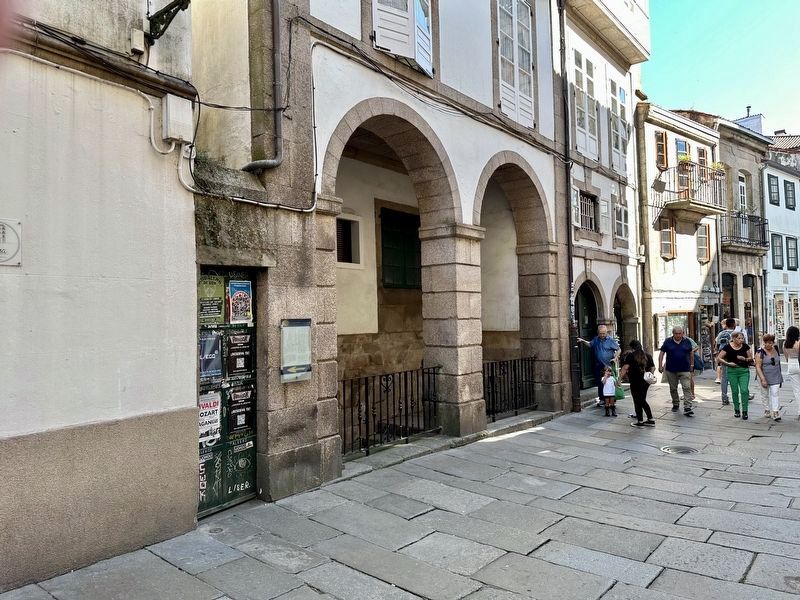
2. Fonte do Franco / Fountain of Francis Marker - wide view
The fountain (not visible here), is in the building recess, behind the wrought iron fencing.
Also see . . . Fonte e Capela do Franco, Santiago de Compostela (Galicia Pueblo a Pueblo, in Galician).
The Legend (in translation): According to the golden LEGEND collected in the CALIXTINO CODEX, which narrates the arrival of the apostle's body to Galicia, the wild oxen delivered by Queen Lupa entered there, miraculously converted into tame ones, which dragged the cart that transported the remains of the apostle Santiago from Iria, stopping in a field called arcis marmoricis, and which in time would be called Santiago de Compostela.(Submitted on October 19, 2023.)
Manuel Murguía points out that the legend of the Apostle Santiago is completely impregnated with Celticism and relates it in this sense to Román, evangelizer of Cornwall (England): “When Romándies, he is left at the mercy of the oxen that drive the cart in which he goes, the corpse, to indicate the place where the saint wants to be buried. They cross the forest and, when they reach the place where the most robust oaks stand, they stop and there, therefore, the grave is dug. The same in the legend of James Zebedee. “His disciples carry the venerated remains in a cart to which they harness wild bulls, and in the place where they stop, there they deposit the inanimate body of the Apostle." Murguía believes that the place where Santiago was buried was a “vast building consecrated to the Celto-Galician god who was worshiped in the place where the oxen that carried the Apostle's body in the cart stopped.”Photographed by Andrew Ruppenstein, September 13, 20233. Fonte do Franco / Fountain of Francis
Tradition also includes that the oxen, after drinking at the fountain, no longer wanted to take another step, which was interpreted by the disciples of Santiago as a divine indication that this was the chosen place. Other versions of the legend say that water gushed from the ground when the oxen stopped and began to dig in the ground.
Credits. This page was last revised on December 20, 2023. It was originally submitted on October 19, 2023, by Andrew Ruppenstein of Lamorinda, California. This page has been viewed 213 times since then and 29 times this year. Photos: 1, 2, 3. submitted on October 19, 2023, by Andrew Ruppenstein of Lamorinda, California.
