Near North Side in Chicago in Cook County, Illinois — The American Midwest (Great Lakes)
Abraham Lincoln
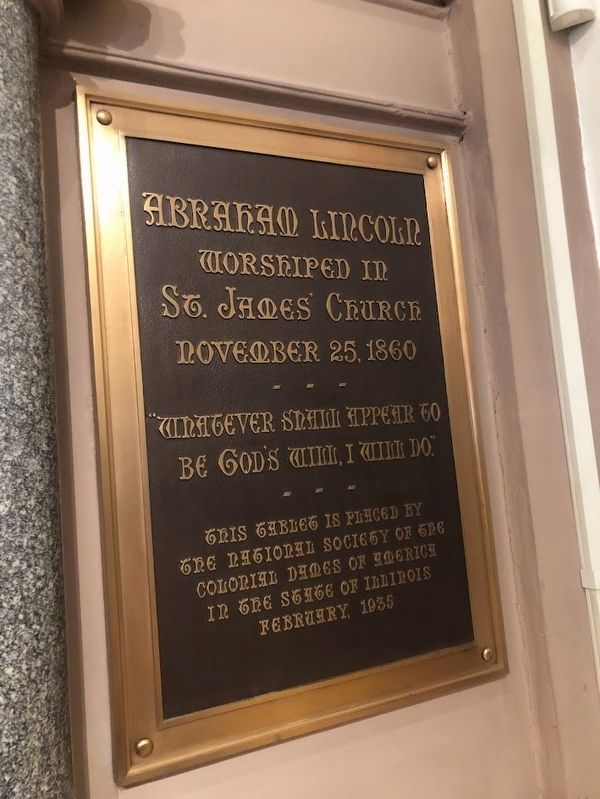
Photographed by Sean Flynn
1. Abraham Lincoln Marker
Abraham Lincoln worshiped in St. James' Church November 25, 1860
"Whatever shall appear to be God's will, I will do."
Erected 1935 by National Society of the Colonial Dames of America in the State of Illinois.
Topics and series. This historical marker is listed in these topic lists: Government & Politics • Patriots & Patriotism • Religion & Religious Structures • War, US Civil. In addition, it is included in the Chicago's Surviving Pre-Fire Structures, the Former U.S. Presidents: #16 Abraham Lincoln, and the The Colonial Dames of America, National Society of series lists. A significant historical date for this entry is November 25, 1860.
Location. 41° 53.682′ N, 87° 37.597′ W. Marker is in Chicago, Illinois, in Cook County. It is in the Near North Side. It can be reached from the intersection of North Wabash Street and East Huron Street, on the right when traveling north. When walking into St. James Cathedral through its Wabash Street entrance, the Lincoln tablet is found to your left, in the right-side corner of a large altar built in memorial of the church's Civil War dead. Touch for map. Marker is at or near
this page online

Regionally, this marker is on Chicago’s North Side. It is also in the American Midwest. Globally, it is in North America, on the Great Lakes, in the Western Hemisphere, in the Western World, and in the Anglosphere. Historically, it finds itself in what was once the Viceroyalty of New France, the territory of the Mississippian Culture, and the Northwest Territory.
Other nearby markers. At least 8 other markers are within walking distance of this marker: John B. Murphy Memorial (within shouting distance of this marker); Ransom R. Cable House (about 300 feet away, measured in a direct line); McCormick Double House (about 300 feet away); Daniel Chester French (about 300 feet away); Hotel Cass (about 300 feet away); Headquarters of the Chicago and Northeast Illinois District Council of Carpenters (about 300 feet away); Cyrus Hall McCormick (about 300 feet away); Metropolitan Water Reclamation District of Greater Chicago's Wastewater System (about 400 feet away). Touch for a list and map of all markers in Chicago.
More about this marker.
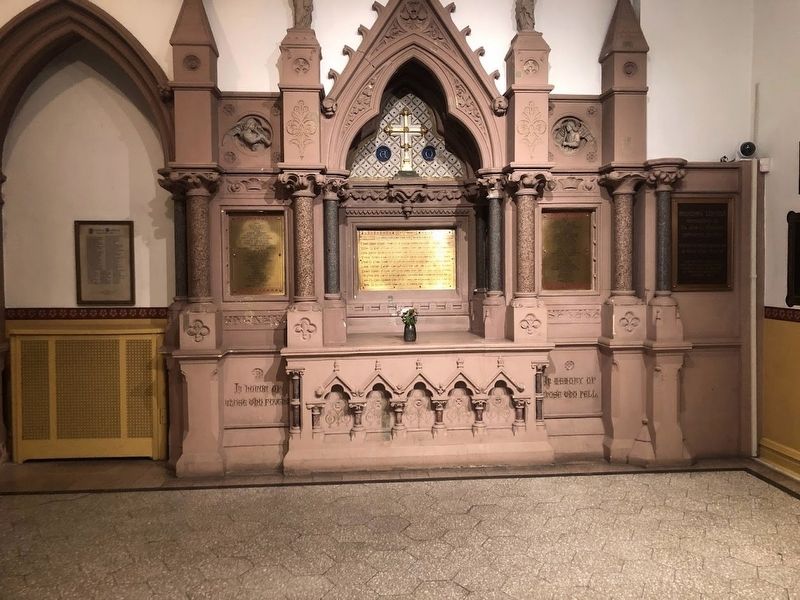
Photographed by Sean Flynn
2. Memorial altar and Abraham Lincoln marker
The Lincoln marker is on the far right of this photo. The inscription at the bottom of the altar reads: "In honor of those who fought. In memory of those who fell." The golden tablet in the middle lists the names of men from the parish who died in the Civil War, what unit they were part of and where they died. The other golden tablets on either side list major battles of the Civil War.
Regarding Abraham Lincoln. On November 25, 1860, President-Elect Abraham Lincoln and his wife Mary attended Sunday services inside St. James' Episcopal Church in Chicago. They were joined by Vice President-Elect Hannibal Hamlin, and many of the other pews were filled with Chicago dignitaries. Later that day, Lincoln attended a Sunday school at North Market Mission Sabbath School, run by Dwight Moody (later founder of Chicago's Moody Bible Insitute) at North Market Hall, which stood about one-third of a mile from St. James at the corner of Hubbard and Dearborn until burning down in the Great Chicago Fire in 1871. The Lincolns were staying at the Tremont House, a prominent hotel that stood at Lake and Dearborn streets, about ¾ of a mile south of St. James; it also was destroyed in the 1871 fire.
St. James Cathedral was the first Episcopal parish in Chicago; its first service was held in 1834 at what is now the intersection of Wabash and Illinois. The parish
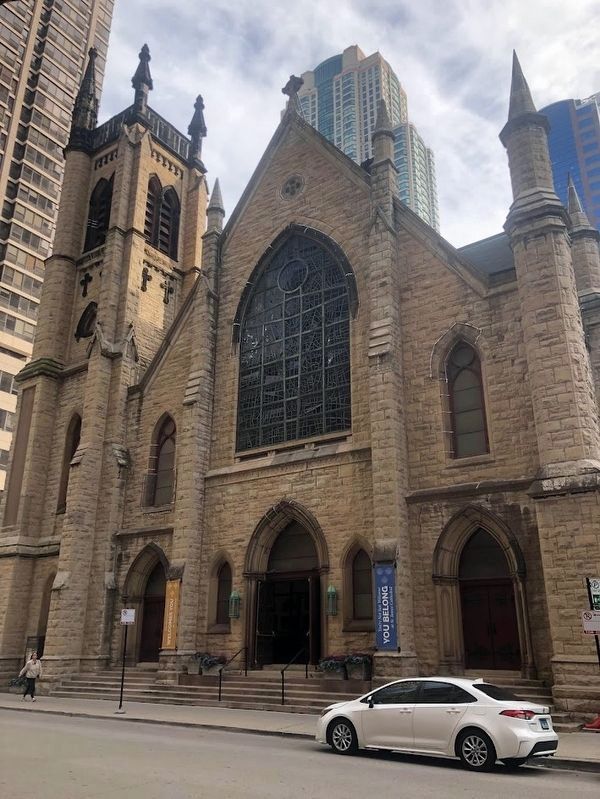
Photographed by Sean Flynn, October 18, 2023
3. St. James Cathedral
The bell tower, to the left, was the only portion of the church to survive the Great Chicago Fire. It was incorporated into the rebuilt post-fire church; note the blackened, soot-stained stones at the very top. The Civil War memorial inside the foyer, where the Lincoln plaque is located, also survived the fire.
Also see . . .
1. The Lincolns Leave Chicago.
Excerpt: "The next morning, the Lincolns attended Sunday services at St. James Episcopal Church on Huron Street. They were accompanied by Hamlin and their friend Isaac N. Arnold, and surrounding pews were occupied by Chicago’s most prominent officials and business leaders. Afterward, the Lincolns returned to their suite at the Tremont Hotel for their Sabbath midday dinner. But this was interrupted by John V. Farwell, a local merchant who reminded the president-elect that he had promised to visit a Sunday school in a less privileged section of town.(Submitted on October 20, 2023, by Sean P. Flynn of Oak Park, Illinois.)
"Lincoln and Farwell took a carriage to the North Market Mission Sabbath School, where Reverend Dwight Moody delivered a sermon to about 600 youths. Word quickly spread that the visitor among the audience was the president-elect, and Moody announced that Lincoln was there only onthe condition that he not be required to speak. However, 'if Mr. Lincoln finds it in his heart to say a few words for our encouragement, of course, we will listen attentively.'Courtesy of Chicago History Museum, circa 18704. St. James Church, pre-fireThe church as it would have appeared to Abraham Lincoln in 1860. The bell tower to the left survived the Great Chicago Fire of 1871 and was incorporated into the rebuilt church.
"Lincoln reluctantly came up to the pulpit and delivered a brief, unrehearsed speech to the children. He urged them to obey their teachers and if they 'put into practice what you learn from them,' then 'some of you may become President of the United States.' Later that night, Lincoln and Hamlin dined at the home of Illinois legislator Jonathan Y. Scammon.
"The Lincolns left Chicago the next morning. Unlike the crowded railroad car they took into the city on the 21st, the Lincolns took a private car home. Freezing rain kept most onlookers away from the stations where the train stopped, so Lincoln didn’t have to deliver any more impromptu speeches. The president-elect returned to his Springfield home at 6:30 p.m., and according to reporter Henry Villard, he looked 'rather the worse for wear.'"
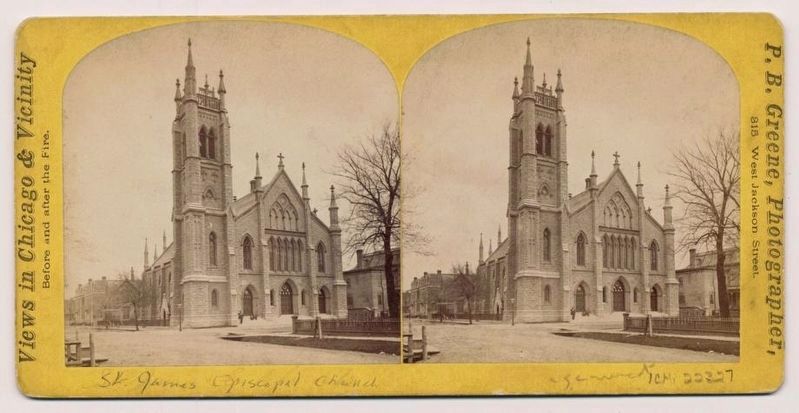
2. St. James Episcopal Church I. A history of the first St. James Church,
Courtesy of the British Library, circa 1860
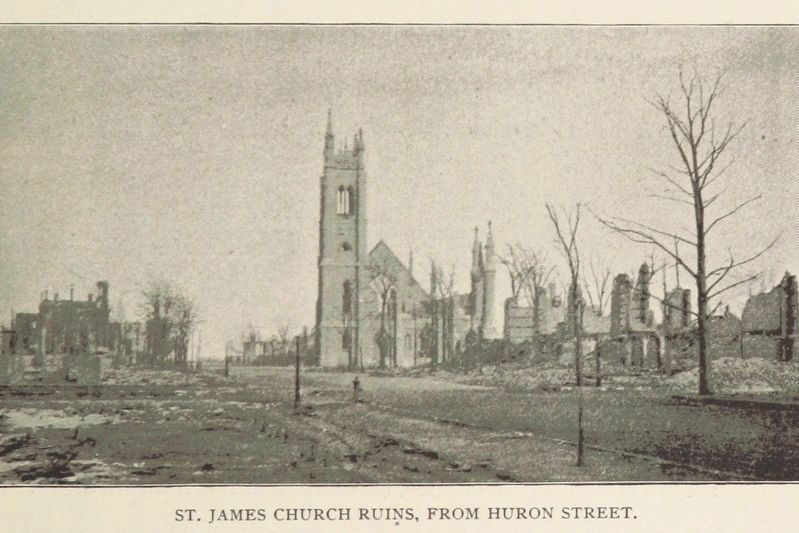
5. Ruins of St. James Church, after the 1871 fire
St. James' bell tower survived the Great Chicago Fire, as did some of its walls and its recently erected memorial to the parish's Civil War dead. The bell tower was incorporated into rebuilt cathedral.
Additional commentary.
1. National Society of the Colonial Dames of America series
This marker is indoors, in the vestibule of St. James Church, but is included as part of the series of markers erected by the National Society of the Colonial Dames of America.
— Submitted January 3, 2025, by Sean P. Flynn of Oak Park, Illinois.
Additional keywords. abraham lincoln grand dames chicago
Credits. This page was last revised on January 24, 2026. It was originally submitted on October 20, 2023, by Sean P. Flynn of Oak Park, Illinois. This page has been viewed 596 times since then and 100 times this year. Photos: 1, 2, 3, 4, 5. submitted on October 20, 2023, by Sean P. Flynn of Oak Park, Illinois. • Devry Becker Jones was the editor who published this page.
