Naperville in Will County, Illinois — The American Midwest (Great Lakes)
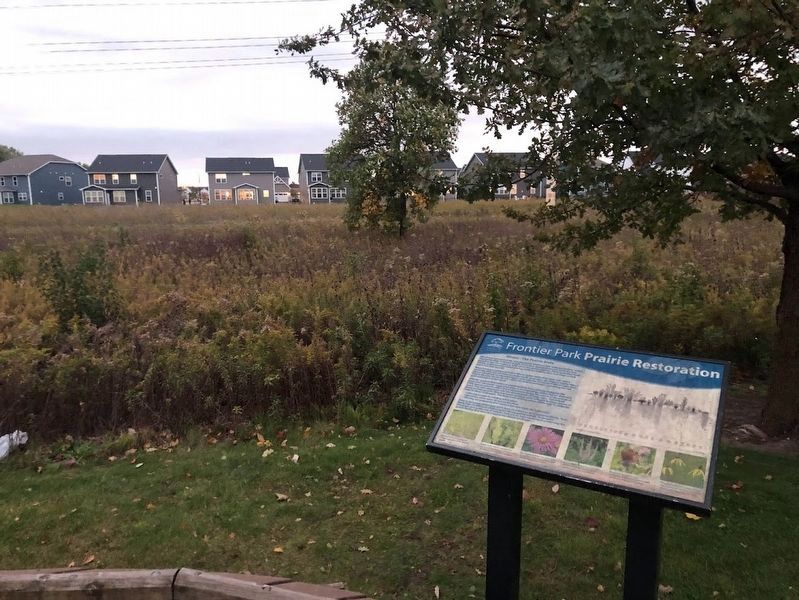
Frontier Park Prairie Restoration
Illinois — The Prairie State

Photographed by Sean Flynn
1. Frontier Park Prairie Restoration Marker
When Europeans settlers arrived in Illinois in the 1830s they were met with a landscape they did not know or understand: an endless sea of grass higher than a person's head, full of unknown insects and animals. However, it did not take them long to discover the fertile soil within the prairie and begin converting the tall grass ecosystem to farmland.
With the gradual elimination of prairie land we have come to recognize the important role prairie vegetation plays in the hydrology of this region. Over 850 plant species evolved within this environment during the course of thousands of years. One vital adaptation was the development of deep roots. This helped plants survive periodic fires and animal grazing while aiding in finding sources of water in times of drought. The
this page online
• reducing erosion by holding soil in place
• absorbing storm water to reduce flooding
• filtering out pollutants that would otherwise enter our waterways
Prior to European settlement, there were 22 million acres of prairie in Illinois. Now, fewer than 20,000 acres of the original Illinois prairie remain. Restoration plantings such as this one at Frontier Park are an important step in preserving the prairie habitat that once dominated the Illinois landscape.
Big Bluestem (Andropogon gerardi)
• A dominant plant of the tallgrass prairie
Prairie Dock (Silphium terebinthinaceum)
• This plant's big leaves are close to the ground and feel like sandpaper
New England Aster (Aster novae-angliae)
• Butterflies enjoy these flowers that bloom September-October
Culver's Root (Veronicastrum virginicum)
• Native Americans and European settlers used roots as medicine
Bergamot (Monarda fistulosa)
• Butterflies and hummingbirds feast on these pretty, purple flowers
Yellow Coneflower (Ratibida pinnata)
• Butterflies and hummingbirds feast on these pretty, purple flowers
This project was funded in part by an Open Space Lands Acquisition and Development Grant from the Illinois Department of Natural Resources
Erected by Naperville
Photographed by Sean Flynn, October 21, 2023
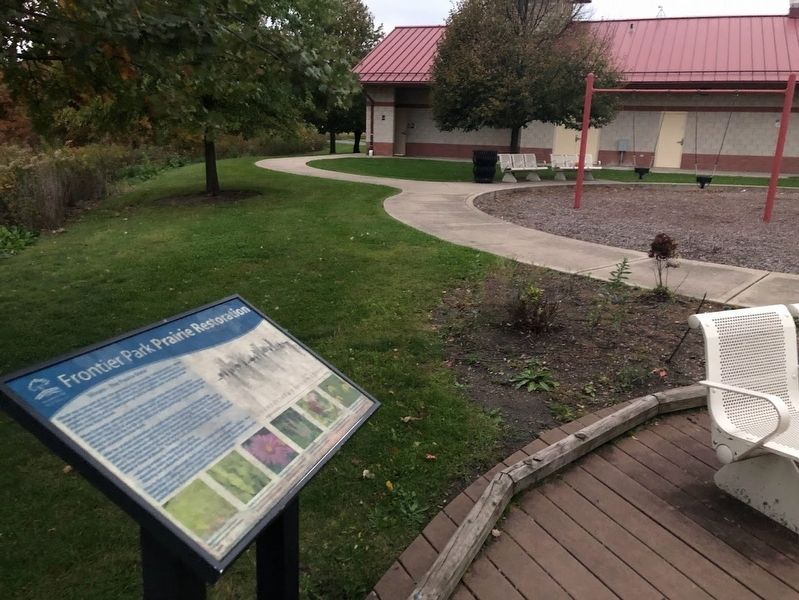
2. Frontier Park Prairie Restoration Marker and the nearby prairie
Topics. This historical marker is listed in these topic lists: Environment • Horticulture & Forestry • Parks & Recreational Areas • Settlements & Settlers. A significant historical year for this entry is 1835.
Location. 41° 42.215′ N, 88° 11.807′ W. Marker is in Naperville, Illinois, in Will County. It can be reached from Frontier Park Drive east of Cedar Glade Drive, on the right when traveling east. The marker is near the playground close to the concessions and restrooms building, near the parking lot at Frontier Sports Complex. Touch for map. Marker is at or near this postal address: 3380 Cedar Glade Drive, Naperville IL 60564, United States of America. Touch for directions.

Regionally, this marker is in Greater Chicago. It is also in the American Midwest. Globally, it is in North America, on the Great Lakes, in the Western Hemisphere, in the Western World, and in the Anglosphere. Historically, it finds itself in what was once the territory of the Mississippian Culture and also the Northwest Territory.
Other nearby markers. At least 8 other markers are within 3 miles of this marker, measured
Photographed by Sean Flynn, October 21, 2023
3. Frontier Park Prairie Restoration Marker
Credits. This page was last revised on September 21, 2024. It was originally submitted on October 21, 2023, by Sean P. Flynn of Oak Park, Illinois. This page has been viewed 139 times since then and 22 times this year. Photos: 1, 2, 3. submitted on October 21, 2023, by Sean P. Flynn of Oak Park, Illinois. • Devry Becker Jones was the editor who published this page.
