Taylor in Stark County, North Dakota — The American Midwest (Upper Plains)
Custer Trail
Photographed by Cosmos Mariner, August 22, 2023
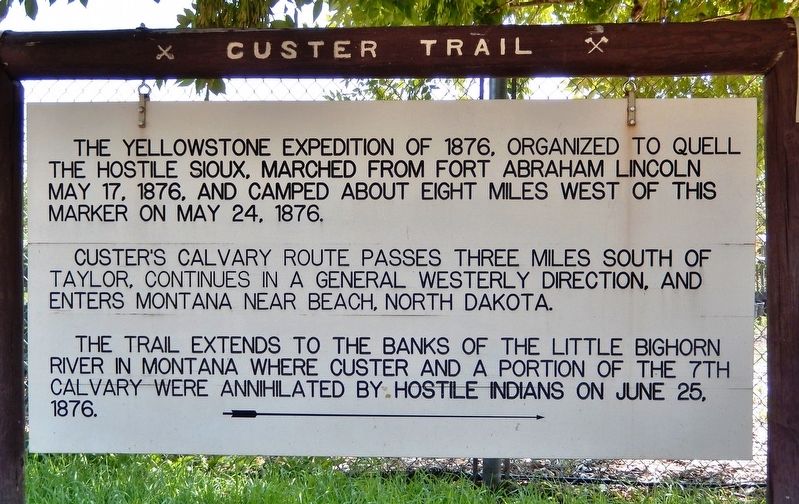
1. Custer Trail Marker
The Yellowstone Expedition of 1876, organized to quell the hostile Sioux, marched from Fort Abraham Lincoln May 17, 1876, and camped about eight miles west of this marker on May 24, 1876.
Custer’s Calvary route passes three miles south of Taylor, continues in a general westerly direction, and enters Montana near Beach, North Dakota.
The trail extends to the banks of the Little Big Horn River in Montana where Custer and a portion of the 7th Cavalry were annihilated by hostile Indians on June 25, 1876.
Topics. This historical marker is listed in these topic lists: Indigenous Peoples and Communities • Wars, US Indian. A significant historical date for this entry is May 24, 1876.
Location. 46° 54.032′ N, 102° 25.591′ W. Marker is in Taylor, North Dakota, in Stark County. It is at the intersection of Main Street West and Dagnault Avenue, on the left when traveling west on Main Street West. Touch for map. Marker is in this post office area: Taylor ND 58656, United States of America. Touch for directions.

Regionally, this marker is on the Missouri Plateau. It is also in the American Lewis & Clark Corridor, on the prairies, and
this page online
Other nearby markers. At least one other marker is within 6 miles of this marker, measured as the crow flies: Yellowstone Expedition of 1876 (approx. 5.7 miles away).
Related markers. Click here for a list of markers that are related to this marker. Custer Trail / Yellowstone Expedition of 1876
Also see . . . 1876: Custer defeated; Lakota and Cheyenne prevail. Excerpt:
On June 25 and 26, on the Greasy Grass River (which is now known as the Little Bighorn), 2,000 Lakota and Cheyenne, who are defending their summer hunting camp, fight and defeat U.S. troops led by Lieutenant Colonel George Armstrong Custer. Custer and the 209 soldiers fighting under him are killed. The Indians lose just 32 men.(Submitted on October 23, 2023, by Cosmos Mariner of Cape Canaveral, Florida.)
Photographed by Cosmos Mariner, August 22, 2023
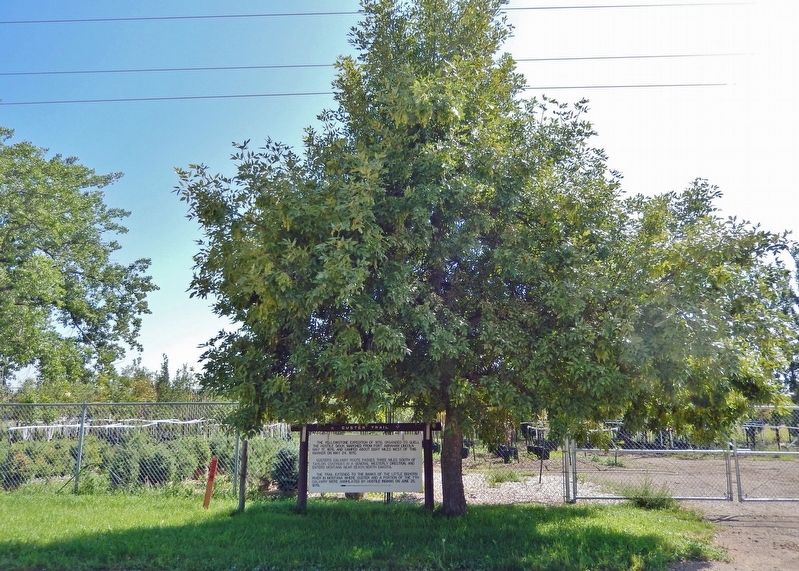
2. Custer Trail Marker
Credits. This page was last revised on October 23, 2023. It was originally submitted on October 23, 2023, by Cosmos Mariner of Cape Canaveral, Florida. This page has been viewed 378 times since then and 105 times this year. Photos: 1, 2. submitted on October 23, 2023, by Cosmos Mariner of Cape Canaveral, Florida.
